




Nyla Uddin • March 31, 2026
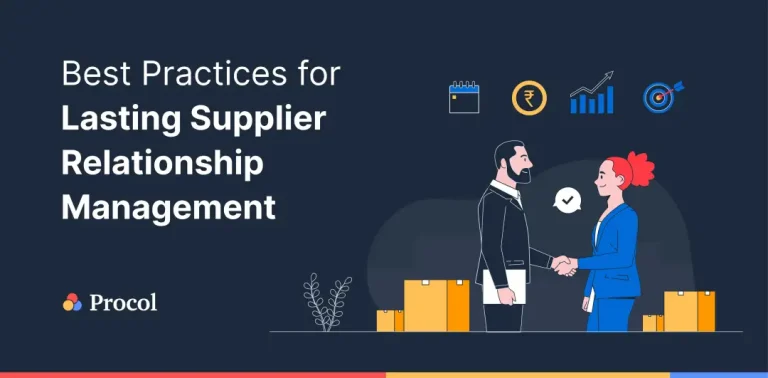
Best Practices for Lasting Supplier Relationship Management

ProcolContent Writer
Last update: March 5, 2026
4 min read
Introduction
According to a PwC survey, organizations that adopted SRM systems claimed improved customer satisfaction, lower inventory, and more sustainable products and processes as significant benefits of the approach, with 50% claiming increased effective operations.
Improving connections with suppliers can improve business productivity and working relationships, one of the primary principles of SRM. Instead of merely operating independently from your supplier, you develop a tighter connection that promotes dependability, trust, and productivity in your company. By forming supplier alliances, companies get a competitive advantage and improve the working atmosphere for both organizations.
What is Supplier Relationship Management (SRM)?
An aspect of supply chain management, supplier relationship management (SRM), involves focusing on building and maintaining business relationships throughout the supply chain network. The practical procedures for integrating communication and cooperation between businesses and their suppliers are known as supplier relationship management (SRM). SRM affects a supply chain’s ability and is among the most crucial components in most businesses.
Since information is more critical in supply chain management, companies must redesign their processes for maintaining and exchanging information. Organizations are unable to manage the business independently. In addition to giving businesses a more significant competitive edge to sustain in the market, solid relationships also aid in market expansion.
Although the notion of Supplier Relationship Management (SRM) has been utilized in supply chain management for some time, it has only recently been applied to boost benefits throughout the distribution network. SRM is currently one of the significant variables affecting the supply chain. In the future, SRM won’t be a choice for businesses; it’ll be a must.
According to McKinsey, companies pay 58 cents on every dollar of revenue on supplier payments and may thus gain from boosting their variety. Leading corporations know this, having pledged over 50 billion USD to work with MWBEs in the coming decade.
The Necessity of Supplier Relationship Management (SRM) System
-
In the previous decade, businesses have evolved dramatically. Firms cannot thrive today by only producing and selling. As global digitalization increases, data has become essential to supply chain management. Particular aspects show that some businesses need supply chain administration to reduce costs and increase benefits instead of only data.
Effective enterprise executives, for example, may conclude that long-term partnerships with particular suppliers are preferred to assure supply continuity, whilst short-term agreements with other suppliers might better provide company flexibility and adjustable pricing. -
Although the information is not acquired by utilizing supply chain ideas, it is the primary driver in the supply chain system. In contrast, data can result in lowering costs, increasing benefits, shortening lead times, and effectively managing the supply chain, among other things. Organizations have shifted from developing supply chains separately to collaborating with SRM suppliers to concentrate primarily on data.This concept aims to boost customer satisfaction and discover what customers anticipate so businesses may provide more value to their products or services. Companies later learned that simply delighting customers was not enough to become more successful in the industry.
-
Since procurement software costs are considered among the most significant expenditures in most businesses, the concept of a proactive approach based on advanced cooperation, known as Supplier Relationship Management (SRM), emerges. Per a recent CPOs poll by Bain, 50% of firms faced intense pressure to speed up their digital conversion before COVID-19.
Benefits of SRM
SRM can assist firms in improving and integrating e-procurement and sourcing efficiency. There are certain advantages to using a supplier relationship management (SRM) system to create a collaborative structure throughout the distribution chain.
1. Collaboration & Execution
Supplier relationship management (SRM) delivers solutions to build the foundation of network communication, like decision-making in the e-procurement procedure. SRM can guarantee that the complete supply chain meets the business’ aim in this sector. Furthermore, supplier management can enhance processes across the supply chain with various cultures, partners, and regions inside the business.
2. Source
SRM procurement software helps resolve conflicts in the procurement software procedure. SRM procurement software assists organizations and their suppliers in avoiding tense negotiation processes. Firms may use the SRM e-procurement system and optimize it, so everybody benefits from its coordination.
3. Monitoring Progress
As information is critical in supply chain administration, real-time data should be efficiently tracked to conquer business challenges. Supplier management may alert companies with needed details to boost agility in tracking and responding to changes. According to Accenture, customers who utilized digital platforms for less than 25% of their buys before the pandemic had a 160% surge worldwide.
Final Takeaway
A company that wants to boost its bottom line and grow its procurement procedure must focus on supplier relationship management (SRM). Developing long-term relations with functional, low-risk vendors can result in a stable and dependable distribution network that will boost your firm for decades. By forming alliances, you may protect your company against future supply chain disruptions and the need to enter into new expensive agreements with potentially risky providers.
Procol is one of India’s fastest-growing procurement software, managing thousands of transactions throughout a trusted platform of sellers and buyers. Schedule a demo to learn about its innovative approaches to building robust and flexible procurement strategies to deal with unexpected and emerging supplier management challenges.
Schedule a Demo
We’d love to hear from you. Please give us a call on +1 315-645-2799.
Explore more from Procol
Discover expert tips, how-to guides, industry insights, and the latest procurement trends.

What is addressable spend? Definition & tips to optimize (2026)
Check out how to optimize total addressable spend in procurement for...

What is sourcing optimization? A complete guide (2026)
Since procurement is becoming more complex every day, companies are slowly...
Supplier Onboarding: Steps, Tips & Best Practices
Introduction Suppliers are essential for business operations because they are the...