




Nyla Uddin • March 31, 2026
List of 24 essential procurement KPIs & metrics to track (2026)

Nyla UddinContent Writer
Last update: March 17, 2026
11 min read

For businesses, procurement doesn’t just mean buying goods at the lowest price. Procurement KPIs are numbers you should be tracking to measure whether your decisions are actually bringing value. While cost savings are an important part, it’s equally critical to make smart decisions. In fact, cost savings remain a big priority for 77% of procurement departments, highlighting the importance of tracking these metrics properly. This blog will explain the importance of measuring KPIs, the key numbers businesses should monitor, and how procurement tracking software works alongside your business to make sure you’re succeeding every step of the way.
Key Takeaways
What are procurement KPIs?
Procurement KPIs, also known as procurement key performance indicators, are measurable values that show how efficient and effective a company’s sourcing and purchasing activities are. These metrics help a company stay on track with all aspects of the sourcing and purchasing process, monitoring areas like cost, quality, and speed, to name a few. KPIs help businesses see if their buying strategy is meeting their overall goals.

Why should you measure procurement key performance indicators?
Procurement performance metrics give organizations important insights into all areas of their buying process, such as cost, operations, and more. In 2026, it’s become even more important to measure the progress of the procurement process, because KPIs highlight areas businesses may have missed. In fact, McKinsey reports that procurement efforts, such as tracking KPIs, result in 9-12% cost reduction for organizations.
There are various KPIs in procurement that a company can use to track processes better, and each of them has a unique function. A KPI for the procurement department shows if costs and supplier quality are as expected. Here, even delivery times are monitored to make sure suppliers are meeting deadlines. And last but not least, strategic sourcing KPIs help companies choose the best suppliers and get better deals.
Procure to pay KPIs help find areas of improvement and allow companies to compare themselves to the industry. This means that they can monitor what others are doing and what’s leading them to success so that they can implement it into their own processes. They even help alert organizations to potential risks and keep them on track with their goals, making the procurement cycle as meaningful as possible.
The main categories of procurement performance metrics
Procurement KPIs are further broken down into various categories that show performance in many different areas, like cost savings, spend management, purchase order cycle time, procurement ROI, and compliance rate. They also monitor how trustworthy your suppliers are, and if your processes are bringing in the revenue that they should be. Let’s explore these categories deeper.
1. Cost management:
Procurement key performance indicators for cost management measure how much money a business spends, how much of that is saved, and how spending is controlled. This KPI for purchasing departments monitors these areas:
- Cost savings – The amount of money saved due to sourcing better, exploring more suppliers, and negotiating well.
- Procurement ROI – This measures the return on investment that procurement activities have given the company. Simply put, it’s how much value was gained.
- Spend under management (SUM) – The total amount of money the company was able to save/control during the procurement process.
- Cost avoidance – This measures if the company was able to keep spending in control and avoid spending more than the budget.
- Purchase price variance (PPV) – The difference between the prices that the company originally planned and the actual prices. This helps monitor how closely the budget was followed.
- Invoice discrepancies – This KPI identifies if there are any errors in the invoices. It monitors how often the line items did or did not match the invoice.
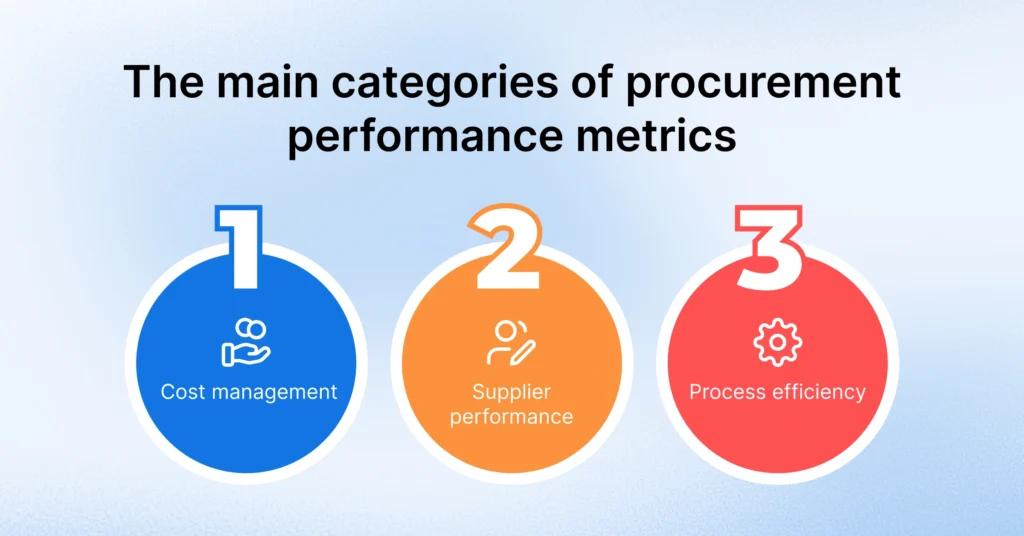
2. Supplier performance:
These procurement KPIs show how well suppliers are able to meet deadlines and provide the company with the best and good quality products. They also measure if suppliers are living up to all the contract terms. These are the procurement KPI examples that vendor performance covers:
- Supplier lead time – The time taken from when the order was placed to when it was delivered.
- Supplier quality rating & defect rate – This KPI examines if the quality of the products/services was as the company expected and if there were any defective or damaged goods.
- Supplier availability & On-time delivery – Checks if suppliers were always able to meet demand on time and to the company’s satisfaction. Simply put, without cutting corners.
- Contract compliance – This is one of the predictive procurement KPIs thatmonitors whether the vendors always work according to the contract terms and deliver as per the terms in the contract.
- Diversity & local sourcing – In essence, this KPI tracks supplier diversity, which is how engaged the company was with different vendors to find the best quality goods, and didn’t just stick with their usual source.
- Sustainability KPIs – Checks if the supplier’s efforts were eco-friendly.
3. Process efficiency:
These procurement performance metrics monitor how smooth and fast the procurement process is. It checks the length of the cycle, delays, and even employee performance.
- Purchase order & procurement cycle time – How fast orders were placed by the team and fulfilled by the vendor.
- Order accuracy – This checks if all the orders were placed correctly and without mistakes in the items, or were correctly assigned to their respective orders.
- Emergency purchase ratio – This KPI tracks how often urgent orders were placed outside of the usual procurement process. Here, the number should be low, as unapproved purchases lead to money being wasted.
- Ordering efficiency – The number of orders processed per supplier.
- Employee KPIs – Tracks how staff performed in various procurement tasks and the speed at which they were able to complete all the tasks assigned to them.
24 key procurement KPIs you can’t miss in 2026
As we have talked about earlier in the article, procurement KPIs track many aspects of a company’s purchasing process. They look at everything from cost savings and supplier performance to spend under management and compliance rates. And these are just a few of the many details they look at. Let’s take a look at more procurement key performance indicators companies should track.
1. Spend KPIs
Spend management KPIs help businesses track how they are spending their money and where they can reduce costs. Because a high volume of purchases is made regularly, understanding how exactly procurement spending works helps companies become more efficient.
(i) Maverick spends
Maverick spending happens when employees buy goods or services outside the formal approval process. According to a Basware report, companies lose 10-20% of their savings from maverick spending. This is why it’s important to track indirect procurement KPIs, as indirect purchases are more prone to unapproved spending. This can increase costs and create operational risks.
Here’s how to measure maverick spend:
- Combine all of the data from your past purchases.
- Separate purchases made through approved channels.
- Subtract approved spend from total spend to find maverick spend.
(ii) Total spend under management
This KPI for purchasing department measures the percentage of money spent during procurement that was controlled and within budget, usually when contracts are followed well, and the entire process is led well. Higher control means better cost visibility and supplier management.
(iii) Purchase price variance (PPV)
PPV shows the difference between an item’s standard cost and its actual purchase cost. Monitoring PPV is important as it helps understand how to budget well and also keeps the team up to date on supplier pricing trends.
(iv) Procure-to-pay KPIs
This purchasing KPI measures the overall efficiency of the process, right from placing the order to making the final payment. When procure-to-pay processes are fast, they help reduce costs and avoid delays.
2. Supplier KPIs
Supplier KPIs help you keep track of your vendors. Measuring this KPI for procurement department is especially important as it helps you separate the reliable suppliers from the untrustworthy ones. It also helps track how high-quality their supplies are and how efficiently they’re able to deliver on time.
(i) Number of suppliers
It’s important that your suppliers be “just right.” Too many suppliers can complicate procurement, and too few vendors limit your choice. This leaves you highly reliant on just one supplier to provide the best. And if they don’t, then you’re stuck with them. So, finding the right balance ensures efficiency.
(ii) On-time delivery
This KPI measures whether suppliers meet agreed delivery schedules. They help keep dates on track and make sure suppliers don’t miss out on the scheduled times, as late deliveries can cause delays in the cycle.
(iii) Supplier defect rate
Supplier defect rate KPI can also be used as a KPI for a procurement manager. There is a formula that they can use to calculate whether the goods suppliers are receiving are up to the company’s standards.
Formula: (Defective items ÷ Total items received) × 100
(iv) Contract compliance rate
This procurement contract management KPI for the procurement department shows how well suppliers follow all the terms laid out in the contract. There are many terms discussed in the contract like price and quality of goods, so it’s very important to track if both buyers and suppliers are working according to those terms. A higher rate of compliance reduces a lot of risks for both parties.
(v) Vendor rejection rate
This tracks how often goods are rejected and the costs incurred because of that rejection. This is used as a learning for teams and managers, as it helps them improve how they select suppliers and examine their performance.
3. Procurement Process KPIs
These procurement performance metrics measure how well the procurement department works and then identify areas for improvement. This helps optimize costs, makes processes faster, and enhances supplier relationships over time.
(i) Purchase order cycle time
This purchasing KPI indicates the time between when the purchase request was sent and when the order was placed. If the procurement cycle is short, it means it is more efficient because the teams involved are able to communicate well.
(ii) Rate of emergency purchases
This is one of the purchasing KPI examples that shows how often orders are placed urgently due to poor planning or poor team communication. If emergency purchases are done very often, this is a cause for concern as they consume a big part of the business’s total budget, so it can lead to a lot of wasted funds and unnecessary stock.
Formula: (Emergency purchases ÷ Total purchases) × 100
(iii) Orders processed per staff member
This is a way to measure how efficient the staff is at processing procurement requests. It helps identify which members or teams need training, and also if there’s any need to get more staff on board to lighten the load and distribute work better.
(iv) Spend under contract
Spend under contract is the percentage of purchases made through approved contracts. In this group of purchasing metrics and KPIs, as compared to emergency purchases or maverick spend, it’s good if this is high, as it means the rules are being followed.
Formula: (Spend under contract ÷ Total spend) × 100
(v) Strategic sourcing KPIs
These KPIs for procurement track sourcing activities that reduce costs, mitigate risks, and improve supplier relationships. Examples include supplier consolidation and cost savings from negotiation.
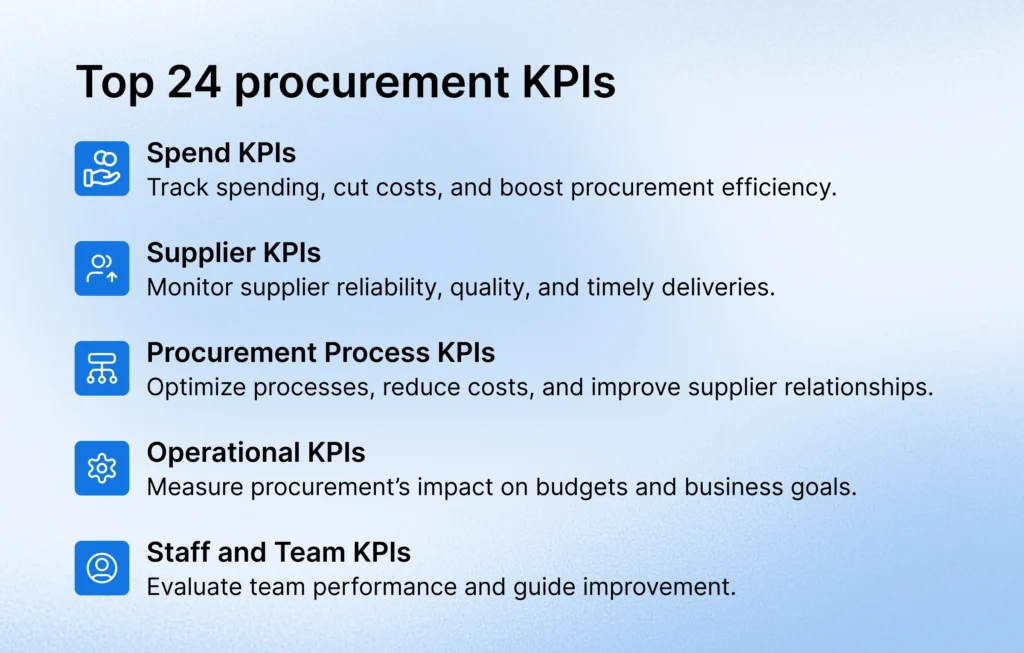
4. Operational KPIs
Operational procurement key performance indicators show the overall impact of procurement activities on your business’s performance. They help teams understand how well and accurately the process has been carried out and if the team’s efforts have resulted in any profits and have been aligned with the company’s goals. It also monitors how much the activities were able to be within the budget of the organization.
(i) Procurement ROI
Measures the value generated by procurement activities aside from their cost. It takes into account supplier and team performance, both, and assesses how valuable that’s been to the company. A higher ROI shows an effective procurement strategy.
(ii) Inventory turnover
This shows how often inventory is sold and replaced in a given period. On-time selling and restocking indicate a good ability to forecast demand and a good pool of suppliers ready to fulfill that demand.
Formula: Cost of goods sold ÷ Average inventory
(iii) Inventory accuracy
This is one of the sourcing KPIs that compares recorded inventory with actual stock to avoid shortages or overstocking.
(iv) Cost per invoice
This performance area tracks how many manual resources are being used to process invoices. Here, automation helps reduce this KPI and makes the invoicing process faster.
(v) Spending-to-sales revenue ratio
Shows the percentage of revenue spent on procurement. A lower ratio means higher profitability.
Formula: (Procurement spend ÷ Sales revenue) × 100
(vi) Indirect procurement KPI
This measures the efficiency in buying items that don’t directly impact a company’s main goal, but act as a helping hand that helps them reach goals, like office supplies and services. Helps control costs in indirect spend categories.
5. Staff and team KPIs
Staff KPIs evaluate the performance of procurement teams and individual managers. This creates room for improvement and lets teams know how well they’re working and where they need guidance.
(i) KPI for procurement manager
This measures a manager’s effectiveness in meeting procurement goals. It tracks how well they are able to come up with strategies to reduce costs and manage suppliers.
(ii) Key performance indicators for the procurement officer
Tracks officers’ success in following procedures and meeting deadlines.
(iii) Purchases on time and within budget
This procurement performance area checks if staff are able to complete purchases according to the given schedule and budget. This shows good planning and excellent efficiency.
(iv) Purchasing metrics and KPIs
These KPIs are measured for the whole team. These indicate the number of purchase orders processed, error rates, and the length of procurement cycle times.
How Procol helps businesses track procurement KPIs
When procurement data is all over the place and scattered across papers and emails, it becomes very difficult to measure your performance accurately. Most of the time, you’d have no idea where to start looking, and it may seem very overwhelming. And without a clear look into your processes, you can’t understand what you’re doing wrong and what’s going well for you.
Procol helps fix this by combining all of your procurement data into a unified procurement platform. We will provide you with a centralized experience, so you can easily track sourcing and suppliers from a single dashboard. This way, leadership has better visibility into the sourcing KPIs they need to track and, as a result, it improves your overall business efficiency and delivers 100% visbility and compliance.

Conclusion
Procurement KPIs act like a scorecard for your business. They tell you where you’re doing well, where you could improve, and how well your suppliers are performing. This blog talked about the importance of tracking purchasing KPIs and gave you a detailed explanation of the various numbers that monitor each aspect of the purchasing cycle. When you track these procure to pay KPIs consistently, you’re bound to make better decisions that positively impact your organization and supplier relationships. And when Procol joins the picture, success is just a few steps away.
Frequently asked questions
What do the 5 P’s of procurement stand for?
The 5 P’s of Procurement are Price, Product, Place, People, and Process. These are the key areas to manage in procurement.
Which five KPIs are most commonly used to measure procurement performance?
The top five procurement KPIs are cost savings, supplier performance, procurement cycle time, contract compliance, and spend under management.
What KPIs are defined under the Procurement Act?
Under the Procurement Act, KPIs are measures used to measure supplier performance and whether they are abiding by and fulfilling the terms of the contract throughout the lifecycle.
What are the 3 P’s in procurement?
The 3 P’s in Procurement are People, Process, and Paperwork. These three elements are very important to ensure everything runs smoothly.
What do the 4 P’s of KPI represent?
The 4 P’s, often in KPI contexts, are Product, Price, Place, and Promotion.
What is a procurement KPI dashboard and how is it used?
A procurement KPI dashboard is a visual tool that shows managers and teams key performance indicators. This helps in monitoring how effective the procurement process is and whether operations are running smoothly.
Which KPIs should be tracked for purchasing activities?
The main purchasing KPIs that should be tracked are cost savings, supplier performance, and procurement cycle time to measure efficiency and value.
What tools can be used to measure procurement KPIs?
Today’s modern enterprises use procurement software to efficiently measure procurement KPIs. To measure procurement KPIs for your organization, you can use Procol’s end-to-end procurement platform, which displays key metrics on an easily navigable dashboard. Using this platform, you can easily access all KPIs and track procurement performance effectively.
What is an example of a KPI for procurement manager?
The primary example of this type of KPI would be cost savings. This measures the percentage of money saved in current procurement activities as compared to the previous year’s budget or total spending. This KPI tracks how efficiently the company allocates its budget and how well it is able to adhere to it.
Schedule a Demo
We’d love to hear from you. Please give us a call on +91 76666 82222.
Explore more from Procol
Discover expert tips, how-to guides, industry insights, and the latest procurement trends.

What is addressable spend? Definition & tips to optimize (2026)
Check out how to optimize total addressable spend in procurement for...

What is sourcing optimization? A complete guide (2026)
Since procurement is becoming more complex every day, companies are slowly...

Supplier Onboarding: Steps, Tips & Best Practices
Introduction Suppliers are essential for business operations because they are the...