
Procol • February 4, 2026
What is green procurement? | Guide to importance & policies

Mehak ChawlaContent Writer
Last update: September 5, 2025
16 min read
If you still think going green in your purchasing decisions is overrated or just a passing trend, this blog will change your opinion of green procurement. BusinessLine says that green purchasing in India has the potential to significantly reduce greenhouse gas emissions and transform the Indian procurement system by promoting more sustainable production. Furthermore, as expectations rise around responsible sourcing and climate-conscious decisions, businesses are rethinking the traditional methods of procurement to prioritize products that protect people and the environment.
This blog explains the true meaning of sustainable procurement, why it’s becoming a global priority, and how companies can turn eco-friendly purchasing into a competitive advantage in the modern world.
What is green procurement?
Green procurement is the practice of purchasing goods and services that have minimal to no strain on environmental resources. This process is a commitment to reducing environmental impact over the life cycle, rather than simply purchasing based on price and quality.

What is green public procurement?
Green procurement matters for numerous reasons. It reduces environmental impact, ensures organizations stay compliant, and enhances a company’s reputation and bottom line. Companies today are expected to operate responsibly across three sectors: people, planet, and profit. Early approaches to sustainability in procurement involved simply swapping harmful materials for their better, eco-friendly counterparts. However, companies are now switching to a more holistic approach and a more sustainable mindset. This includes environmental, social, and economic impacts throughout the relationship and the full supply chain.
This shift is driven by evolving stakeholder and consumer expectations, as regulations are tightening and a global movement toward the triple bottom line (TBL) is being seen. Procurement teams are being held fully responsible for ensuring ethical sourcing practices, reducing carbon emissions, and improving labour standards while eliminating hazardous components completely. In addition to this, they must also uphold compliance, anti-bribery rules, diversity, equity, and workplace well-being. As the procurement world shifts, these are becoming mandatory requirements rather than temporary solutions for MNCs, governments, and nonprofits alike.
Green procurement also prepares businesses for the future. It aligns operations with global sustainability goals, responds to changing customer demands, and supports long-term value creation. As McKinsey states, companies with strong ESG practices often achieve higher efficiency and lower costs. All said and done, companies are adopting the greener method of procuring goods and services as it helps them meet business needs today and also be considerate of the needs of future generations.
What is a green procurement policy?
A green procurement policy is a formal and structured strategy that guides organizations to be mindful of the environmental impact of their purchasing habits. In this framework, there is clear criteria for evaluating the sustainability of suppliers and products based on energy efficiency, recyclability, waste reduction, and ethical sourcing practices.
This policy is applicable to all types of purchases, ranging from everyday operational items to the materials and services used in core business activities. The purpose of a green purchasing policy is to ensure that an organization’s buying decisions are sustainable and have minimal impact on the environment. Additionally, it supports and aligns with other goals such as quality, cost, and compliance.
A sustainable procurement framework also looks at the product’s full lifecycle instead of simply measuring its effect on the environment. This means that it gauges how it’s made, used, and how it will be disposed of.
What should a green procurement policy include?
A green procurement policy helps ensure business buying practices are environmentally friendly and sustainable for a long period of time without having a negative impact on natural resources. Therefore, it’s crucial to have robust green procurement guidelines in place that help organizations adhere to rules and ensure they’re purchasing in a way that’s healthy for their surroundings. This policy should include clearly defined sustainability standards such as energy efficiency and recycled products, a framework for evaluating suppliers based on environmental and social performance, and a focus on the entire lifecycle of a product or service. Here are some green procurement guidelines.
1. Clearly defined sustainability standards
Create specific sustainable environmental criteria for all procurement activities, addressing: energy efficiency, renewable resources, recyclability, low emissions, and chemically non-toxic materials. These can be assessed using various means such as sustainability scoring, third-party procurement audits, and supplier self-assessments. Clear standards will support employees in deciding on sustainable purchasing habits that are predictable and simple.
2. Consciously evaluated supplier sustainability processes
Support and select those suppliers who are environmentally and sustainably producing, have ethically sourced input material, and show a passion for operating transparently. The sustainability of suppliers is just as important as the products or services being purchased that may be labeled as “green,” with organizations supporting responsible supply chains.
3. Thinking about the whole product lifecycle
Green procurement practices take into account the entire procurement lifecycle, not just when they are purchased, but throughout the entire process. This step involves assessing how goods are made, used, maintained, and then disposed of or recycled. The green purchasing lifecycle allows you to make purchasing decisions that are socially and environmentally healthy, minimize waste, energy, and resources, and support long-term sustainability.
4. Careful consideration of eco-friendly options
Be well-educated on the products and services that have been made to have little to no environmental impact. Some examples of the same are: energy-efficient household appliances, reusable or recyclable products, and items with a lower carbon footprint. Additionally, putting eco-friendly products first gives the impression that your organization seeks to create new and more sustainable innovations that are better for the long term, thus appealing to suppliers and consumers alike.
5. Including “green” in your procurement process
Green procurement in supply chain management should be present in the entire procure-to-pay process, tenders, and contracts. Formalizing environmental criteria as an official part of your purchasing policies will enable you to take sustainability into account in everyday sourcing and purchasing decisions and help introduce eco-conscious thought processes into the organization.
6. Track, measure, and report on performance
Tracking and measuring performance helps you stay accountable for your sourcing decisions and helps you measure against sustainability goals. This section of your green procurement policy should encompass key procurement KPIs and metrics, such as percentage of sustainable spend, certified suppliers, the people responsible for collecting and reporting on data, and software to gather data. Monitoring these metrics helps organizations find areas for improvement, share those results with stakeholders, and keep the company motivated to achieve targets.
7. Train employees and stakeholders and assign responsibilities
Green procurement practices need skilled personnel to execute them. Provide ample education and training on sustainable procurement practices to teams, employees, and suppliers. To add to that, your policy will be truly successful if you assign responsibilities to stakeholders, such as the Chief Procurement Officer (CFO), Category managers, sustainability teams, end users, and finance and legal departments. Awareness and training are important for a consistent approach across the organization and for embedding sustainability within the culture of the company.
8. Promote collaboration and innovation
Collaborate with your suppliers to develop eco-friendly products, consider sustainable alternatives, and work together to improve procurement processes. Collaborative action creates and fosters innovation and builds strong supplier relationships, thereby expanding the scope of green procurement practices.
9. Review and update guidelines annually
Sustainability standards and technologies are evolving. As such, consistent review of purchasing policies can support organizations’ efforts to follow best practices, remain in compliance with new regulations, and consistently evaluate new green products.
Why is a sustainable procurement policy important?
In today’s world, where consumption and production are at their highest, a sustainable procurement policy that supports and promotes the “green” way of buying is more important than ever. A study conducted by the International Institute of Sustainable Development found that public procurement in India accounts for almost 30% of its GDP. This is why a green procurement policy is critical, as it reduces supply chain risk, improves brand image, and can reduce costs by making resources efficient. Additionally, as governments introduce stricter rules and regulations around emissions, labour standards, and reporting, a well-structured and documented policy helps procurement teams stay compliant and ensure audit readiness. Adding on to that, it also shows customers, investors, and procurement stakeholders that the organization is committed to responsible operations, which strengthens trust and transparency. Lastly, it also supports operational resilience by joining hands with suppliers who follow ethical and environmentally aligned practices.
Here’s a short list of the benefits this policy provides:
Business and operational benefits
- Controls costs through a lifecycle/TCO approach
- Ensures compliance with laws and industry standards
- Strengthens continuity and supply chain reliability
- Minimizes business and supply chain risks
- Builds competitive advantage and brand reputation
- Supports access to capital through strong ESG performance
Environmental benefits
- Reduces waste and improves resource efficiency
- Lowers carbon emissions and energy use
- Limits risks of sourcing from non-certified suppliers
- Reinforces adherence to environmental guidelines
Social benefits
- Encourages employee involvement in sustainability initiatives
- Promotes fair labour, eliminating child labour, and supporting living wages
- Contributes to local communities and social programs
What are the benefits of green procurement?
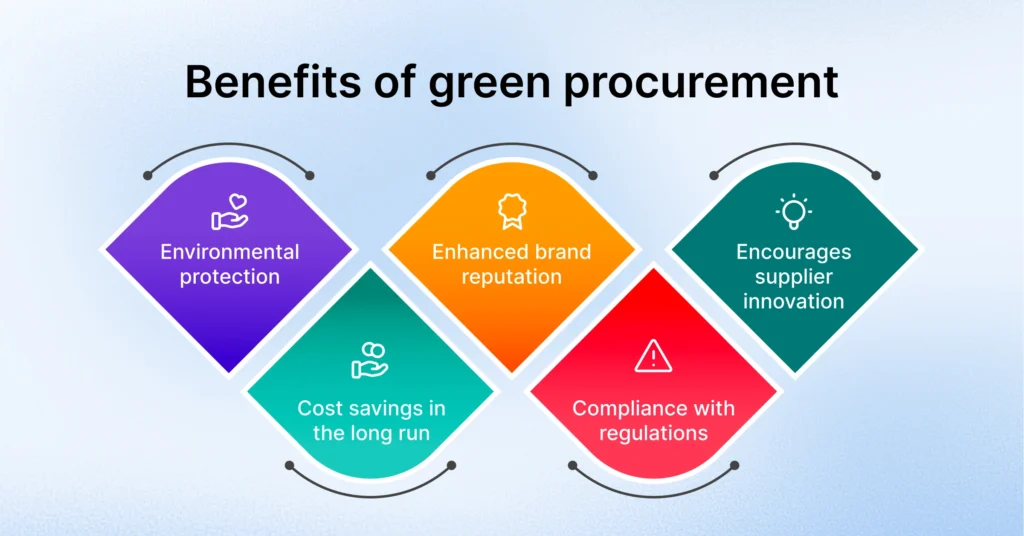
Green procurement is being widely adopted by the Indian procurement industry thanks to its numerous benefits. Findings suggest that eco-friendly procurement has the ability to reduce emissions, with one analysis stating that it could reduce yearly steel-related CO2 emissions by 8 to 40 million tonnes. Therefore, it is evident that sustainable procurement delivers benefits such as reducing pollution and waste, and even has economic benefits such as cost savings and innovation. It also offers social advantages such as improved brand reputation and risk management. Here are the top benefits of green procurement in supply chain management, highlighted and explained in detail.
1. Reduced environmental footprint
Green procurement faces critical environmental issues head-on, such as climate change, pollution, deforestation, and excessive resource use. Choosing eco-friendly products and services reduces waste, lowers emissions, reduces dependency on raw resources, and eliminates harm to the ecological environment. In addition, numerous companies are also enforcing carbon management practices wherein greenhouse gas emissions are monitored, reported on, and minimized as much as possible. This eco-friendly approach helps organizations drastically reduce their carbon footprint.
2. Lower waste generation and better resource efficiency
Another impactful step that eco-friendly procurement practices are taking is to choose goods with minimal packaging, or better yet, recyclable and compostable packaging. This step encourages organizations to implement waste reduction within their teams, as a tactic such as this directs waste away from landfills. Additionally, this promotes proper waste segregation and the reuse of salvageable materials wherever possible. This protects the environment and also reduces long-term disposal and operational costs.
3. Long-term cost savings and operational efficiency
The procurement lifecycle is often reduced by the usage of sustainable products such as energy-efficient equipment, durable materials, and recyclable elements. Organizations also achieve better operational efficiency through environmentally friendly practices such as optimized energy use and better resource management. Moreover, in public and private sectors, these efficiencies result in measurable, long-term savings.
4. Positive brand reputation and enhanced market trust
Organizations that prioritize sustainability build trust with customers, investors, and stakeholders. Adopting green procurement practices indicates a very solid commitment to environmental and social causes and sets green procurement examples. Not to mention, this is a strategic way to attract environmentally conscious customers, investors, and regulatory bodies to the business, as they have increasing expectations of the organization to make responsible purchasing decisions. Transparent reporting, impactful sustainability measures, and lawful sourcing may open doors to better business opportunities in the future.
5. Boosted supplier and industry innovation
When buyers prioritize sustainable materials and opt for more eco-friendly products, it motivates suppliers to innovate and develop sustainable materials, processes, and technologies. This demand encourages more maintainable production practices. Additionally, reinforces the market and encourages the stocking of eco-friendly goods and leads an industry-wide change and adoption of better standards.
6. Stronger partnerships and collaborative growth
Ecological procurement actually makes a difference in partnerships and collaborations, too. It encourages like-minded thinking, allowing organizations with shared interests to pursue environmentally acceptable practices, share knowledge, and solve common problems. Thus, this improves supply chain resilience and overall industry performance. Organizations can set common goals and communicate openly with partners to help one another adapt to regulatory and market changes.
7. Healthier and safer work environments
Choosing non-toxic and sustainably sourced products not only has a positive impact on the environment but also improves organizational health and safety. Environmental procurement enables reduced exposure to hazardous chemicals, cleaner indoor spaces, and safer building materials. These factors contribute to better employee morale because once they see that the organization truly cares about both the environment and them, they will be more motivated to work. This leads to fewer sick days and improved operational well-being.
8. Social responsibility and community impact
Environment-friendly procurement supports broader societal goals by promoting ethical labour practices, which reduces pollution in the local communities and encourages organizations to invest in socially responsible practices. One of the many green procurement guidelines is to improve the quality of life, build trust within communities, and keep an organization’s sustainability initiatives flourishing.
Tips to implement successful green procurement practices
Green procurement in supply chain management can be successfully implemented by setting clear sustainability objectives after evaluating your current impact on the environment, establishing a green procurement policy, and adequately training employees and stakeholders. Here are some tips on how to ensure your eco-friendly practices deliver results and keep purchasing decisions sustainable.
1. Build awareness around the topic and train internal stakeholders
Educating your procurement team is important if you want the transition to be successful. Start by raising awareness about why it’s important to switch to sustainable purchasing practices. Then, once your stakeholders understand its impact, you can provide training on environmental criteria, organizational sustainability goals, and how each role contributes to the source-to-pay process. This ensures that everyone from all departments understands what’s expected of them and follows green procurement consistently.
2. Assess your current environmental impact
Before improvement comes understanding the stage you are currently at. You need to evaluate your existing procurement footprint and how it is impacting your surrounding environment. Do this by conducting a full assessment of your supply chain to pinpoint areas contributing to waste, emissions, or resource depletion. Additionally, use tools like Life Cycle Assessments (LCAs) to understand environmental costs and establish a baseline for improvement.
3. Establish clear and actionable green procurement policies
Create a formal green procurement policy that highlights commitments to environmental rules, product criteria, and supplier expectations. Talk with your team and together define what “eco-friendly” means for your organization. Adding to that, communicate these guidelines across all relevant teams. Clear documentation helps unify decision-making and prevents ambiguity.
4. Collaborate and communicate with suppliers
Suppliers are the gateway to sustainability in the sourcing world. If you engage them early, you’ll be able to innovate more and collaborate on different projects that put the environment first. Share your eco-friendly procurement ideas and policies with them and offer guidance and training where required. You can also develop criteria to evaluate suppliers based on their environmental performance and encourage them to adopt greener manufacturing, packaging, and logistics practices.
5. Integrate environmental standards into product requirements
Embed sustainability into your specific procurement needs so suppliers are aware of your requirements beforehand. You can include criteria such as recyclability, renewable or recycled materials, and reduced energy use. Additionally, it is beneficial to include recognized environmental certifications in your requirements, such as Energy Star, FSC, or Cradle to Cradle. Lastly, consider the total cost of ownership, including environmental impact, instead of only upfront pricing.
6. Prioritize renewable and eco-friendly materials
Select products with the least impact on the environment, namely, renewable or recycled resources. Doing this reduces dependency on non-renewable materials and encourages your organization to take more sustainable sourcing decisions.
7. Monitor progress through KPIs and regular reviews
Create KPIs to track the performance of your newly implemented environment-centered procurement activities. These will help you monitor emissions reduction, waste minimization, and energy savings. Also, conduct reviews to evaluate supplier performance, policy adherence, and the cost benefits you achieve from making greener choices.
8. Build a culture of continuous improvement
Form a dedicated team that oversees the execution of sustainable procurement initiatives and encourages cross-department collaboration. Regularly update policies based on new regulations, market trends, and stakeholder feedback. When you nurture a culture where employees propose ideas and suppliers innovate, sustainability becomes part of everyday operations.
What are the challenges of implementing green procurement?
Going green in the procurement space is a wonderful initiative, but it comes with various challenges that may turn companies away from implementing green procurement. These hurdles range from high upfront costs, limited availability of sustainable products and suppliers, to a lack of clear regulations or standards. Organizations may also struggle with internal resistance to change, which would slow down the adoption of eco-procurement. However, there are solutions for these challenges, which are denoted in this section, so companies can implement this change worry-free and make their procurement process friendly for the environment.
1. Limited awareness and sustainability knowledge
One of the first challenges faced by organizations when it comes to sustainable procurement is that employees, procurement teams, and even suppliers may lack clarity about sustainability practices. Even shareholders may struggle to see the benefits of going green. As a result, they might not be aware of the impact on the life cycle or how to consider and evaluate “green” options. Moreover, if a manager or procurement director is unable to provide stakeholders with or collect relevant information, it might cause confusion and inconsistent adoption.
Solution:
Prepare your team for the shift by offering structured training sessions, sharing best practices and benefits, and building the internal capacity to collect and analyze sustainability data.
2. Higher upfront costs and budget constraints
Some sustainable products may initially be more expensive than their non-sustainable alternatives, which causes organizations to worry about the impact purchasing them will have on their budget. Additionally, some premium sustainable products may come with a heavy price tag, which might unnerve companies looking to gain profit over a short period of time. However, considering the long-term benefits is important.
Solution:
Consider using the life-cycle costing approach, which gives you a view of the total cost of ownership. It shows long-term savings from durability, lower energy consumption, and reduced disposal costs.
3. Limited availability of sustainable suppliers and products
Some sustainable products or sustainable suppliers may not be available in all locations due to regional supply chain limitations. This is because the market for sustainable products is still new, so the availability might be scarce and, as mentioned before, costs might not be favourable for everyone. This leads to longer lead times, supply risk, and reduced competition.
Solution:
Because searching for a whole new supplier pool may take copious amounts of time, engage your current suppliers early and tell them about the benefits of green procurement. Encourage them to adopt greener standards. Or, you can start the search in the market for suppliers who already meet environmental criteria.
4. Lack of clear standards and risk of greenwashing
As said before, the environmental procurement transformation is still up and coming. Therefore, due to inconsistent definitions, it is difficult to verify whether suppliers actually live up to their ecological claims, or are just “greenwashing.” There is a risk of vague labels and no universal benchmarks, so it’s hard to say if these statements are true. This leads to compliance risks and uncertainty.
Solution:
Supplier assessments can help you with this challenge. Yes, you can adopt recognized certifications, but conducting assessments using third-party criteria may be able to help you solidify your decision while onboarding suppliers.
5. Internal resistance to change
Shifting from the traditional means of procurement to sustainable methods is a significant shift, and chances are, the entirety of your organization might not be open to accepting this. The reason is that teams may fear an extra workload or perceive sustainability as disruptive. They might be used to doing things a certain way, and don’t want to be perceived as incapable in case they take time to adapt to the new ways.
Solution:
Train and educate your employees and stakeholders to remove any apprehension or fears they may have about this process. Communicate the advantages and disadvantages of green procurement clearly to them, so that they know what to expect, highlight real-world success stories, and implement change in gradual phases.
6. Insufficient internal resources and time
Like every big change, sustainable procurement, too, requires time for research, supplier evaluation, data tracking and collection, and aligning departments with business objectives. Simply put, it doesn’t happen overnight. Teams must learn how to carry out sustainable sourcing activities and must be trained to incorporate them in their day-to-day operations. However, they may struggle to do so if they are already overstretched.
Solution:
Have inter-departmental brainstorm sessions, set long-term goals, and allocate your resources well. Remember to phase out the implementation process to avoid straining your team and disrupting their productivity. Keep reminding yourself that all good things take time and that the new method of procurement will benefit not only the environment but your organization as well.
7. External barriers: funding, policy support, and cultural factors
Regulations and policies differ from region to region, hence some may lack proper government incentives, supportive legislation, or cultural alignment toward sustainability. This may slow down adoption due to market volatility and a lack of financial support.
Solution:
Organizations can lead by example and influence the public to adopt a greener mindset. The biggest to the smallest brands can start the chain of change and encourage others to align with global sustainability frameworks.
8. Technology gaps and data management complexity
Procurement teams often find that they require new technologies to aid them in the environmental transformation. However, they may be unable to access the exact tools needed to track environmental data, integrate sustainability KPIs, or verify supplier performance accurately.
Solution:
Invest in scalable digital tools that allow you to customize configurations according to your needs. Provide teams with essential training to build technological proficiency.
Conclusion
Green procurement is rapidly becoming fundamental for organizations and governments wishing to balance economic growth with sustainability. From green public procurement to green purchasing in daily business, it is possible for organizations to create a lower environmental impact, achieve savings, and advance their reputation. With strong policies, authoritative guidelines, and solid examples to follow, many challenges can be resolved. The future rests with innovation, collaboration, and commitment, and poses a powerful way forward to a greener and more sustainable future.

Frequently asked questions
How does green procurement influence supplier relationships?
It encourages deeper collaboration, as buyers often work closely with suppliers to meet sustainability standards. This can strengthen partnerships, drive innovation, and create shared long-term value.
Is green procurement only relevant for large organizations?
No. Small and medium businesses can also benefit by starting with simple steps—like choosing eco-friendly packaging, sourcing local suppliers, or requesting sustainability certifications. Even modest efforts can reduce costs and boost brand reputation.
What role does technology play in green procurement?
Digital tools like spend analytics, supplier sustainability scorecards, and lifecycle tracking platforms help organizations evaluate environmental impacts, improve transparency, and measure carbon footprints more accurately.
What is green public procurement?
Green public procurement (GPP) is the practice where governments and public authorities purchase goods, services, and works that have a reduced environmental impact throughout their life cycle. It helps promote sustainability, encourages eco-innovation, and sets an example for greener markets.
Which is an example of a green procurement product?
Some green procurement examples in products include an LED light bulb, recycled office paper, or a solar panel. Each of these products is designed to lower environmental impact through energy efficiency, recycled materials, or renewable energy use.
What is another name for green procurement?
Green procurement is also known as sustainable procurement. Other similar terms include eco-conscious purchasing and green sourcing.
What are the principles of green public procurement?
Core principles include applying environmental criteria in purchasing decisions, choosing energy-efficient and eco-friendly materials, and maintaining a supply chain that supports long-term sustainability.
Schedule a Demo
We’d love to hear from you. Please give us a call on +1 315-645-2799.
Explore more from Procol
Discover expert tips, how-to guides, industry insights, and the latest procurement trends.
How to Achieve Procurement Cost Savings: Complete Guide & Strategies
Procurement cost savings represent financial benefits achieved through strategic purchasing and...

Procurement orchestration: All you need to know in 2026
Explore the value of procurement orchestration, how it works, its benefits,...

Top 22 spend management KPIs to optimize procurement in 2026
Today’s business world has moved from just ‘buying’ to ‘managing spend’...