





Rutuparna Rout • January 29, 2026
What is source to pay (S2P)? Process, definition & tools (2026)

ProcolContent Writer
Last update: March 5, 2026
12 min read
Procurement plays an important role in driving cost savings and operational efficiency across an enterprise, but manual processes create visibility gaps that hamper spend control & weaken supplier relationships. There is a well-structured source to pay process that helps businesses buy the right products at the right price while maintaining relationships with suppliers. It connects sourcing, contracting, purchasing, and payment into one workflow that makes a source of savings and operational strength.
This guide covers everything you need to know about source-to-pay, including what it is, how it works, why it matters, and how to use it in your business. Keep reading to know how you can make procurement simple and effortless.
Key Takeaways
What is source to pay?
Source to pay is an end-to-end procurement process that includes all activities related to the vendor lifecycle, from sourcing suppliers and negotiating contracts to purchasing, invoicing, and final payments. This is the automated system that links purchasing activities across an organization, making it easier to see what’s happening, follow rules & control costs.

What are the steps in the source to pay cycle?
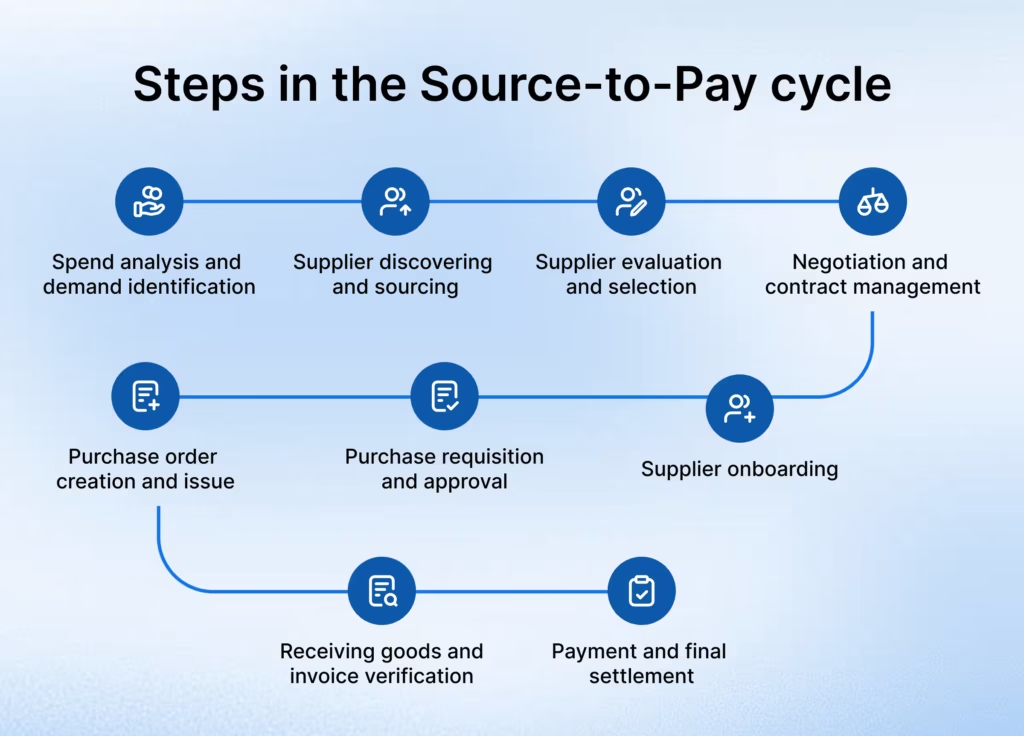
The sourcing-to-payment lifecycle is different for every company depending on its needs, but the way it’s carried out remains the same. A strategic S2P generally looks like this: spend analysis, identifying needs, strategic supplier sourcing, supplier management, contract negotiation, purchasing, goods receipt, and invoice processing and payment. Here are the nine steps involved in the source to pay process.
1. Spend analysis and demand identification
The cycle begins by understanding your business needs and analysing current spending patterns. In this stage, teams do a review of the items that are being purchased. They also check who they’re purchasing it from, where, and whether it was done according to the contract or not. Once a business has this entire picture, it can identify sourcing opportunities, cost-saving areas, and upcoming demand.
2. Supplier discovering and sourcing
Next, strategic sourcing is used to search for suitable suppliers. Teams research the vendor market and interact with suppliers they think are suitable according to company standards. They then issue RFIs, RFPs, or RFQs. This can be done using strategic sourcing software, which is also helpful in running e-auctions to compare suppliers and secure the best price.
3. Supplier evaluation and selection
In this step, supplier responses are assessed based on different criteria such as pricing, quality, and delivery times. They are also evaluated based on the level of risk they pose for the company. Once this evaluation is complete, organizations should think about whether they can afford this investment and also how profitable it will be. Once this is decided, only then should suppliers be chosen and the negotiation process begun.
4. Negotiation and contract management
In this step, teams negotiate pricing, terms, and quantities. Contracts are drafted, approved by the necessary parties, and then issued to the suppliers. These contracts finalize the partnership and set the foundation for all the following source-to-pay process steps.
5. Supplier onboarding
Once contracts have been signed, suppliers are then onboarded to a database. This vendor database stores important information such as payment details, compliance certificates, and contact information. This process can be done manually, but research by ProValet shows that automation speeds up onboarding times by 50%.
⭐Fun fact: Procol’s vendor onboarding platform helps suppliers get onboarded in as little as 2-5 minutes!
6. Purchase requisition and approval
This stage is typically handled by the procurement department, wherein the team creates a purchase requisition for the needed goods and services. The requests are then sent through a predefined approval workflow with approval criteria before moving ahead.
7. Purchase order creation and issue
The requisitions that have been approved can now be converted into purchase orders. A PO is a document that contains details about the product requirements, such as the quantity needed and delivery information. This is then sent to the supplier.
8. Receiving goods and invoice verification
Once goods and services are received from the supplier, they are checked thoroughly. This is done to ensure that the quantity and quality meet the requirements originally set in the contract. Invoices are verified using accounts payable automation software, and once everything matches up, the suppliers can be paid.
9. Payment and final settlement
In the last stage, payments are transferred to the suppliers’ bank accounts based on the agreed-upon terms. This closes the end to end source to pay process, and is often supported by technology to ensure accuracy and compliance.
Difference between source to pay and procure to pay
Source to pay is an end-to-end strategic process covering the entire vendor lifecycle, whereas procure to pay is a transactional, operational process focused on purchasing and invoicing, beginning only after a supplier is selected. Below you can find a detailed description of the source to pay vs procure to pay differences:
| Key difference | Source to pay | Procure to pay |
| Process | Focus on the entire lifecycle, from supplier selection to contract management | Focus mainly on the procurement process, from identification through supplier selection. |
| Best suited for | An organization that needs complex procurement, multiple suppliers, and strategic sourcing | An organization that needs limited supplier interaction and is mainly focused on order fulfillment and payment transactions. |
| Scope | Strategic & operational | Primarily operational |
| Primary focus | Strategic sourcing, supplier relationship management, contract negotiation, and market analysis | Transactional purchasing, order fulfillment, invoice processing, and payment execution |
| Automation Opportunity | Automation of vendor selection, contract lifecycle, compliance tracking, and performance evaluation | Automation of approval workflows, invoice processing, payment execution, and reconciliation |
| Use case | Finding new suppliers, risk mitigation strategies, and the main procurement transformation | Routing goods and services purchasing, accounts payable optimization |
| Technology focus | Source-to-pay technology with AI & analytics for sourcing and compliance | ERP or finance systems focused on transaction execution |
What are the challenges in the source to pay process?
The source to pay process is very structured in nature, but it does come with challenges such as fragmented and unclear data across multiple systems, poor spend visibility, and low compliance rates. Research by Corcentric shows that low compliance is the main reason for nearly 50% of value leakage in S2P, which means this is a major issue. Some of the other challenges in the source-to-pay process include slow approval workflows and supplier onboarding, and high risks of fraud. All of these challenges are explained in detail below, so let’s explore.
1. Lack of compliance across systems
Multiple systems joined together often make processes confusing and hard to adhere to procurement policies. Due to separate tools, each department may follow its own compliance policy instead of a connected, centrally managed one. This makes it difficult to monitor adherence to the source-to-pay process steps.
2. Fragmented systems and poor integration
Using scattered tools requires time-consuming back and forth and risks data silos. This leads to gaps in processes. Without proper source to pay integration, organizations can end up with duplicated data and limited visibility across sourcing.
⭐Fun fact: Procol’s S2P platform centralizes source-to-pay activities in one intuitive platform that’s easy for teams to use!
3. Time-consuming and labour-intensive manual tasks
Many steps in the procurement process, such as sourcing, approval, and invoicing, still need manual effort, which means they rely on humans and, therefore, take up a lot of time. Teams often spend long hours re-entering data and following up with approvals, increasing the risk of errors. A study by PayStream Advisors found that 3.6% of manually processed invoices contain errors, leading to duplicate payments and late fees.
4. Higher costs and value leakage
If negotiated savings don’t align with purchase orders or payments, organizations lose money. Costs also rise from operating multiple systems, as training efforts and licensing fees would increase.
5. Poor inter-departmental collaboration
The end to end source to pay process involves procurement, finance, legal, and IT departments. Each department working on its own platform and following its own rules creates misunderstandings. This negatively impacts the overall procurement process.
6. Limited data visibility and reporting
The S2P process becomes very confusing and cannot be tracked when the data doesn’t match past documents. Also, gathering and cleaning data are time-consuming, too, and without an all-in-one source to pay tool, teams might be unable to accurately track performance.
7. Supplier risk identification and data management
Suppliers can pose various risks to the S2P process. Identifying and centrally managing supplier data is complex. Without modern source to pay technology, assessing supplier reliability, compliance, and performance becomes less consistent.
What are the benefits of source to pay software?
Source to pay solutions add value to an organization’s purchasing cycle. They enforce structure, enable significant cost savings, enhance spend visibility, and improve compliance with legal requirements. An article by Ivalua states that S2P automation for sourcing and contracting tasks reduces cycle times by 40% and leads to a 20-30% decrease in overall procurement and AP costs. Let’s discover more benefits of modern source to pay tools below.
1. End-to-end spend visibility
Source to pay tools bring together all activities right from sourcing and contracting to final payments into a single workflow so that managers have access to all important information and stay on track with progress. This helps them track budgets, allocate resources more efficiently, and improve decisions across all source-to-pay process steps.
2. Higher cost savings and better pricing opportunities
Spend visibility helps gain measurable sourcing savings. Source to pay applications help teams spot areas to save costs and source better suppliers that give them a competitive advantage. Additionally, these applications even help with negotiations. Adding to that, enforced contract pricing ensures that negotiated savings carry through to actual purchases.
3. Faster sourcing and contracting
Source to pay procurement software automates tasks that would usually be done by humans, such as sourcing and contracting. This allows the procurement cycle to move much faster, and teams can also reach their goals on time and enjoy work satisfaction. Digital workflows help teams move through stages faster, making processes more efficient. Automated and standardized processes reduce delays and improve overall efficiency.
4. Improved compliance and risk control
Using S2P software, businesses are less likely to face compliance issues due to built-in controls that ensure all purchases follow company policies and contract terms. Additionally, when all activities run on a centralized platform, companies have a single source of reference that also makes it easier to conduct audits.
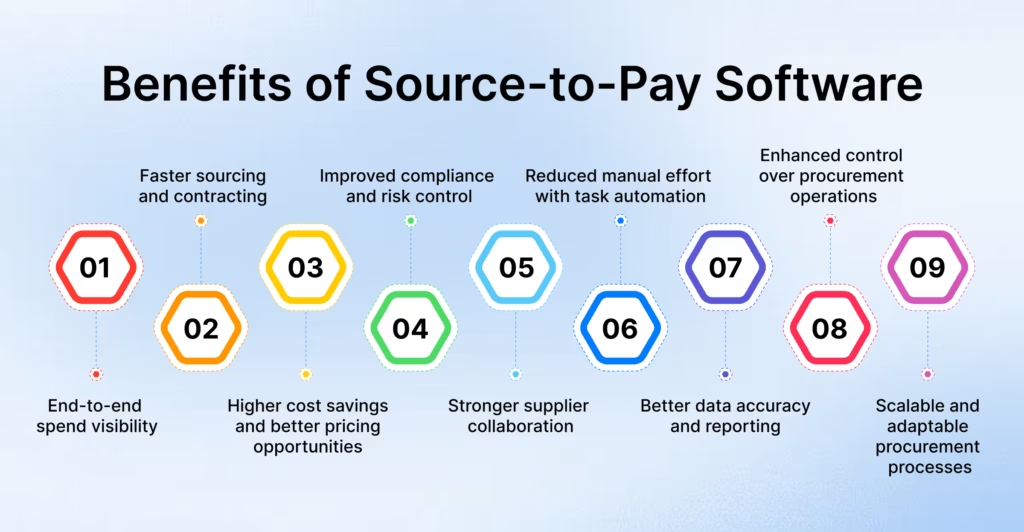
5. Stronger supplier collaboration
When everyone can access data through a shared platform, it improves communication between buyers and suppliers. And for any partnership to be successful, healthy relationships are important. In fact, a report by McKinsey & Company revealed that business parties who collaborate closely and maintain good relationships often work together again on future projects. Easy access to supplier data makes collaboration simple for aspects like pricing, performance, invoicing tasks, and long-term improvement.
6. Reduced manual effort with task automation
Source to pay automation links multiple aspects of the process together, saving time and manual effort. Because of this, teams do not need to keep following up manually or enter the same data multiple times. Instead, automation does it for them, much faster and with no errors. Hence, they can focus on more strategic activities.
7. Better data accuracy and reporting
An intuitive source to pay suite gives teams a center point of reference, so they can generate reports without cleaning extensive datasets. Additionally, source to pay integration allows easy tracking of procurement KPIs without a business intelligence expert, helping teams get the information they need fast.
8. Enhanced control over procurement operations
Technology leads to all sourcing and procurement activities being valuable. Since every aspect is managed well, the results start to show automatically. Source to pay procure to pay solutions help teams manage suppliers, budgets, and approvals in one place, allowing them to create, capture, and measure value at every step.
9. Scalable and adaptable procurement processes
With S2P automation, there’s always scope for scale and improvement. Modern source to pay technology supports growth and remote collaboration, with some software even providing mobile applications for on-the-go collaboration. This helps organizations adapt to change and stay agile.
Top 8 source to pay software in 2026
Choosing a source-to-pay software depends on your needs, business size, and key objectives. This table lists some of the best software, such as Procol, Coupa, SAP Ariba, Ivalua, and GEP SMART, all of which are praised for their robust automation and ERP integration abilities. Let’s explore the top source to pay software providers in 2026.
| Software | Overview | Key features |
| Procol | The leading AI-native source to pay platform that automates and unifies all sourcing and procurement activities. Built to simplify the entire S2P lifecycle, from sourcing, approvals, and auctions, to onboarding, invoicing, and payments. | Sourcing, eAuctions, contract management, eProcurement, payments, vendor management, supplier collaboration, spend analytics. |
| Coupa | A cloud-based source to pay solution designed for business spend management. Helps teams control procurement, invoices, and expenses. | Sourcing & contracts, supplier management, spend analytics, compliance controls. |
| SAP Ariba | A source to pay platform designed to manage enterprise sourcing and procurement operations. Automates procurement processes and simplifies collaboration. | Supplier collaboration, sourcing & contracts, invoice management, spend analysis. |
| GEP SMART | A source to pay tool that covers sourcing, procurement, and savings tracking. Offers functionality for contract and supplier management. | Workflow automation, supplier management, spend analytics. |
| Ivalua | S2P software designed to enhance procurement and supply chain for organizations. Manages suppliers, contracts, and purchasing processes. | Supplier database, contract lifecycle management, requisitions & POs, analytics. |
| JAGGAER | A cloud-based source to pay suite for managing sourcing, spending, suppliers, invoicing, and payments. Centralizes procurement activities and supplier information, enabling better tracking. | Spend analysis, contract management, ERP integrations. |
| Zycus | Source to pay system that automates procurement and accounts payable processes for organizations. Provides spend visibility for enterprises and enhances efficiency. | Spend analysis, supplier management, and sourcing events. |
| Precoro | A lightweight procurement tool for growing teams that need a simple solution. Provides business spend management, AP automation, and eProcurement. | Requisitions, budget tracking, approval workflows. |
6 key automation opportunities in the S2P process
A 2026 Fortune Business Insights report highlights the growing digital procurement transformation, noting that many organizations see the value in automating sourcing, with S2P software emerging as a strategic tool for streamlined procurement. The primary aim of automating the source-to-pay process is to create value by making the supply chain more efficient, with key automation opportunities including supplier onboarding, AI-powered invoice processing, automated PO generation, and real-time spend analytics. Here are the key opportunities for source to pay automation.
1. Enhancing supplier management
Automating supplier data collection, onboarding, and evaluation reduces manual effort and errors. An integrated supplier management solution makes coordination easier, reducing the time spent on manual research. Source to pay platforms gather and store supplier information in one hub, ensuring you work with relevant data.
2. Simplifying sourcing activities
Source to pay solutions automatically conduct activities like sending RFIs, RFPs, and RFQs. A single system gathers and processes all information from suppliers about their products and services. The source to pay system also organizes responses and ranks them based on criteria, speeding up selection.
3. Automating purchase orders and requisitions
Manual purchase orders are error-prone and cause delays. Source to pay tools create, cross-check, and validate PO data against preset standards, ensuring accuracy before they are routed for approval.
4. Invoice management and reconciliation
Managing paper invoices can be a costly process. Automated invoice reconciliation matches invoices to purchase orders, identifies mismatches, and handles approvals automatically. Furthermore, AP automation software helps avoid overcharging and undercharging, ensuring consistency.
5. Approval workflows for faster payments
Automated workflows release and authorize payments. These are integrated with an organization’s existing ERP or finance platforms. Source to pay applications ensure payments are authorized quickly and accurately, reducing the time spent on emails and spreadsheets.
⭐Fun fact: Procol’s no-code approval workflows automate multi-level approvals with full visibility, helping teams save 15K+ hours on manual follow-ups!
6. Contract management and compliance tracking
Automating procurement contract management ensures contracts are executed and monitored on time, helping in compliance tracking. Source to pay platform tools can automatically trigger contract renewals and monitor compliance, ensuring businesses stay aware of terms and avoid penalties.
How Procol’s source to pay suite enhances procurement efficiency
Procol unifies procurement with a smart AI-powered source to pay procurement software. The software connects all stages of S2P under one platform, offering procurement leaders full visibility and control. Procol helps teams break free from disconnected systems and time-consuming manual processes, unifying sourcing, payments, and supplier management activities with an easily navigable interface. The system uses agentic AI in sourcing to secure more competitive pricing and reduce risk, enhancing efficiency at the source.
Noon, a leading Middle Eastern digital ecosystem, was struggling with fragmented procurement, unclear intake requests, scattered data, and limited visibility into performance. By centralizing sourcing with Procol, they streamlined intake-to-PR workflows, introduced transparent eAuctions, improved vendor onboarding, and unified spend data. Using Procol, they managed $88M in spend, $7M in savings, and processed over 10,000 PRs each year, completely transforming their procurement.

Conclusion
Source to pay system is a game-changer for your business. It helps you reduce costs, stay compliant, work more effectively with suppliers, and automate tasks, all of which lead to better results. The source to pay suite can help you make better use of your resources while empowering your procurement through procurement software. By adopting this software, your organization not only improves procurement but also transforms the operation. The right solution provides clear visibility into spending and enables faster, smarter decision-making. Now is the time to embrace and unlock lasting value for your enterprises.
Frequently asked questions
What is meant by source-to-pay?
Source to pay meaning refers to the complete, end-to-end business process that manages all activities related to acquiring goods and services for an organization. It starts with identifying a need and finding suppliers, moves to contract negotiation, purchasing, and finally ends with goods receipt and payment.
What is S2P vs P2P?
Source-to-pay (S2P) is the strategic and comprehensive process covering the entire lifecycle from identifying organizational needs to final payment. Procure to pay (P2P) is a subset of S2P and is mainly focused on the operational aspect of the procurement process (ordering to payment).
What is an example of source-to-pay?
A key example of source-to-pay is a manufacturing company using S2P automation to simplify the procurement process by identifying suppliers, automating onboarding, generating purchase orders, and matching invoices with delivered goods.
What are the best practices of source to pay?
The best practices of source to pay include automating the entire lifecycle and moving from manual processes to automated workflows for sourcing and payment activities. Additionally, using a single platform for all processes instead of relying on multiple disconnected systems improves efficiency and reduces errors.
What is the future of source-to-pay?
The future of the source-to-pay automation will use digital tools and AI to automate the everyday tasks. This makes procurement teams focus on what matters most, such as strategic planning, risk management, finding insights, and meeting sustainability goals.
Who needs a source-to-pay solution?
Organizations with multiple suppliers and high spend need S2P to gain visibility and control. It suits mid-to-large and fast-growing companies. S2P removes inefficiencies from manual procurement.
When should a company use source to pay?
Companies should use S2P when procurement becomes fragmented, and spending is hard to track. It’s critical when compliance and supplier risks increase. S2P enables strategic sourcing over reactive buying.
How does AI help in the source to pay process?
Artificial intelligence in the source to pay process shifts it from a manual and reactive function to an automated, predictive, and strategic function. This is done with the help of AI smart source to pay procurement software, which is able to analyze vast datasets, automate repetitive tasks, and enhance decision-making.
Schedule a Demo
We’d love to hear from you. Please give us a call on +1 315-645-2799.
Explore more from Procol
Discover expert tips, how-to guides, industry insights, and the latest procurement trends.
Procurement orchestration: All you need to know in 2026
Explore the value of procurement orchestration, how it works, its benefits,...
Top 22 spend management KPIs to optimize procurement in 2026
Today’s business world has moved from just ‘buying’ to ‘managing spend’...

What is supplier diversity and why is it important?
In the modern corporate competitive world, where both market resilience and...