
Rutuparna Rout • January 29, 2026
What is supplier diversity and why is it important?

Rutuparna RoutContent Writer
Last update: December 8, 2025
14 min read

In the modern corporate competitive world, where both market resilience and economic inclusion principles are critical, supplier diversity has solidified its standing as a core business strategy. Supplier diversity represents a crucial element of this linkage, transforming traditional procurement from a cost-focused function into a powerful engine for innovation, market resilience, and community uplift. This approach transforms procurement, turning it into a powerful driver of innovation, supply chain resilience, and economic inclusion. This comprehensive exploration will define the immense value of supplier diversity and outline the essential components of a successful supplier diversity program.
This supplier diversity guide covers best practices, performance-tracking methods, benchmarking strategies, and technology solutions to help organizations achieve their diversity goals.
What is supplier diversity?
Supplier diversity is a proactive business development strategy that intentionally includes companies owned by individuals from traditionally underrepresented groups in a company’s supply chain. This includes businesses owned by women, minorities, veterans, and individuals with disabilities, aiming to create a more inclusive marketplace and foster a more resilient and innovative supply chain.

Why is supplier diversity valuable for procurement?
Implementing supplier diversity offers significant advantages to your business, the economy, and the local communities. Here are the reasons why it is so valuable:
Boosting Your Business Performance
Commencing a supplier diversity program offers several benefits directly to your business:
- Increased Competition and Flexibility: The most diverse firms are often small, making them inherently innovative and agile. Extending business to them allows them to expand and compete better in the market. Including this diversity in procurement strategies ensures that your sourcing strategies process consistently taps into fresh ideas and competitive pricing.
- Improving Market Share: Aligning your supply chain with the values of diversity and inclusion enhances your corporate reputation and promotes a more inclusive work environment. This resonance opens doors to new markets, ultimately improving your overall market share.
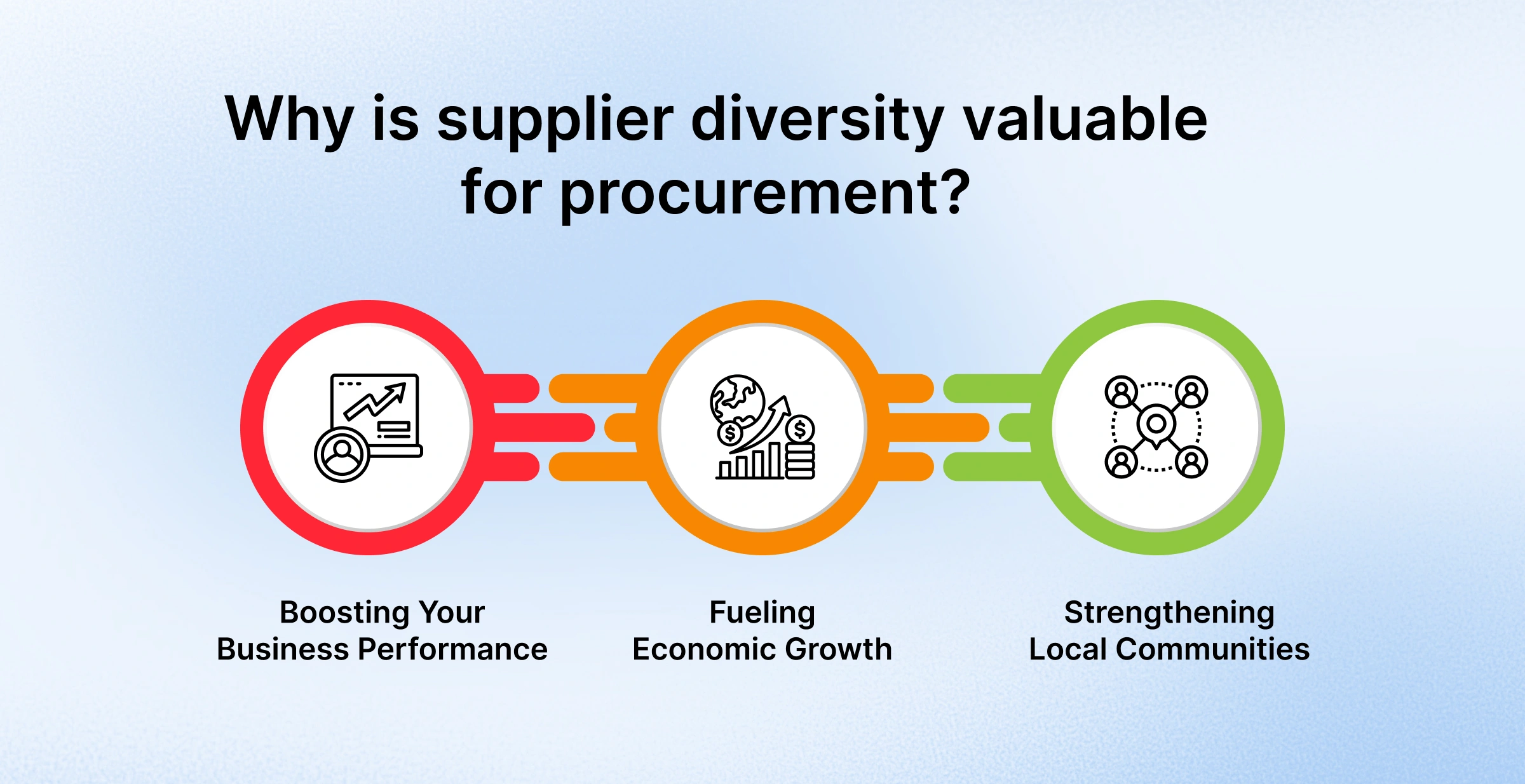
Fueling Economic Growth
On a broader level, supporting diverse suppliers is an investment in economic vitality:
- Accelerating Economic Boost: Small businesses are the engine of the economy, accounting for a significant portion of economic activity (e.g., 44% of the U.S. economy in 2019). By helping diverse small businesses grow, you directly facilitate overall economic growth and accelerate economic upturn.
- Driving Inflow of Cash: Supporting diverse suppliers provides the economy with a crucial inflow of cash, benefiting not only the national economy but also the corporation’s more direct community.
Strengthening Local Communities
To a more local degree, the impact of purchasing from diverse businesses is profound:
- Job Creation and Higher Wages: Diverse businesses can use these contracts to retain existing jobs, create new ones, raise wages for their employees, and ultimately generate more tax revenue. This economic uplift directly helps their local communities thrive.
- Demonstrating Economic Influence: Many companies with formal supplier diversity programs assess indicators of this economic influence, such as jobs created and money invested in the economy, to demonstrate how their diversity programs positively impact their communities.
What are the steps in the supplier diversity program?
Supplier diversity is valuable for procurement because it drives innovation, reduces risk, increases competition, enhances brand reputation, and promotes social responsibility by tapping into new suppliers, fostering unique ideas, creating a resilient supply chain, and aligning with conscious consumer values. The steps in this program to ensure its successful implementation and growth typically include the following key actions:
1. Establish a Business Case and Secure Executive Support
Clearly articulate the program’s value and objectives to secure leadership commitment and resource allocation. Executive sponsorship is crucial for fostering cross-functional engagement and promoting supplier diversity.
2. Supplier diversity police and sourcing
Develop a formal policy that defines diversity criteria, outlines the program scope, and describes the engagement processes. Build or leverage databases of certified diverse suppliers and engage industry groups and peer companies to broaden your supplier network.
3. Develop and Invest in Program Resources
Outline specific strategies, including target-setting, procurement process changes, outreach campaigns, training programs, and technology investments. Assign ownership of the program to dedicated staff and provide ongoing education for procurement teams.
4. Implement Inclusive Procurement Practices
Incorporate diversity requirements into sourcing, RFPs, and supplier onboarding to ensure diverse suppliers have equitable opportunities. Simplify processes to remove barriers and provide resources for supplier development.
5. Measure Performance and Report Progress
Establish metrics and benchmarks for diverse spend and supplier engagement, and use technology platforms to track them. Regularly report outcomes to stakeholders to maintain transparency and accountability.
6. Expand Impact through Tier 2 Supplier Diversity
Encourage prime suppliers to engage diverse subcontractors and foster continuous program refinement based on feedback and changing business needs.
What are the key benefits of supplier diversity in procurement?
The key benefits of supplier diversity in procurement include increased innovation, supply chain resilience, and improved brand reputation. Diversifying the supplier pool fosters competition, leading to cost savings and enhanced product development through diverse perspectives.
Below, you can get to know more about it:
1. Boost Competition and Quality in Your Supply Base
When you open your sourcing to a broader, more diverse group of potential partners, you naturally increase competition. This pressure forces both existing and new suppliers to offer better-quality products and services, as well as more competitive pricing, ultimately saving your company money and improving the quality of what you purchase.
2. Drive Greater Agility and Resilience
A broader supplier base is a safer supply chain. If one supplier faces a disruption (like a natural disaster or economic challenge), you have backup options. Furthermore, diverse suppliers are often smaller and more agile, allowing them to adapt quickly and more flexibly to your changing needs or unexpected market shifts, helping you manage risk.
3. Enhance Your Brand Value and Public Image
Having a strong supplier diversity program is a public signal of your commitment to equity and inclusion.
- Customer Goodwill: It strengthens your brand’s reputation with customers, who increasingly prefer to support businesses that demonstrate social responsibility.
- Employee Pride: Employees feel a greater sense of purpose and pride when working for a company that actively contributes to a more equitable world.
4. Open Doors to Increased Market Share
Investing in diverse suppliers can directly translate into higher sales. Studies show that companies dedicating a significant portion of their spending to diverse suppliers see a measurable percentage of their annual sales linked to these programs. Additionally, many large corporations and government bodies require their own suppliers to have diversity initiatives, creating new business opportunities for you if you comply.
5. Fulfill Environmental, Social, and Governance (ESG) Goals
Supplier diversity is a critical pillar of your overall Social and Governance strategy. It underscores your company’s commitment to Diversity, Equity, and Inclusion (DEI) mandates, helping you meet essential corporate responsibility goals and appealing to investors who prioritize ESG performance.
6. Fuel Innovation and New Solutions
When you partner with suppliers from diverse backgrounds and experiences, you introduce different perspectives into your supply chain. This diversity of thought is a proven catalyst for innovation, enabling your company to develop novel solutions and introduce new, unique products and services to the market.
7. Strengthen Connection with Customers
Working with diverse-owned businesses helps your company build a stronger, more authentic presence and connection within diverse communities. This presence enables you to better understand and capitalize on market expansion opportunities within these growing customer segments.
What are the challenges in supplier diversity?
Challenges in supplier diversity include limited executive support, insufficient resources, and resistance to change. Suppliers face restricted access to capital and capacity, while diversity goals often conflict with cost and speed priorities. Addressing these requires a clear strategy, robust data, and the elimination of biases.
Here are the key challenges in supplier diversity, explained simply:
1. Limited Access to Opportunities
It’s challenging for new, diverse suppliers to secure business because large companies often prefer to stick with established, familiar vendors.
- The Status Quo: Procurement teams often choose suppliers they’ve used for years, making it difficult for diverse businesses even to be considered.
- Too Complicated: The rules for qualifying as a vendor are often lengthy and complex, requiring extensive paperwork. This process is overwhelming for smaller, diverse businesses, causing them to give up.
2. Lack of Commitment from Top Leaders
If the company’s highest-level executives aren’t entirely behind the program, it struggles.
- Not a Priority: When leaders fail to prioritize diversity as a core goal, the program is often viewed as optional or secondary.
- No Resources: Without strong executive support, the program will not receive the necessary funding, staff, or influence to implement changes and hold teams accountable for diverse spending targets.
3. Insufficient Supplier Development Resources
A diverse program must do more than just award contracts; it needs to help suppliers grow and thrive.
- Need for Help: Many programs lack sufficient resources for mentorship, training, or financial guidance.
- Can’t Scale Up: Without this development help, diverse businesses struggle to grow quickly enough to handle the large orders and complex needs of a big corporation, thereby limiting their potential.
4. Complex Compliance Requirements
The sheer volume of data and administrative work is a significant obstacle.
- Insufficient Data: It’s hard to find reliable, up-to-date information on which companies are truly diverse-owned (minority-, women-, veteran-owned, etc.). Manual tracking is slow and error-prone.
- Verification Risk: Companies worry about being misled by businesses that claim to be diverse but aren’t (a risk known as “tokenism”). Manually checking and auditing each supplier’s diversity status is time-consuming.
5. Resistance to Change within the Company
Getting employees to change their sourcing strategies habits can be a battle.
- Fear of Risk: Procurement teams may be hesitant to try new suppliers due to perceived risks of quality issues, even if the supplier is fully qualified and certified.
- Old Habits: Overcoming the inertia and skepticism of long-standing procurement practices requires consistent effort and unmistakable evidence that diverse suppliers bring value, such as innovation and better prices.
What is a supplier diversity spend?
Supplier diversity spend refers to the amount of money an organization allocates for purchasing goods and services from businesses owned by underrepresented groups. Diverse supplier spend, also known as diverse spend, refers to the portion of procurement dollars allocated exclusively to small and varied industries.
Key aspects of this spend are mentioned below:
- Tier 1: This refers to the direct spending a company makes with businesses owned by diverse groups, including minorities, women, veterans, individuals with disabilities, and LGBTQ+ individuals.
- Tier 2: This measures the indirect spending. It tracks how much money the company’s leading suppliers (Tier 1) spend with other diverse businesses.
- Categorization: A business is considered diverse if it is predominantly owned and operated by individuals from underrepresented groups, including ethnic minorities, women, veterans, people with disabilities, and LGBTQ+ individuals.
- Measurement: Diverse spend is typically expressed as a percentage of the company’s total purchasing, and sometimes also considers the broader impacts, such as job creation.
- Purpose: The goal is to make purchasing more inclusive, encourage innovation, reach new markets, and help economic growth in diverse communities.
Supplier diversity spend in the private sector and government contracts
Supplier diversity spend in the private sector and government contracts means the money is spent on products and services from businesses owned by underrepresented groups.
Here are two distinct portions of private sector and government contracts mentioned below:
Private sector supplier diversity spend
- Companies establish internal goals and programs to increase purchasing from diverse suppliers, including those owned by minorities, women, veterans, LGBTQ+ Individuals, and individuals with disabilities.
- This diversity spending helps companies meet corporate social responsibility goals.
- It drives innovation, enhances competitiveness, and enables companies to reach new markets.
- Private sector supplier diversity is often voluntary but is widely regarded as good business practice.
Government contracts supplier diversity spend
- Government contracts typically have legal requirements or set-asides that mandate a specific portion of spending be allocated to certified diverse suppliers.
- These rules promote economic inclusion and support community development.
- Suppliers must meet diversity criteria to qualify for government business.
- Tracking diversity spend is crucial for ensuring compliance with regulations and meeting reporting requirements.
How to monitor supplier diversity performance?
Monitoring supplier diversity performance involves tracking key metrics such as the percentage of diverse spend and the number of diverse suppliers. Using scorecards and dashboards for visualization, along with regular reviews and feedback, drives continuous improvement and ensures alignment with business goals. Key metrics are :
1. Establish Strategic Goals and Business Alignment
- Measure economic and social impact to support core business goals directly, moving beyond compliance and CSR reporting.
- The ultimate goal is to get a clear picture of the positive impact on both the company’s bottom line and the well-being of the communities it serves.
2. Ensure Accurate Supplier Identification and Verification
- Use third-party certification agencies as the preferred method for authenticating and classifying diverse suppliers.
- A correct classification system is necessary to ensure that the spending on goods and services from diverse suppliers is measurable.
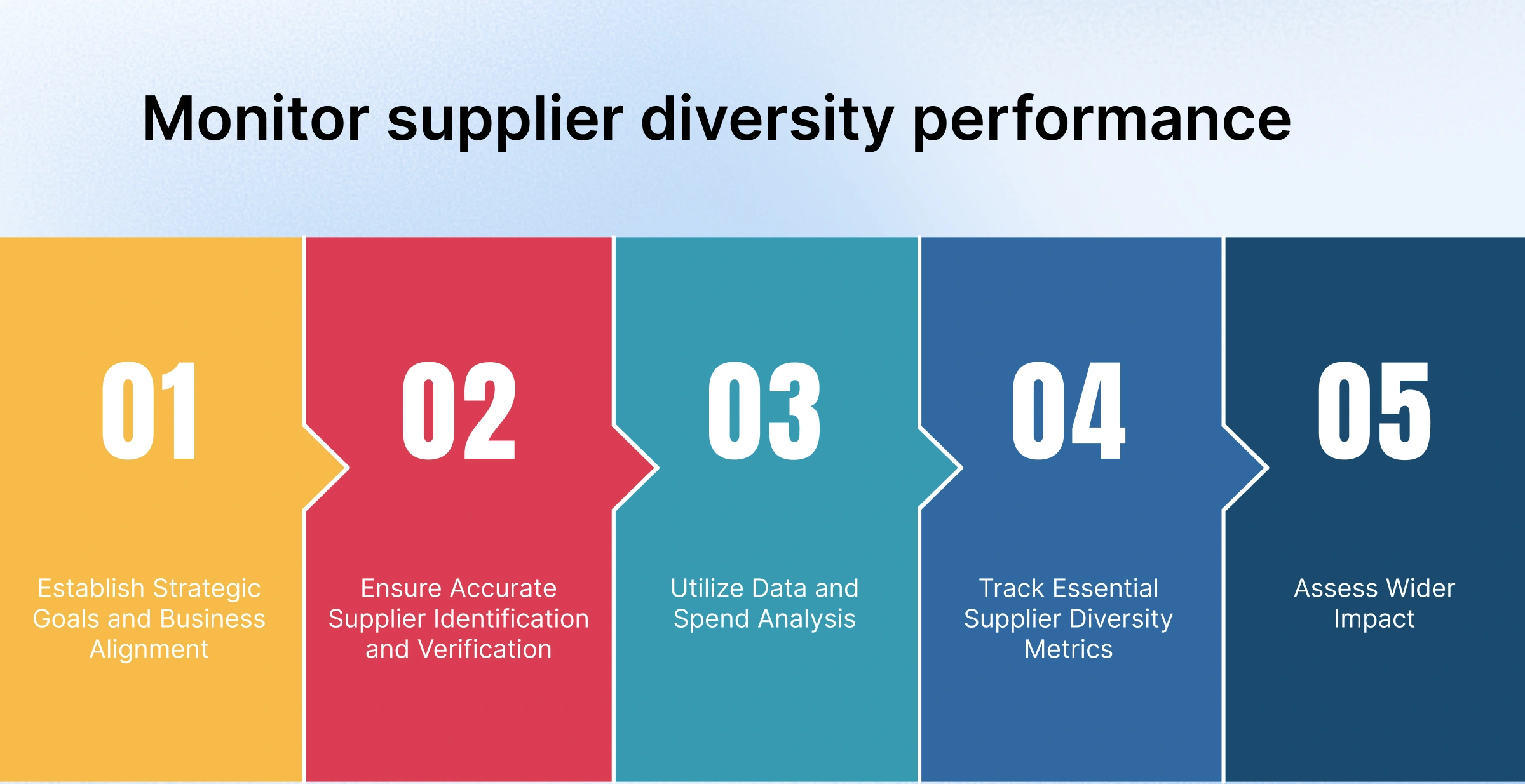
3. Utilize Data and Spend Analysis
- Employ spend analysis solutions to track and measure the share of diverse supplier spend out of the total category spend.
- Analyze your current supplier diversity to inform necessary improvements and set purposeful targets at the category level.
4. Track Essential Supplier Diversity Metrics
Performance monitoring involves tracking a variety of metrics that depend on the organization’s goals, size, and industry:
- Total Diverse Spend: Track the total amount spent on diverse suppliers, broken down by department, division, or location.
- Spend by Diverse Category: Monitor spend per specific category of diverse suppliers (e.g., veteran-owned, women-owned).
- Spend by Sourcing Category: Measure diverse spend per sourcing category (e.g., I.T., MRO, logistics).
- New Supplier Engagement: Track the number of new diverse suppliers brought into the supply chain.
5. Assess Wider Impact
- Acknowledge that while direct spend is measurable, the indirect impact, including job creation and broader economic benefits to the local community, is more challenging to measure but essential to monitor
8 successful key factors in supplier diversity
Eliminating barriers that prevent achieving diversity goals is the first key step. Successful supplier diversity programs have strong leadership support, clear, measurable goals, and strong visibility into supplier data. They continuously monitor diverse spending, partner with diversity organizations, and support diverse suppliers in succeeding within the company’s procurement process.
So here are the eight successful key factors mentioned below:
1. Secure Senior Leadership Commitment
Achieving significant progress starts at the top, requiring the CEO’s personal endorsement of specific goals and performance metrics. This ensures the program is prioritized and receives the necessary resources and organizational buy-in.
2. Define and Communicate Quantifiable Targets
Develop a clear supplier diversity program with measurable and communicated targets to provide the initiative with structure and direction. Sharing your efforts publicly informs diverse vendors and supporting organizations, encouraging them to engage with your company.
3. Achieve Supplier Data Visibility
Utilize digitization and cloud-based procurement solutions to track and categorize suppliers based on their diversity status easily. Better visibility of supplier data simplifies ongoing monitoring and accurate reporting of diversity efforts.
4. Continuously Monitor and Track Spend
Implement processes to monitor and track spending across all supplier categories on an ongoing basis. This continuous review helps assess performance against established targets and identifies areas needing improvement.
5. Establish Partnerships with Diversity Organizations
Collaborate with specialized external organizations that support diversity to expand your network quickly. These partnerships are crucial for facilitating connections with qualified, new, diverse vendors.
6. Integrate Diversity into Procurement Processes
Embed diversity considerations directly into core processes like supplier onboarding, sourcing, and the Procure-to-Pay (P2P) lifecycle. This ensures that diversity is a standard requirement, rather than an afterthought, in the vendor selection process.
7. Support Diverse Supplier Qualification
Offer educational programs or mentorship to help diverse business owners successfully navigate your supplier qualification requirements. Providing this practical support removes barriers and increases the pool of ready-to-work diverse suppliers.
8. Utilize Existing Supplier Relationships Strategically
Communicate your diversity goals to current partners, encouraging them to seek diverse subcontractors and alternatives within their own supply chains. This supplier relationship strategy leverages your existing network to connect you with new, diverse partners and opportunities indirectly.
What are the best practices in supplier diversity?
The successful implementation of a supplier diversity program relies on several key best practices that elevate it from a simple initiative to a core business strategy. So here are those best practices that improve procurement in a good note:
Establish Clear Diversity Goals and Metrics
The foundation of success is setting clear, measurable goals that align with the overall business objectives. By defining quantifiable targets, organizations ensure that all teams are moving in the same direction, enabling accurate progress tracking and demonstrating the tangible impact.
Integrate Diversity into the Overall Procurement Strategy
Supplier diversity should not be treated as an isolated function; instead, it must be integrated into the core procurement strategy. This means making diversity a standard consideration in all sourcing decisions across every category, ensuring consistent and impactful results throughout the entire procurement lifecycle.
Implement Supplier Diversity Training Programmes
Investing in procurement staff training is crucial to building a culture of inclusion. These programs equip teams with the skills and knowledge to effectively identify, engage, and nurture relationships with diverse suppliers, reinforcing the importance of diversity.
Utilise Supplier Diversity Databases and Certification Bodies
To maintain integrity and efficiency, organizations must use third-party certification bodies and specialized databases. This ensures that diverse suppliers are qualified and have their credentials verified, mitigating the risk of misrepresentation and streamlining the compliance process required for diverse suppliers partnering with Procter & Gamble.
Develop Mentorship and Capacity Building Programmes
Going beyond basic sourcing, best practice involves developing mentorship and capacity-building initiatives. By offering training, resources, and access to networks, organizations help diverse suppliers grow, strengthening the entire supply chain and fostering long-term, competitive relationships, a successful model implemented by Unilever.
Collaborate with Internal Stakeholders
Effective supplier diversity requires cross-functional collaboration with internal teams like marketing, product development, and operations. This approach uncovers new opportunities for diverse suppliers that align with broader business needs, maximizing the program’s overall impact across the organization, as demonstrated by Coca-Cola.
Implement Tier 2 Supplier Diversity Programmes
A powerful strategy is implementing Tier 2 programs that require or encourage primary (non-diverse) suppliers to use diverse subcontractors. This creates a significant multiplier effect, influencing the entire supply chain and expanding economic impact across diverse communities, a requirement Ford successfully managed.
Leverage Technology for Supplier Discovery and Management
Modern procurement relies on advanced technology platforms to streamline the identification, evaluation, and management of diverse vendors. These tools enhance spend management visibility and provide the necessary data for evidence-based decision-making in diversity efforts, a key metric tracked by Microsoft.
Participate in Supplier Diversity Events and Organisations
Active engagement in industry events and organizations is vital for networking and strategic outreach. This demonstrates corporate commitment, allows procurement teams to learn from peers, and provides opportunities to expand the diverse supplier pipeline, as evidenced by events such as the Capital One Supplier Diversity Summit.
Regularly Review and Refine Supplier Diversity Strategies
Ultimately, a successful program necessitates ongoing evaluation and refinement of its strategies. Regular annual reviews ensure that diversity efforts remain relevant, effective, and aligned with evolving business needs, market changes, and emerging opportunities. General Motors (GM) uses this process through verification surveys.
How does Procol’s procurement software help implement supplier diversity easily?
Procol’s procurement software streamlines supplier diversity implementation by providing an end-to-end platform that automates and simplifies the vendor lifecycle. The system offers accelerated onboarding and automated due diligence, enabling smaller, diverse suppliers to navigate qualification while ensuring compliance and efficiently verifying certification status.
It enables customizable supplier registration and categorization, making it simple for companies to identify and manage diverse vendors.
By centralizing all supplier data, the platform eliminates manual effort. It provides 360-degree supplier analytics and real-time reporting, enabling the tracking of diversity spend, monitoring performance, and assessing risk profiles in one place. This user-friendly approach facilitates efficient communication, transparent bidding, and compliance, ultimately enabling organizations to engage with a broader range of vendors, track progress accurately, and achieve diversity goals more effectively.
Conclusion
To fully realize the value of supplier diversity, organizations must treat it as a core business strategy. Achieving success requires three non-negotiables: strong executive commitment, setting clear, quantifiable goals (including Tier 1 and Tier 2 spend), and utilizing technology for verification and precise performance tracking. By strategically investing in diverse suppliers, companies simultaneously secure their supply chain while fostering significant community and economic growth.

Frequently asked questions
What are the leading supplier diversity certifications?
The top supplier diversity certifications are MBE (Minority-Owned Business), WBE (Women-Owned Business), VOSB (Veteran-Owned), LGBTBE (LGBT-Owned), and DBE (Disadvantaged Business Enterprise). Certified by NMSDC, WBENC, NGLCC, and SBA, these certifications verify diverse supplier credentials for procurement programs.
What is a diverse supplier?
A diverse supplier is a company that’s 51% owned, controlled, and operated by minorities, women, veterans, LGBTQ+ individuals, or persons with disabilities. Certified diverse suppliers help companies meet supplier diversity requirements and corporate diversity goals.
What are supplier diversity metrics?
Supplier diversity metrics track program performance through diverse spend percentage, number of certified suppliers, tier 1 and tier 2 spending, supplier retention rates, cost savings, and ROI. These KPIs measure the success and compliance of the supplier diversity program.
What are the advantages for businesses that actively seek diverse suppliers?
Companies using diverse suppliers benefit from increased innovation, expanded market reach, enhanced brand reputation, improved customer loyalty, competitive cost savings, reduced supply chain risk, and compliance with supplier diversity mandates from Fortune 500 companies and government contracts.
How to increase supplier diversity?
Increase supplier diversity by identifying procurement needs early, auditing current supplier demographics, using supplier diversity databases, attending supplier diversity trade fairs, setting measurable diversity spending goals, partnering with certification agencies such as NMSDC and WBENC, and tracking performance metrics monthly.
Schedule a Demo
We’d love to hear from you. Please give us a call on +1 315-645-2799.
Explore more from Procol
Discover expert tips, how-to guides, industry insights, and the latest procurement trends.

Procurement orchestration: All you need to know in 2026
Explore the value of procurement orchestration, how it works, its benefits,...

Top 22 spend management KPIs to optimize procurement in 2026
Today’s business world has moved from just ‘buying’ to ‘managing spend’...

Top 10 accounts payable automation software in 2026: ratings & features
Managing accounts payable manually might seem simple when your business is...