



Procurement Spend Analysis: Why Is It Important for Business?

Last update: September 1, 2026
Controlling business spending is a crucial aspect of any business, and procurement spend analysis lets companies cut costs and improve the procurement process. Spend analysis is about getting visibility and insight to make business decisions for its success. Thus, checking the spending pattern makes looking for opportunities to facilitate operations, cut costs, and build supplier relationships easier.
Procurement spend analysis helps companies break down expenses across different categories, vendors, and departments. This guide will explain procurement spend analytics in more detail.
What is procurement spend analysis?
Procurement spend analysis is a method that impacts how businesses collect and examine data about their procurement spending. This approach uses analytic tools to find ways to cut costs, boost business productivity, and create value beyond just saving money. It’s a critical process that helps companies grasp their spending patterns and cost-saving opportunities and use data to make choices that improve their procurement processes. This practice turns raw data into useful information, giving insights into an organization’s procurement and spend analytics activities.

Key components of procurement spend analysis
The procurement spend analysis process typically involves several key components:
- Data collection: Gathering spending data from all sources within a company, including various business units and the entire organization.
- Data cleansing: Cleaning the data for errors and applying standard formatting to ensure consistency and accuracy.
- Data categorization: Grouping spend data by supplier parent name and standardized spending categories.
- Data analysis: Examining the organized data through analytical tools to obtain meaningful insights relevant to the organization’s objectives.
- Reporting: Generating real-time management reports at various levels of detail to provide actionable insights.
Types of spend analysis in procurement
Spend analysis is an essential part of procurement as it helps organizations track, consolidate, and optimize their spending. There are numerous types of analysis conducted in the process, namely supplier spend analysis, category spend analysis, tail spend analysis, and item spend analysis. All of these categories help teams enhance operations and identify major and minor areas in which they can enhance efficiency. Here are the key types of spend analysis in procurement, further explained.
1. Direct spend analysis
Direct spend analysis focuses on costs tied directly to producing your final product. It includes raw materials, components, and production services. This helps optimize sourcing strategies, identify key suppliers, and negotiate better deals. A spend analysis example is analyzing steel or engines for manufacturing.
2. Indirect spend analysis
Indirect spend covers non-product expenses like office supplies, marketing, utilities, and software. Analyzing indirect spend reveals hidden costs and improves operational efficiency across departments.
3. Supplier spend analysis
Tracks how much is spent with each supplier. Helps identify key suppliers, assess dependency risks, consolidate suppliers, and strengthen supply chain stability.
4. Category spend analysis
This type of procurement spend analysis groups expenses into categories such as IT, marketing, or manufacturing. Highlights which areas consume the most resources and opportunities for cost savings.
5. Item-level spend analysis
Focuses on individual products or SKUs. Identifies high-cost items, maverick spend, and opportunities for bulk buying or supplier consolidation.
6. Payment term spend analysis
Analyzes supplier payment terms and their impact on cash flow. Helps negotiate early payment discounts, extended terms, and reduce extra costs.
7. Contract compliance analysis
Ensures purchases follow negotiated agreements. Identifies contract leakage and enforces compliance to maximize contract value.
8. Tail spend analysis
Covers low-value, high-frequency purchases. Helps consolidate minor transactions to preferred suppliers and reduce inefficiencies.
9. Maverick spend analysis
Maverick spend, or dark spend, constitutes about 10%–20% of total indirect procurement costs and can lead to great loss if not managed well. This analysis tracks purchases made outside approved procurement processes. Prevents policy violations and unnecessary costs.
10. ABC classification
Categorizes spend based on importance:
- A items: High value, critical
- B items: Moderate value
- C items: Low value, often tail spend
Focuses resources on strategic areas.
What is the importance of spend analysis in procurement?
Spend analysis is important for a company to avoid losing out on the insightful information that data can provide. Spend analytics uses financial predictions and historical data analysis to make sure spend analytics in procurement teams remain ahead of both present and future business needs. Having a better understanding of your company’s spending patterns will enable you to make more informed and effective purchases. Your likelihood of controlling your spending increases with knowledge about where and why your money is being spent. Examining historical spending data in detail might also assist you in streamlining your workflow.
8 Key benefits of procurement spend analysis
The procurement spend analysis process organizes, verifies, examines, and methodically reports on company spending. This process helps companies to make intelligent choices, cut costs, and boost productivity. It includes several essential steps that shed light on purchasing activities. Using procurement spend analysis has many upsides for companies:
1) Cut costs: Spend analysis has a significant impact on lowering procurement costs. It helps find ways to save money and identifies areas needing modification.
2) Better supplier relationships: It gives you insights into building stronger supplier relationships. This opens up more options for strategic sourcing and puts you in a better position to negotiate.
3) Boost productivity: Spend analysis helps identify issues in the procurement process. It shows where you can make things run smoother, like cutting down on time and eliminating unnecessary tasks.
4) Smarter choices: It makes data more reliable and of higher quality by cleaning up, validating, and enriching it. As a result, you can make choices based on solid facts.
5) Increased transparency: Spend analysis lets you see all your organization’s spending patterns. This helps make sure contracts are followed and keeps supplier risks in check.
6) Forecasting and budgeting: Spend analysis insights help forecast and budget future strategic sourcing plans.
7) Sustainability tracking: Companies increasingly use procurement spend analysis to determine their sustainability impact and set goals to track it.
8) Realized savings reporting: It can look at past spending to report actual savings compared to what was agreed on.
Common use cases of spend analysis
Spend analysis in the procurement process supports smarter decisions by turning raw spend data into actionable insights. It helps organizations uncover consolidation opportunities, control maverick spend, strengthen contract compliance, and improve budgeting accuracy across teams. Here’s where spend analysis can be used.
1. Identifying savings and risks through automated insights
Automated recommendations are a practical spend analysis example in procurement, where systems continuously scan spend data to surface savings and risk opportunities. By analyzing contracts, invoices, suppliers, and categories together, procurement teams can quickly identify supplier consolidation options, compliance gaps, maverick spend, and pricing anomalies, without manually digging through reports.
2. Using conversational analytics to access spend data faster
Conversational analytics allows teams to interact with spend data using simple, natural language queries. Instead of building dashboards, users can instantly ask questions related to budgets, suppliers, or categories and receive clear summaries or visuals. This approach makes procurement and spend analytics more accessible to non-technical stakeholders and speeds up day-to-day decision-making.
3. Gaining deeper visibility with a spend cube view
The spend cube presents procurement data across three key dimensions: category, cost center, and supplier. This multidimensional view allows teams to analyze spending from different angles, uncover hidden patterns, and identify gaps in spend visibility across business units.
4. Converting spend insights into strategic action
Together, automated insights, conversational analytics, and spend cubes help procurement teams move beyond static reporting. These use cases enable faster execution, stronger sourcing decisions, and improved control over enterprise-wide spend.
How do you analyze spend patterns?
It is important to organize your spending data to analyze your company’s spending pattern thoroughly. This analysis might reveal which teams are spending the most money as well as whether business expenses are concentrated in particular areas. For example, you will now be able to analyze the spending patterns of each of your sales teams individually.
By analyzing your statistics, you can pinpoint particular problems with your expenses, such as:
- Overpayment of invoices: It’s possible that you paid some invoices more than necessary or that you paid them more than once.
- Currency conversion: If you’re working with foreign suppliers, you may be hit with conversion costs for expenses in specific currencies.
- Fraudulent spending: This analysis might be the first chance to examine the veracity of particular charges and determine whether any expenses are out of the ordinary.
- Overdue system enhancements: Spend analytics can show you where your systems need to be improved, especially in terms of keeping accurate and dependable spending data.
What are the ways to conduct a spending analysis?
By following the steps mentioned below, businesses can easily look for cost-saving opportunities and make data-driven decisions to optimize spending patterns.
Data collection
To start the procurement spend analysis process, you must collect all the important spending data from different sources in the company. This means getting information from sourcing, procurement, and financial transaction software databases. These include ERP systems, general ledgers, e-procurement platforms, and expense management tools. Data from every department, business unit, and manufacturing plant is essential to understand direct and indirect spending.
To facilitate this process, organizations should:
- Identify all procurement and sourcing-related data sources
- Compile data into a centralized location
- Use extract, transform, and load (ETL) procedures to overcome issues with different formats, currencies, and languages.
Data cleansing
Once the data has been collected, it must be cleaned to ensure accuracy and consistency. This step involves:
- Normalizing data so it can be correctly associated and rolled up
- Addressing language and currency differences
- Comparing and standardizing product and supplier fields, such as names and descriptions
- Correcting errors, filling in gaps, and ensuring data integrity
Data cleansing is ongoing, as new spend data is continually generated. Establishing a repeatable process for maintaining data quality over time is essential.
Data categorization
Categorizing spend data is a crucial step in the analysis process. It involves organizing the data into logical hierarchies based on a standardized taxonomy. This allows procurement professionals to understand and track where money is being spent. Some common categorization standards include:
- UNSPSC (United Nations Standard Products and Services Code)
- NAICS (North American Industry Classification System)
- eClass
Data analysis
The final step is to analyze the cleansed and categorized data using analytical tools. This involves:
- Processing the data through AI engines, business rules engines, and human spend analysts
- Measuring spending data against key performance indicators (KPIs)
- Visualizing data to show patterns and trends
- Preparing analysis and reporting relevant to organizational goals
Linking spending to associated sources such as vendor accounts, projects, and categories is vital during this stage. This allows for a more thorough analysis and enables teams to track finance performance KPIs over time.
Examples of spend analysis in procurement
Companies can break down procurement spend analysis into three main types: supplier spend analysis, category spend analysis, and item-level spend analysis. Each spend analysis in procurement example gives companies different insights and advantages as they try to improve their buying processes and cut costs.
Supplier spend analysis
Supplier spend analysis looks at how much money a company pays its vendors. This review illuminates the number of suppliers a company uses, the cash it spends with each, and the contract terms that impact buying decisions. By building detailed spending profiles for each supplier using past data, companies can compare year to year and make decisions based on hard facts.
The benefits of supplier spend analysis include:
- Consolidation of vendor lists
- Cost savings through volume pricing
- Improved negotiation leverage for better terms and pricing
- Strengthened supplier relationships
Organizations can analyze supplier spending to identify opportunities to streamline their supplier base and potentially save money through bulk purchasing agreements.
Category spend analysis
Category spend analysis involves examining expenditures across various product and service categories. This approach allows organizations to explore spending patterns within defined category hierarchies, providing a comprehensive overview of the procurement and spend analytics landscape. Categories may include supplies, products, fixed assets, debt, wages, or other cost centers.
Critical aspects of category spend analysis include:
- Identifying spend leakage issues
- Understanding the scope and breadth of each category
- Analyzing whether similar goods and services are being purchased from too many different vendors
- Informing budget allocations and guiding expense streamlining efforts
Category spend analysis is particularly useful for controlling procurement costs in high-ticket categories and aligning category purchasing with business needs. It enables organizations to make strategic decisions that drive value and savings across different procurement categories.
Item-level spend analysis
Item-level spend analysis focuses on individual purchases and line items and analyzes each transaction to identify business needs to run effectively. This approach provides a clear view of spending patterns at the SKU level that may lead to cost reduction.
Key features of item-level spend analysis include:
- Classifying individual purchases by department and supplier
- Identifying instances where specific items are purchased from various suppliers or locations at different prices
- Highlighting opportunities for purchasing optimization
- Detecting spend leakage issues, such as purchasing from non-preferred vendors or maverick spend

What are the key performance indicators (KPIs) in spend analysis?
KPIs, or key performance indicators, for procurement spend analytics are essential for organizations to measure all procurement-related activities and identify areas for improvement. These KPIs also give organizations valuable insights into various aspects of procurement, enabling them to make data-driven decisions and optimize their spending patterns.
Cost savings
Any business aims to cut costs. The cost-saving metric tracks the total money that the organization has saved to reduce expenses, like strategic sourcing, supplier negotiations, and spend consolidation. It helps quantify the financial benefits of looking at spending and provides a straightforward way to measure procurement effectiveness.
Cost savings are further divided into three main categories:
- Actual Savings: It is the year-over-year expense reduction that an organization achieves through procurement efforts.
- Cost Reduction: This eliminates unnecessary expenses by cutting specific goods and services.
- Cost Avoidance: This measures the amount of money avoided spending due to unnecessary repairs, replacements, or damages.
To effectively track cost savings, organizations should:
- Set a target percentage for actual savings year over year
- Identify specific cost reduction goals for each department or category
- Implement strategies to avoid unnecessary expenses, especially in manufacturing, retail, life sciences, or healthcare sectors.
Spend under management
Spend Under Management (SUM) is an essential metric that indicates how much of a company’s total spend is managed through procurement processes. It clearly depicts how much control and visibility the procurement team has over the company’s expenses.
Supplier performance metrics
Monitoring supplier performance is essential for ensuring suppliers meet the organization’s standards and contractual obligations. Key supplier performance metrics include:
- On-time delivery rates
- Order Accuracy
- Quality of goods or services
- Lead times
- Invoice accuracy
By tracking these metrics, organizations can:
- Identify top-performing suppliers
- Strengthen relationships with preferred vendors
- Negotiate better terms and pricing
- Mitigate supply chain risks
To effectively manage supplier performance, companies should:
- Set clear performance expectations
- Regularly review and assess supplier performance
- Implement a supplier scorecard system
- Collaborate with suppliers to address performance issues and drive continuous improvement
Tools and technologies for effective procurement spend analysis
In today’s quick-moving business world, companies use more high-tech spend analysis tools for procurement to simplify their buying patterns and better understand their spending patterns. These cutting-edge solutions help businesses base their choices on data, find ways to save money, and boost their financial performance.
Spend analysis software
Spend analysis software has become essential for corporations looking to expand their procurement processes. Implementing procurement and spend analytics software makes it easier to gather information from several sources, such as orders, invoices, and other financial documents, and categorize the spending data. This grouping lets companies see their costs across different products, services, and departments.
Spend analysis software offers a key benefit: it creates reports and visuals that give companies insights into their spending patterns and spot areas where they can cut costs. These reports show total spending divided by category, supplier, and department. Moreover, this software helps find duplicate payments, late payments, and other mistakes that can lead to extra expenses.
Data visualization tools
Visualization tools turn complex financial data into easy-to-understand visuals like charts and graphs. This helps both technical and non-technical users quickly spot trends and patterns in spending.
Procurement spend analytics dashboards are popular for giving instant overviews of spending. They show data based on set targets or KPIs, and some advanced procurement and spend analytics tools let users customize their reports.
AI and machine learning applications
AI and ML are transforming procurement spend analysis with advanced capabilities. These technologies enhance spend management from data cleansing to predictive analytics.
AI analyzes vast data in real time, enabling quick, informed decisions. ML algorithms improve data quality and automate vendor name rationalization and transaction categorization processes.
AI and ML also boost anomaly detection in spend data, flagging potential errors or unusual patterns during data entry and post-transaction analysis. This improves accuracy and helps prevent fraud or policy violations.
4 types of spend analysis tools
Spend analysis in procurement is conducted using various tools that streamline the process and make managing data more organized. These come in various forms, ranging from spreadsheets and business intelligence (BI) platforms to specialized spend analytics software. Each of these tools offers a different level of automation, scalability, and analytical depth based on the operational needs and size of your organization. Explained below are the main types of spend analysis tools for procurement and their pros and cons.
1. Spreadsheets (Excel-based tools)
Spreadsheets are considered the most common and accessible tools for conducting spend analysis. Consider them the “go-to” tool, especially among small to mid-sized organizations. They allow procurement teams to use formulas, pivot tables, and charts to track spend and generate basic insights.
Pros:
- Accessible and familiar: Most procurement teams already use Excel, which keeps the learning curve low.
- Flexible and customizable: Enables basic reporting through formulas and pivot tables.
- Cost-effective for small datasets and limited analysis needs.
Cons:
- Error-prone and time-consuming: Heavy reliance on manual data entry increases inaccuracies.
- Limited scalability: Struggles with large datasets and lacks automation for cleansing or classification.
- Collaboration, version control, and data security can become challenging.
2. Business intelligence (BI) tools
BI tools are software applications used for the visualization and analysis of large datasets using dashboards and reports. These tools help procurement teams visualize trends and patterns using real-time or near-real-time data.
Pros:
- Enhanced data visualization: Interactive dashboards improve visibility into spend patterns.
- Real-time analytics: Faster access to insights supports timely decision-making.
- Integrates with ERP and finance systems to centralize spend data.
Cons:
- Complex setup and high costs: Customization and ownership costs can be high.
- Limited procurement focus: Lacks built-in procurement KPIs and category taxonomies.
- Longer time to value due to configuration and data modeling.
3. ERP or procurement suite modules
Many ERP and procurement platforms offer embedded spend analysis modules that leverage transactional data already present in the system. These tools provide standard dashboards aligned with procurement workflows.
Pros:
- Direct access to transactional procurement data
- Seamless integration with sourcing and P2P processes
- Often included within existing suite licenses
Cons:
- Limited depth and flexibility compared to best-of-breed tools
- Fewer advanced analytics and AI-driven insights
4. Dedicated spend analytics software
Spend analysis in procurement can be conducted precisely with dedicated software that’s built to fit the needs and demands of an organization and its processes. These platforms deliver automated cleansing, classification, and advanced analytics through an intuitive spend analysis in procurement dashboard.
Pros:
- Procurement-specific intelligence: Pre-built KPIs, automated classification, and AI-driven insights.
- Scalable and automated: Handles large data volumes with minimal manual effort.
- Identifies savings, risks, and compliance gaps faster.
Cons:
Requires ERP and supplier system integration during onboarding.
Higher implementation costs: Greater upfront investment than spreadsheets or BI tools.
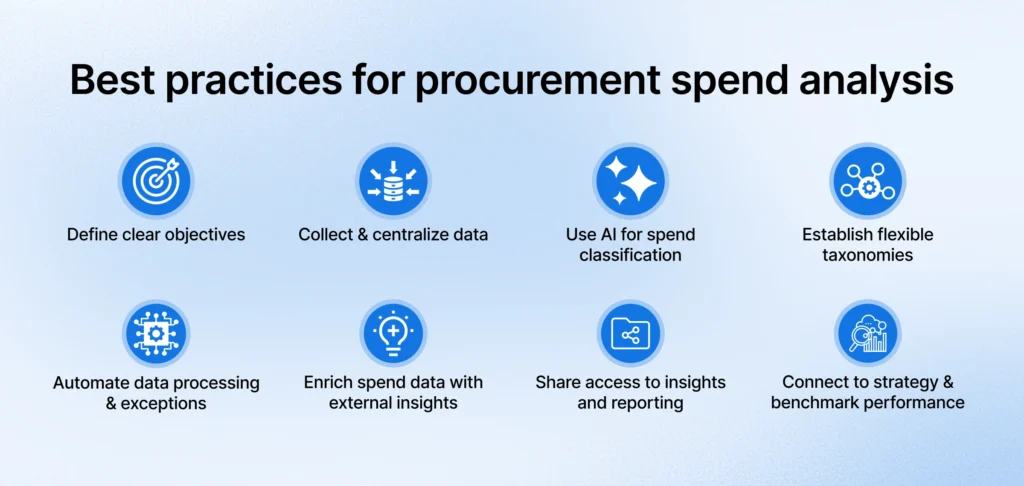
8 best practices for procurement spend analysis
Spend analysis differs across organizations. Hence, while there’s no textbook way to administer spend analysis in procurement, there are certain proven ways you can ensure it’s more effective for your business. Start by defining clear goals and objectives, collecting and centralizing data from all sources, and ensuring data is clean, consistent, and categorized to help identify savings opportunities and manage risks. Here are the key practices companies can adhere to to generate actionable insights and ensure they make wise decisions.
1. Define clear objectives early
Before diving into spend data, set clear goals for your analysis. Whether the focus is cost reduction, supplier performance, or compliance, clear objectives for your spend analysis and e-sourcing strategy guide a structured, repeatable analysis process and ensure results align with business priorities.
2. Centralize and unify spend data
Gather data from all internal and external sources. Centralizing data from ERPs, procurement systems, and finance tools creates a single source of truth, improving accuracy and enabling consistent analysis across regions and categories.
3. Use AI for spend classification
AI in spend classification is extremely helpful, as it can gather information that you may have missed. Automation improves speed and accuracy, handles unstructured descriptions, and continuously learns to improve classification coverage at scale, which is the core of modern procurement spend analytics.
4. Build flexible, scalable taxonomies
Once your spend data is classified, develop dynamic category structures that evolve with changing suppliers and sourcing strategies. Flexible taxonomies prevent rework and ensure consistency as procurement needs change.
5. Automate data processing and exceptions
Spend analysis is truly effective when you have structured data. Automated pipelines, self-healing logic, and exception workflows help maintain data quality while routing low-confidence transactions for review.
6. Enrich data with external benchmarks
Make your data more relevant to industry standards. Combining internal spend with external benchmarks, pricing indices, and ESG metrics adds context, highlights savings opportunities, and supports risk-aware decisions.
7. Democratize access to insights
Insights should be available to everyone. Self-service dashboards, filtering by supplier or category, and natural language queries help stakeholders act faster and align decisions across teams.
8. Connect insights to action and benchmarking
Make your spending data valuable by aligning it with your goals. Linking insights to sourcing actions, performance tracking, and peer benchmarking ensures continuous improvement within procurement and spend analytics.
How Procol AI helps in procurement spend analysis
Procol delivers AI-powered procurement spend analysis that turns data chaos into actionable insights. Trusted by enterprises like Signature Global, our ERP-integrated platform offers real-time visibility into spend and performance, enabling faster collaboration, smarter decisions, and cost savings.
Our Spend Analytics AI agent centralizes procurement data, removes manual bottlenecks, and leverages dynamic workflows, automated approvals, and intelligent audit trails. Teams can identify savings opportunities, streamline processes, and make confident, data-driven decisions.
Signature Global, a leading real estate company, achieved a 40% reduction in PR-to-PO time, 14% cost savings, and successfully routed 700+ Cr+ in spend through the platform. From sourcing optimization to real-time spend tracking, Procol empowers procurement and finance leaders to uncover hidden savings, strengthen supplier relationships, and drive measurable business impact. Read more about this success story in detail here.
Shivangi is a Senior Content Marketer specializing in B2B SaaS, procurement, and enterprise technology. She creates research-driven content that helps procurement leaders and business decision-makers navigate AI, digital transformation, sourcing, and spend management. Her work focuses on turning complex industry developments into clear, practical, and actionable insights.
Schedule a Demo
We’d love to hear from you. Please give us a call on +91 76666 82222.
Explore more from Procol
Discover expert tips, how-to guides, industry insights, and the latest procurement trends.
10 Best Procurement Software for Businesses of All Sizes
Looking for the best procurement software companies? Compare the top 10...

Younus Sideeq • August 10, 2026

Ultimate Guide to Japanese Reverse Auction in 2026
Japanese reverse auctions offer procurement teams a smarter way to drive...
Younus Sideeq • July 9, 2026

Reverse Dutch Auction: What It Is and How It Works
Procurement teams today are expected to reduce costs, shorten sourcing cycles,...
Younus Sideeq • July 9, 2026