Rutuparna Rout • December 2, 2025
The complete guide to spend analysis in procurement | Procol

Nyla UddinContent Writer
Last update: December 2, 2025
28 min read
In today’s business environment, understanding where your money goes is just as important as earning it. It’s the key to staying competitive and ensuring your operations stay sustainable. Spend analysis in procurement helps you do that by giving you a well-rounded view of your spending, uncovering hidden issues, and driving better financial decisions. And with AI and automation becoming everyone’s go-to these days, it’s doubly important for businesses to start now and start strong. This blog will explain why spend analysis is so essential, how the process works, the benefits of conducting a timely review, benchmarking, and KPI monitoring, and the best tool in the procurement industry to give you a holistic view of your processes. Keep reading to learn more.
What is spend analysis in procurement?
Spend analysis in procurement is the process of collecting, cleansing, classifying, and analyzing an organization’s expenditure data to gain visibility into aspects such as spending patterns, supplier performance, and cost-saving opportunities. This process also enables organizations to improve efficiency and strategize their spending.

What is the importance of spend analysis?
Spend analysis is essential for procurement teams as it provides organizations with visibility into their spending, which helps them identify areas where they need to reduce costs, improve process efficiency, and make smarter decisions about budgeting and supplier relationships. Analyzing expenditure data helps companies stay informed and protects them against numerous risks that come with untracked spending.
Procurement spend analysis helps identify inefficiencies and bottlenecks that delay the procurement process and hinder relationships, such as duplicate suppliers, poor contract terms, or uncontrolled spending. Simultaneously tracking these areas enables better forecasting and budgeting. It was found that businesses that use intelligent spend analysis tools and software often reduce manual data workload up to 90%, identify savings 3-5x faster, and improve negotiation outcomes by 15-25% through real-time insights and benchmarking.
Furthermore, as AI tools gain popularity in the procurement landscape, spend analysis automation is being adopted by organizations worldwide, supporting the continuous evolution of procurement strategies. Spend analytics in procurement helps leaders turn spreadsheet data into decisions that help them gain control over their performance and ensure they meet organizational goals.
How does the spend analysis process work?
Spend analysis in procurement is a structured and formal process that involves collecting, cleansing, classifying, and analyzing expenditure data to uncover cost-saving opportunities and improve efficiency. The process may be tailored to each organization depending on its unique needs and goals; however, the following steps are widely recognized as the common process of how to conduct an efficient spend analysis.
1. Identify all sources of spend data
A strategic spend analysis process starts by gathering data from every system and business unit, including ERP, accounts payable, e-procurement, expense management platforms, and global mass payments. All data, from structured to unstructured, should be uploaded into a centralized platform, as the information will have to be put into the general ledger of the organization. This should cover direct, indirect, and service spend to provide a complete view of organizational expenditures.
2. Aggregate data
All data must be complete, connected, and continuously refreshed, combining the data into one organized environment. This process happens automatically, and no manual uploads are to be done, as that can result in errors and overlaps. Hence, automated extraction from multiple systems speeds up the cycle, while external data enrichment adds valuable context.
3. Cleanse, de-duplicate, and standardize data
Cleansing raw data is important to prevent mishaps. It is essential to prepare the data for analysis. Here, use AI, which is the preferred method, to remove duplicates, normalize supplier names, standardize formats, and correct minor errors. This ensures accuracy and allows data from disparate sources to be reliably analyzed.
4. Categorize spend data
Spend analysis tools organize expenditure into coherent and meaningful direct and indirect categories, which group similar types of spend together to avoid confusion. Classified data helps in faster and more detailed analysis, and also enables better insights, helps spot spending trends, and efficient management of supplier performance.
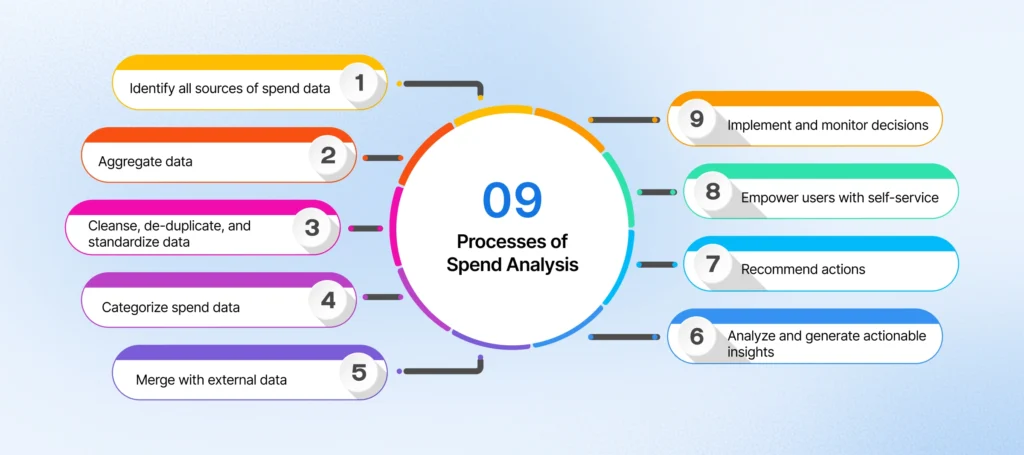
5. Merge with external data
Combine internal data with external intelligence, such as benchmarking, supplier profiles, ESG scores, and market trends. This enriches the data and gives it context and relevance instead of being scattered numbers, and makes it truly strategic, supporting further decision-making.
6. Analyze and generate actionable insights
Apply analytics workflows and AI-driven predictive modeling to identify trends in your patterns, forecast future spending rates, quantify and validate savings opportunities, and flag risks like supplier dependencies or contract non-compliance. AI highlights key areas and gives teams insights that they once spent weeks digging through files for, making data analysis more relevant and sustainable.
7. Recommend actions
It’s crucial to translate the insights generated in the previous step into actionable recommendations. One can only gain the true value of spend analysis by executing these insights and ensuring they deliver. Guided actions give meaning to spend analytics in procurement and suggest cost savings, supplier consolidation, working capital improvements, vendor communication, and sustainability measures.
8. Empower users with self-service
Procurement leaders, finance partners, and other stakeholders must be able to directly communicate with, edit, and review spend analysis data. Conversational and self-service tools help explore data, ask questions in plain language, and act on insights immediately, without depending on technical specialists to help out. An intuitive and conversational interface guides users through complex data with ease.
9. Implement and monitor decisions
After executing the guided actions, measure results and, accordingly, repeat the cycle. Spend analysis is conducted regularly and is not simply a one-time operation. Make impactful changes that contribute to the betterment of your procurement process, ensuring strategic impact and continuous optimization.
What are the types of spend analysis in procurement?
Spend analysis is an essential part of procurement as it helps organizations track, consolidate, and optimize their spending. There are numerous types of analysis conducted in the process, namely supplier spend analysis, category spend analysis, tail spend analysis, and item spend analysis. All of these categories help teams enhance operations and identify major and minor areas in which they can enhance efficiency. Here are the key types of spend analysis in procurement examples, further explained.
1. Direct spend analysis
This type of analysis focuses on the costs directly associated with materials and services needed to produce your final product. With direct spend analysis, you get a clearer picture of the goods necessary for your business. These may include raw materials, components, and production-related services. Properly understanding and conducting direct spend analysis allows businesses to optimize their sourcing strategy and identify key suppliers for critical operations.
2. Indirect spend analysis
Indirect spend refers to the money spent on non-product-related activities, such as office supplies, utilities, marketing services and materials, and software subscriptions. These expenses are not directly connected to product creation, so they might not seem significant, but indirect spend can represent significant costs. It’s crucial to analyze this category just as well, as businesses can discover hidden problems and find opportunities to reduce expenses across various departments.
3. Supplier spend analysis
This type of procurement spend analysis looks at how much your organization is spending with each supplier. Businesses can identify key suppliers and assess their dependency risks simply by understanding their spending patterns. With this analysis, you can decide whether to diversify your supplier pool and eliminate the risks of relying heavily on a single supplier. Additionally, businesses can find opportunities to consolidate supplier relationships for better pricing and terms.
4. Category spend analysis
Category spending analysis is the process of grouping spending to create a defined hierarchy to identify issues faster. These groups include IT, marketing, or manufacturing, to name a few. Conducting this review helps you see which of the areas are consuming most of your resources and allows you to prioritize their spending based on strategic value. It also enables you to identify which categories pose the greatest chance for savings. This is one of the spend analytics in procurement that highlights opportunities for better contract negotiations.
5. Item-level spend analysis
Item-level analysis focuses on individual products and classifies them to determine which product consumes your funds the most. It identifies which department utilized it and which supplier it was for. This analysis helps in discovering discrepancies and potential opportunities for bulk buying or consolidation. Additionally, businesses can also identify leakages and maverick spending.
6. Payment term spend analysis
This analysis focuses on the payment terms negotiated with suppliers and how these terms impact your cash flow and purchase-to-pay process. Payment term spend analysis allows you to find better terms for negotiation, early payment discounts, or better payment conditions. This identification improves financial stability and reduces overall costs.
7. Contract compliance spend analysis
Contract spend analysis in procurement ensures that companies stay in compliance with their negotiated contract terms and aren’t participating in purchases that were not agreed to. Therefore, this analysis identifies possibilities of contract leakage, where spending falls outside the procurement negotiation terms. Ultimately, it helps businesses enforce better compliance.
8. Tail spend management
Tail spend refers to low-value, high-frequency purchases. These expenses are smaller and are usually overlooked, but they may impact your bottom line significantly and create inefficiencies. Tail spend analysis helps consolidate these purchases and reduce the number of suppliers to only preferred or key suppliers. Therefore, this comprises budget as well as vendor management, helping businesses reduce costs by focusing on these frequent but minor transactions.
9. Maverick spend control
Maverick spending happens when purchases are made outside of the approved procurement process or with unfamiliar vendors. Doris Carreon, the Merchandising Director at JGOC Group, says maverick spending is considered malpractice and should be avoided at all costs. Maverick spends analysis catches and controls this nature of reckless spending. Organizations can identify unauthorized purchases and ensure adherence to procurement policies, preventing unseen costs and improving procurement discipline.
10. Automated insights for cost savings and risk mitigation
Modern procurement and spend analytics use automated recommendations to highlight potential areas for cost savings and risks or leakages in existing processes. These systems continuously analyze procurement spend data and flag areas to consolidate suppliers, renegotiate terms, or eliminate risks such as non-compliance or maverick spending. This automated process helps procurement teams act fast and strategically.
11. Conversational analytics for real-time insights
Conversational analytics allows procurement professionals to interact with spend data using simple and natural language, enabling them to ask questions to the software directly instead of manually sifting through reports. Users can clarify queries such as “How much did we spend on travel this quarter?” and receive immediate, actionable insights based on the nature of their question. Additionally, all responses are summarized and presented to the user in a readable interface that does not require prior technical knowledge.
12. Multidimensional spend cube
The spend cube is one of the spend analysis tools for procurement that allows teams to analyze data across multiple dimensions, such as suppliers, corporate business centers, and categories. This cube allows you to look at vast amounts of data from various angles, only in a more comprehensive and simplified way. This way, businesses can identify patterns, improve sourcing strategies, and discover savings opportunities that traditional analysis methods might overlook.
What are the benefits of spend analysis in the procurement process?
Spend analysis in procurement is vital as it brings many benefits to the overall process. These include reduced costs through better negotiation and costs by identifying savings opportunities, improving operational efficiency, streamlining procurement processes, consolidating vendors, and eliminating risks by increasing compliance and supplier visibility. Here’s a detailed elaboration of each of the benefits.
1. Cost reduction
Spend analysis gives you more visibility into your finances, allowing you to see areas in which you can save more. Conducting a regular analysis helps you identify inefficiencies and stop spending unnecessarily on items you don’t immediately require. Companies can gain insights into duplicate purchases, maverick spending, and benchmark their suppliers. Additionally, the introduction of AI and smarter platforms helps businesses catch angles they might have missed.
2. Increased spend visibility
Spend analysis gives companies a clear view of every expense and also provides actionable insights. Procurement teams can get a better understanding of the metrics that encourage improved cost savings, process efficiency, and supply chain performance. Also, spend analysis provides a detailed look into how money is spent, going beyond simply tracking expenses. Businesses can track spend by category, supplier, and department, helping maintain compliance and accountability.
3. Time savings and efficiency
By automating and centralizing spend data, spend analysis drastically reduces manual effort. With the help of AI automating tasks like data cleansing, supplier classification, and categorization, time spent on these tasks is significantly reduced, enabling teams to focus on identifying opportunities for reducing spend and managing supplier collaboration better.
4. Enhanced supplier management
With spend analysis, you can gain insights about the performance of all your suppliers. Digital platforms help evaluate suppliers based on aspects such as delivery times, product quality, adherence to contract terms, and compliance. This evaluation helps you identify top-performing suppliers and those that require improvement. Some analysis tools for procurement include setting procurement KPIs for suppliers to assess impact and gauge which relationships to further invest in or replace.
5. Risk mitigation and supplier stability
Spend analysis helps identify potential risks and ensure compliance by tracking off-contract spending and vendor behaviour. AI-driven monitoring helps companies see unusual patterns and non-compliant supplier partnerships using their credit scores and ESG information. AI in spend analysis helps companies intervene and make supplier relationships more stable.
6. Improved compliance and spend governance
Companies can strengthen their procurement governance using spend analysis by discovering off-contract purchases and policy violations. This process sets rules that the company and vendors must abide by, such as ensuring teams adhere to approved supplier lists, contract terms, and ethical sourcing practices. Therefore, this ensures organizations maintain transparency and are fully accountable for every dollar spent.
7. Accurate demand forecasting and budgeting
Spend analysis helps in the classification of spending patterns, which means companies can accurately predict demand using historical data and identify common trends that they may need to refine or stop entirely. Teams use cost analysis to spot new sourcing categories, consolidate suppliers, and enhance sourcing potential. By predicting their procurement process, companies can align budgets with business goals.
8. Strategic decision making
Spend management and analysis give you AI-based insights to help you make strategic decisions that center around your goals. Clean and categorized spend data is essential to make faster and more confident decisions that deliver the best results for your business. Here, companies can use AI agents and embedded action items to turn data into a strong procurement strategy that scales without adding overhead.
9. Stronger alignment between finance and procurement
In the procurement process, it’s important for all stakeholders to be aligned with data and decisions. Spend analysis closes the gap between finance and procurement teams by giving them shared visibility into spending data and performance numbers. Recent data from Deloitte highlights how shared communication and strategic alignment between the finance and procurement departments allow integrated operations and ultimately, benefits for the whole company, such as stronger decision-making and more unified financial strategies.
10. Continuous improvement with performance benchmarking
Benchmarking your performance is an industry-approved way to gain a better understanding of your organization’s spending patterns. For example, using a spend management KPI like total spend under management helps you identify key areas for improvement. Additionally, compare yourself to your competitors of similar size and level of activity for a fair comparison and accuracy in your improvement strategies.
What are the KPIs and metrics of spend analytics in procurement?
Strong spend analysis in procurement includes KPIs and metrics to help procurement leaders measure how effectively their teams manage costs, suppliers, and overall purchasing activities. These KPIs include Spend Under Management (SUM), which measures the total percentage of controlled spend in the procurement process, and Cost Savings, which focuses on the financial benefits from activities like negotiations and sourcing. Other important metrics are Spend Visibility, Supplier Performance, Contract Compliance, and Procurement Cycle Time, all of which assess efficiency and control spend across the organization. Here’s an explanation of each.
1. Spend under management
The spend under management KPI measures the percentage of total spend that is actively managed by the procurement team. A higher percentage of spend under management means stronger oversight, better control, and more efficient procurement processes. Additionally, it’s a reflection of how well the organization is able to recognize and control maverick and non-compliant spending.
2. Cost savings
The cost savings KPI assesses the amount of money that is saved through conducting initiatives like supplier negotiations, strategic sourcing, or spend categorization. This measures the impact of procurement decisions and demonstrates how spend analytics directly contributes to company-wide strategic improvements.
3. Spend visibility
Spend visibility tracks how a company manages its spend data, meaning it measures how much of your total spend data is clean, categorized, and easily accessible. High visibility ensures procurement teams can spot inefficiencies, manage suppliers easily, and make smarter, data-driven budgeting or sourcing decisions based on accurate insights.
4. Supplier performance
This KPI tracks how reliable suppliers are and whether they are suitable for an organization. It uses metrics like on-time delivery, quality of goods and services, and contract compliance. Regularly monitoring suppliers and adhering to vendor management KPIs helps strengthen relationships and ensures that vendors continue to meet performance expectations.
5. Contract compliance rate
Contractual compliance KPI is one of the procurement and spend analytics that evaluate the percentage of spend that adheres to negotiated contracts versus off-contract, dark, or maverick spending. A high compliance rate indicates better governance and cost control. Additionally, it also signifies that fewer unauthorized purchases are made.
6. Procurement cycle time
The procurement cycle time KPI measures how long it takes to move from requisition to purchase order. If the procure-to-pay cycle time is shorter, it indicates the presence of faster decision-making, intelligent strategy, fewer disruptions, and better operational efficiency across all procurement workflows.
7. Payment terms compliance
This KPI is rather uncommonly used, but its importance should not be underestimated. Tracking adherence to payment terms helps organizations maintain positive and professional supplier relationships while also getting early payment discounts. Late or inconsistent payments can negatively impact supplier trust and lead to missed financial opportunities.
8. Supplier consolidation
This KPI helps monitor the supplier count and the spend concentration among them. This helps identify opportunities to consolidate vendors into more organized groups for better cost management, negotiate fair pricing, and reduce complexity. Strategic supplier management can lead to better partnerships and improved terms.
9. Spend by category
This KPI breaks down spend into categories, particularly direct and indirect expenses. This is done to help procurement teams pinpoint high-cost areas and optimize their sourcing strategies accordingly. It gives them a broad yet comprehensive picture of the exact areas where budgets are being allocated across departments in the organization.
10. Operational efficiency metrics
Measuring operational efficiency gives procurement heads a 360-degree view of all financial activities. There are several operational KPIs, such as purchase order accuracy, invoice processing time, and employee productivity. Tracking these KPIs closely is an integral part of spend analysis in procurement as it improves accuracy and reduces administrative workload.
Benchmarking in procurement and spend analytics
One of the important spend analysis tools in procurement is benchmarking. This is the process of systematically comparing an organization’s performance, costs, and processes against industry standards or top-performing competitors to discover strengths, weaknesses, and areas of improvement. Internal data is useful for giving you insights into how your own operations are performing, but it is unable to reveal how well you’re performing compared to the market. In spend analysis in procurement, benchmarking adds extra value by offering an external reference. You can think of it as comparing yourself to the high players in the industry to see where you can improve to be as efficient as they are. These reference points validate your success, highlight opportunities, and support smarter decision-making. Therefore, procurement benchmarking helps optimize strategies for better cost savings and operational maturity.
In spend analytics, benchmarking turns raw data into insights you can use to improve. By measuring procurement KPIs that were talked about earlier, such as payment terms, supplier performance, or cost savings, you can gauge your performance against industry averages. This helps in further understanding where you stand competitively in the market. Additionally, benchmarking plays an important role in supply chain risk management, helping procurement leaders identify gaps between current processes and industry best practices. It encourages collaboration between procurement and finance and helps you make more confident and profitable negotiations.
What are the types of benchmarking?
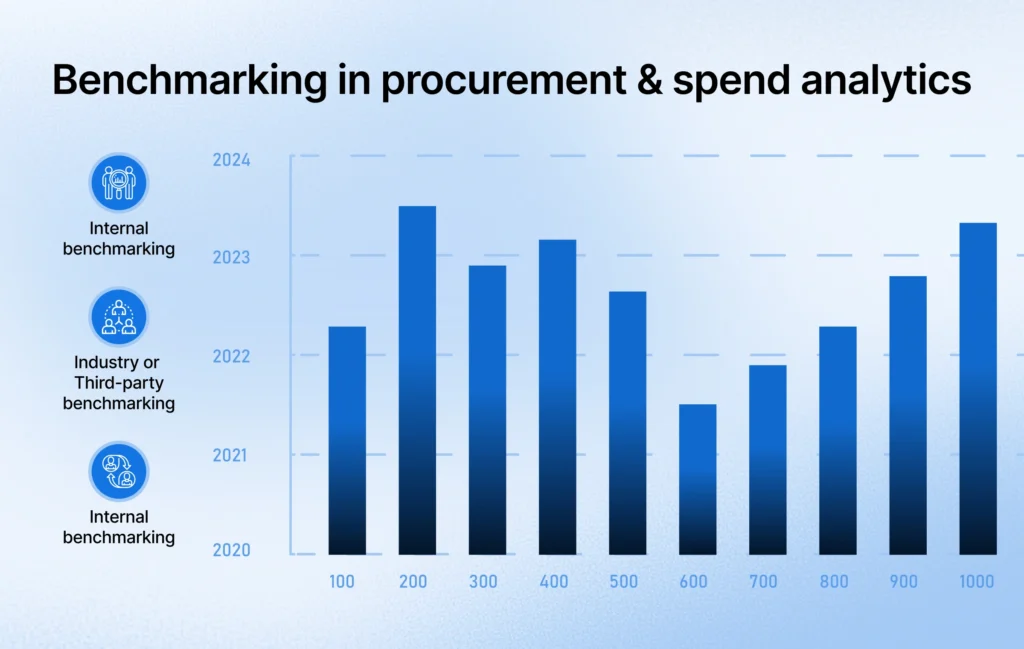
- Internal benchmarking: Compare spend and procurement KPIs across your own business units or time periods to track progress and ultimately enforce new internal standards.
- Industry or third-party benchmarking: Measure performance against broader industry averages or reports to uncover trends and areas for improvement.
- Peer-based community benchmarking: Use anonymous, aggregated data from global peers to set realistic targets for your performance based on real-world spend data.
Key benefits of benchmarking:
- Identifies hidden opportunities and inefficiencies.
- Strengthens negotiations with data-backed insights.
- Ensure stakeholder alignment through transparent performance metrics.
- Enhances procurement maturity and competitiveness.
- Informs strategic planning and risk management.
Therefore, benchmarking is a helpful comparison, but it also relies heavily on context. When done strategically, it gives you a procurement transformation roadmap for your spending and helps you continuously improve to stay competitive in the evolving procurement industry.
What are the types of spend analysis tools?
Spend analysis in procurement is conducted using various tools that streamline the process and make managing data more organized. These come in various forms, ranging from spreadsheets and business intelligence (BI) platforms to specialized spend analytics software. Each of these tools offers a different level of automation, scalability, and analytical depth based on the operational needs and size of your organization. Explained below are the main types of spend analysis tools for procurement and their pros and cons.
1. Spreadsheets (Excel-based tools)
Spreadsheets are considered the most common and accessible tools for conducting spend analysis. Consider them the “go-to” tool, especially among small to mid-sized organizations. They allow users to create formulas, pivot tables, and charts to customize spend tracking. However, tools like Excel are limited and useful only for basic analysis, unable to handle large datasets or scale to complex procurement environments.
Pros:
- Accessible and familiar: Most procurement teams already use Excel, which makes the learning curve less intimidating.
- Flexible and customizable: Allows tailored reporting and analysis through custom formulas and charts.
Cons:
- Error-prone and time-consuming: Spreadsheets tend to rely heavily on manually entered data, increasing the risk of mistakes.
- Limited scalability: Struggles with large datasets and lacks automation for cleansing or classification.
2. Business intelligence (BI) tools
BI tools are software applications used for the visualization and analysis of large datasets using dashboards and reports. These tools are quite commonly used across various departments in a business, but they’re ideal for spend analysis, especially for organizations needing real-time and detailed insights into their spending patterns. However, they require significant configuration and may not offer procurement-specific features.
Pros:
- Enhanced data visualization: Create interactive dashboards that help procurement teams see trends and spot inefficiencies.
- Real-time analytics: Real-time data processing gives precise insights that enable faster decision-making.
Cons:
- Complex setup and high costs: Require extensive customization for procurement organizations and become complex. It also comes with a high total cost of ownership (TCO).
- Limited procurement focus: Lacks built-in procurement KPIs and features found in dedicated spend analysis software.
3. Dedicated spend analytics software
Spend analysis in procurement can be conducted precisely with dedicated software that’s built to fit the needs and demands of an organization and its processes. Spend analysis software gives deep insights into company-wide spend. They automatically cleanse data, classify it, and turn it into intuitive reports that are structured by AI-driven insights or strategic sourcing and supplier optimization.
Pros:
- Procurement-specific intelligence: Comes with pre-built KPIs, automated classification, and advanced reporting.
- Scalable and automated: Easily handles and quantifies large volumes of data while reducing manual workload.
Cons:
- Higher implementation costs: More expensive upfront than spreadsheets or generic BI tools.
- Requires onboarding and integration: May require advanced technology and need time to integrate with ERP or supplier systems.
Features to look for in spend analysis software
Choosing the right spend analysis software for your business starts with understanding its key features. To ensure the software you choose complements your existing tools well, look for features like data integration and cleansing to create a comprehensive and accurate view of spend data, customizable dashboards and AI-powered analytics for real-time insights, and robust reporting tools for tracking cost-saving opportunities and monitoring supplier performance. Here’s a detailed breakdown of the must-have features in your software to make the most out of spend analysis in procurement.
1. Comprehensive data integration
The spend analytics software of your choosing should integrate with existing financial, ERP, and supply chain systems to provide a consolidated view of all procurement data in one place. This unified view makes it less time-consuming to go through data and keeps it ready for analysis.
Key features:
- Processes high volumes of data
- Consolidates data from multiple sources
- Ensures data accuracy and integration
2. Real-time dashboards & reporting
Customizable dashboards give real-time insights into spend metrics. A procurement spend analysis dashboard categorizes data and prevents duplicate entries, enabling teams to make informed decisions to improve procurement efficiency.
Key features:
- Interactive dashboards for quick insights
- Real-time reporting for timely actions
- Enhancing datasets with historical information and market intelligence
3. AI-powered analytics
AI reporting and analytics capabilities give teams procurement-specific insights, which allow them to tailor their efforts better and uncover category-wise savings opportunities. Teams can predict trends and automate data analysis, which would normally take weeks to accomplish. Automation in spend analysis encourages better decisions and helps in identifying areas for improvement.
Key features:
- AI-driven insights for cost savings
- Predictive analytics for future trends
- Immediate action items powered by AI agents
4. User-friendly interface
A simple, intuitive interface significantly reduces training time and helps all team members easily adapt to the software. Prioritize tools that don’t have such a steep learning curve and come with 24/7 support. Also, look at the ease of use for both desktop and mobile users.
Key features:
- Easy navigation with minimal training
- Mobile-friendly for on-the-go access
- Ensures team collaboration even remotely
5. Scalability & flexibility
Spend analysis tools for procurement should scale easily with your organization, no matter how complex your operations become. They should be capable of adapting to new procurement needs and be usable long-term.
Key features:
- Scales with your organization’s growth
- Adapts to evolving procurement systems
- Requires minimal to no manual updates or maintenance
6. Security & compliance
The software should meet data security requirements and comply with relevant industry and company regulations. Spend analytics in procurement should always be lawful and protect the sensitive procurement information.
Key features:
- Ensures data protection and privacy
- Complies with industry regulations
- Uses role-based access control
7. Customizable reporting & analytics
Choose software that offers you customized reports that measure your performance against market standards, so you know exactly where to improve. Detailed analytics help meet specific and even complex procurement needs and business goals.
Key features:
- Custom reports for detailed analysis
- Tailored insights for better decision-making
- Offers visual dashboards that simplify data
8. Peer benchmarking & external insights
The software that’s completely devoted to your business and customized for your operations will help compare your procurement performance with industry peers through anonymized data aggregation. This will help you evaluate your performance and optimize your procurement strategy.
Key features:
- Benchmark payment terms and pricing trends
- Provides external performance insights
- Sends out automated supplier change alerts
9. AI-powered data cleansing & enrichment
You shouldn’t be crunching numbers and sifting through spreadsheets. AI helps automatically clean and categorize your spend data, which helps in enhancing accuracy and consistency while also reducing manual effort.
Key features:
- Automates data categorization and cleanup
- Enriches data with external benchmarks
- Identifies duplicate entries across all systems
10. Invoice processing & automated workflows
Automated invoice processing and approvals reduce manual errors and speed up approval workflows. This increases process efficiency and team productivity.
Key features:
- Streamlines invoice processing
- Automates workflow approvals
- Simplifies repetitive approval tasks
8 best practices for procurement spend analysis
Spend analysis differs across organizations. Hence, while there’s no textbook way to administer spend analysis in procurement, there are certain proven ways you can ensure it’s more effective for your business. Start by defining clear goals and objectives, collecting and centralizing data from all sources, and ensuring data is clean, consistent, and organized. Here are the key practices companies can adhere to generate actionable insights and ensure they make wise decisions.
1. Define clear objectives
Before diving into spend data, set clear goals for your analysis. If you know whether you want to reduce costs, improve supplier performance, or enhance compliance, it guides a transparent and repeatable process. This ensures that your spend analysis delivers results that scale.
2. Collect and centralize data
Gather data from all internal and external sources. This means that you need to extract data from your ERP systems, procurement platforms, and third-party vendors. So, instead of having confusing and scattered data, you’d be able to start off your cost analysis with a single source of truth, which helps in an accurate and consistent analysis across categories and regions.
3. Use AI for spend classification
AI in spend classification is extremely helpful, as it can gather information that you may have missed. Use machine learning to automate spend classification, reduce errors, and increase speed. AI can handle line-level or unstructured descriptions, identify potential spend categories, and continuously refine accuracy to cover 98%+ of transactions.
4. Establish flexible taxonomies
Once your spend data is classified, develop dynamic category structures that evolve with changing suppliers and sourcing strategies. These are more stable than rigid structures that are only good for temporary use, but are unable to scale with business units. Additionally, use predictive classification and AI-driven suggestions to maintain global consistency and forecast new category requirements.
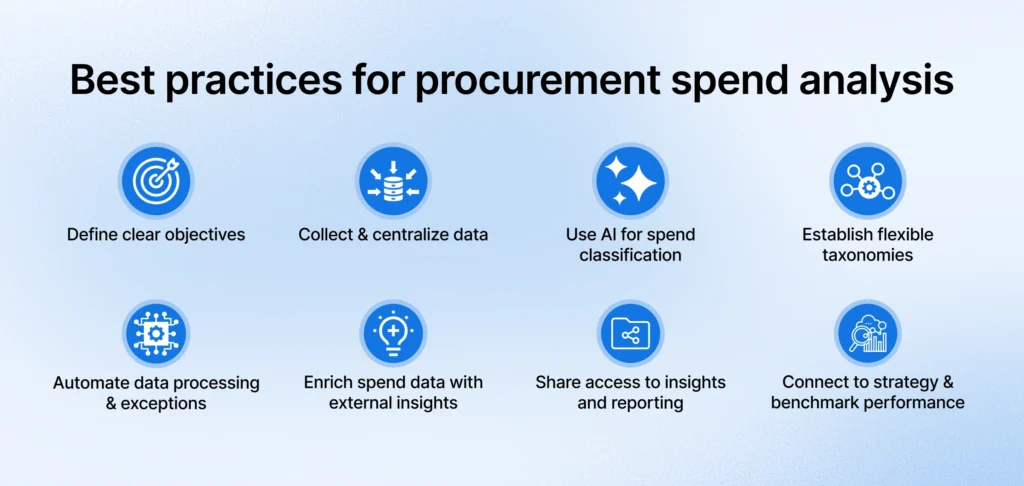
5. Automate data processing and exceptions
Spend analysis is truly effective when you have structured data. For this, you need to set up automated data pipelines and self-healing logic to clean and validate incoming data. Implement workflows for exceptions, which route low-confidence or unauthorized transactions to the right analysts for review, and normalize supplier information.
6. Enrich spend data with external insights
Make your data more relevant to industry standards, as this helps in setting attainable goals for your financial processes. Do this by combining your current internal spend data with external benchmarks. Also, remember to compare your data with competitor price indices and ESG metrics. This additional context is helpful in highlighting areas where you can save more and ensure your practices are sustainable and compliant.
7. Share access to insights and reporting
Insights should be available to everyone. Make them accessible through self-service dashboards and collaboration tools. Another tip is to ensure data filtering by supplier, region, category, and time period to make the data easier to read through. Additionally, allow natural language queries that answer common questions that stakeholders may have.
8. Connect to strategy and benchmark performance
Make your spending data valuable by aligning it with your goals. Use action items to refine categories, manage supplier planning, and allocate budgets more effectively. Benchmarking against industry players helps you spot common trends that make them win, evaluate pricing and payment terms, and identify areas for improvement.
How Procol’s software helps in spend analysis in procurement
Procol’s procure-to-pay software offers spend management capabilities that help businesses manage their spend in a more intelligent and easily navigable manner. Our software brings automation, visibility, and intelligence to every transaction. Teams can tailor our custom approval workflows to the needs of their organization, while ensuring the right leaders approve activities on time. The inbuilt communication aligns buyer and supplier communication and allows faster and more transparent query resolution. We also offer OCR-based 3-way matching that ensures every invoice, PO, and receipt aligns with the purchased items, removing expensive errors.
The highlight of our software that empowers spend analysis in procurement is our AI-powered spend analysis feature, a built-in engine that uncovers hidden patterns, predicts spending trends, and helps teams make smarter decisions. Additionally, it’s supported by a mobile-friendly design, which enables teams to monitor and act on insights anytime, anywhere. And with our newly launched AI Spend Analytics Agent, businesses move beyond reports to real-time recommendations and action items that optimize their procurement strategy and unlock true savings potential.
Conclusion
Conducting spend analysis in procurement doesn’t revolve only around tracking expenses. It’s a much deeper and detailed process, but it’s also equally rewarding. It’s how you can turn data into a strategic advantage. When procurement teams have complete visibility into their spending, they can focus on strategizing, optimizing expenditure, planning budgets, and strengthening supplier relationships. This blog covered a variety of topics, from explaining why spend analysis is a must-have in your organization, to the best practices you can implement to ensure it stays successful. AI-powered solutions like Procol make the spend analysis process simple and result-oriented, offering real-time insights and automation that deliver. So, choose Procol today and build a smarter and more resilient procurement organization.

Frequently asked questions
What is an example of a spend analysis?
An example of a spend analysis is when a manufacturing company discovers multiple departments purchasing the same safety equipment from different vendors. This discovery reveals many inefficiencies and consolidation opportunities to reduce costs and streamline supplier management.
How to perform a spend analysis?
To perform a spend analysis, start by defining objectives, collecting and consolidating data from all sources, then cleaning, categorizing, and analyzing it to identify savings opportunities, supplier overlaps, and areas for improved procurement efficiency.
What is the main objective of conducting a spend analysis?
The main objective of conducting a spend analysis is to enhance visibility into organizational spending. Its aim is to reduce costs, improve procurement efficiency, and ensure compliance with internal policies and supplier contracts.
What is a spend analysis tool?
A spend analysis tool is a data visualization tool, also known as a procurement spend analysis dashboard, that provides organizations with a clear and interactive view of a company’s procurement operations and expenditures.
What’s the difference between spend analysis and spend visibility?
Spend visibility is the foundational step of analyzing and tracking where an organization’s money is spent, whereas spend analysis is the process of using that data to find opportunities for cost savings.
What if spend data is fragmented or unreliable?
Fragmented or unreliable spend data leads to poor decision-making, missed savings opportunities, compliance risks, and inaccurate insights. This is why it is crucial to centralize, clean, and validate data regularly for accurate procurement analysis.
How often should a company conduct spend analysis?
A company should conduct spend analysis at least once a year. However, more frequent reviews are beneficial.
Schedule a Demo
We’d love to hear from you. Please give us a call on +1 (209) 305-4922.
Explore more from Procol
Discover expert tips, how-to guides, industry insights, and the latest procurement trends.
eSourcing strategy: Maximizing savings & efficiency in procurement
The procurement function is a central pillar of success, continuously managing...

Supplier relationship management strategies : The complete guide
In today’s complex business environment, successful operations depend heavily on strong,...

Understanding auction bidding strategy in 2025
An auction bidding strategy includes preparing a budget, bidding strategically, and...