





Guide to reverse auction: Process, types & benefits (2026)

Last update: April 15, 2026
Reverse auctions are a modern and proven way to manage procurement in today’s business world. They benefit both buyers and sellers, providing a competitive yet favourable environment for everyone. An article by Procbay says that companies using reverse auctions report an 18-20% increase in cost savings compared to traditional sourcing methods. Need more proof? Well, keep reading! In this blog, we’ll talk about exactly how the process works and introduce you to the many types of auctions. This blog also talks about the benefits of a backward auction and lists the best practices to help you conduct it better.
Key Takeaways
What is reverse auction?
A reverse auction is an online process in procurement during which sellers compete with each other to offer the lowest price to buyers. The buyer, or the company, sets the terms and the specifications for the goods or services they need, and then the sellers lower their prices as more bids come. The one with the lowest price is selected and awarded the contract.

How do reverse auctions work in procurement?
Reverse bidding takes place on an online platform on which many sellers compete with one another by offering the lowest possible prices on goods and services. These are real-time bidding events, which start with the buyer sending out an RFP (request for proposal), which tells suppliers exactly what they need.
After this, suppliers submit their proposals to confirm that they have the goods to meet the company’s needs. Then, the online reverse auction process finally begins, where all of the suppliers are required to present their bids and go up against one another. This is different from traditional auctions, where prices increase. In the case of a reverse bid auction, sellers try to offer the best deal to the buyer.
The auction ends either when the bidding time closes or when no supplier wants to reduce their prices anymore. It is then up to the buyer to select the supplier and offer that aligns with their needs the most.
What are the types of reverse auctions?
The main types of reverse auctions are ranked and open/English auctions. There are other styles as well, and they are quite interesting, such as Japanese, Dutch, and sealed bid auctions. It is important to know each and understand the role it plays in the procurement process. Here are the types of reverse auctions.
1. Ranked reverse auction
In a ranked auction (also known as a British reverse auction), suppliers are given ranks in real time based on their bids. In this type of auction, suppliers can see the ranks of others but not the exact bid, so they are essentially just trying to offer a more competitive bid. Buyers have the ability to rank sellers by price or quality and even delivery times. This type of reverse bidding requires strategy, as only ranks and not specific bids are available.
2. Open/English reverse auction
As the name makes quite clear, an open reverse bid auction is a very transparent format, and it is used when price is the main factor. In this auction, suppliers can see the current lowest bid, and they have to submit a better price than that to stay competitive. Price is the main thing that is looked at here, but if it’s what the buyer wants, they may still weigh factors such as quality and other requirements before a final decision.
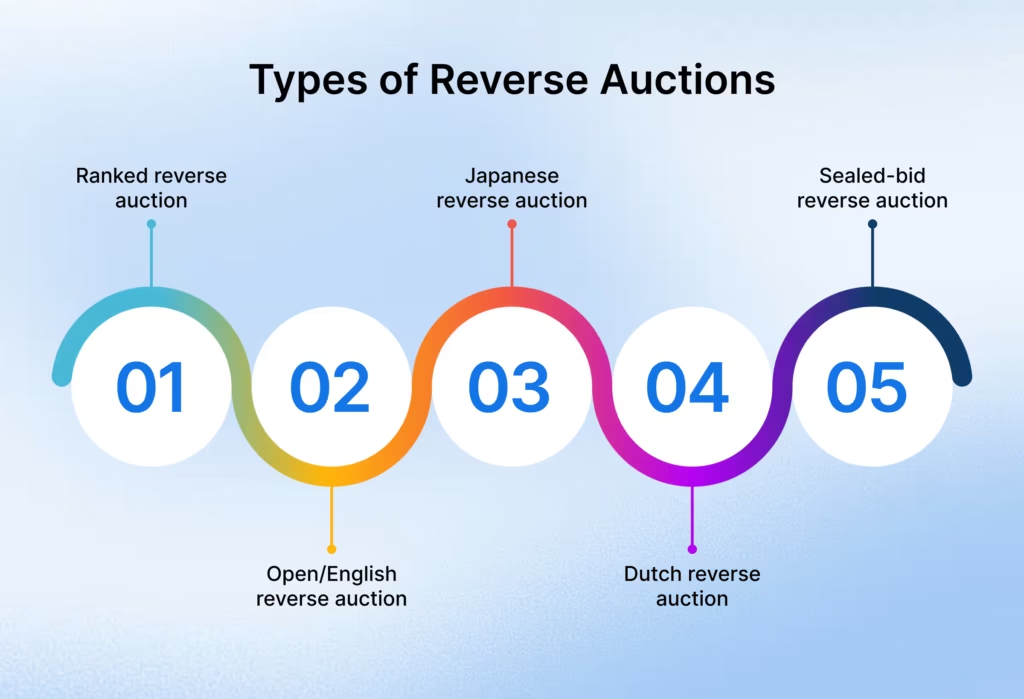
3. Japanese reverse auction
In a Japanese reverse e auction, the buyer sets a starting bid that all suppliers must accept to begin the event. The price increases at certain times, which are decided by the buyer as well, and only the price and the countdown timer are visible to suppliers. The timer will continue to count down as the event goes on, and the price keeps dropping until no supplier wants to reduce their price. This is when they must choose whether they want to stay or drop out. The last remaining supplier wins the contract.
4. Dutch reverse auction
A Dutch reverse bid auction can sometimes be confused with the Japanese auction, but they are different. In this format, like a Japanese auction, suppliers can only see the price and a countdown timer. In this case, though, the price is purposely set to be very low, and it slowly increases. This is done to make suppliers decide if the pre-set price is acceptable to them. If it is, the first one who accepts the deal wins the auction.
5. Sealed-bid reverse auction
In this type of auction, suppliers submit their best and final bids to the buyer. But the catch is that they must do this privately and cannot see other suppliers’ bids. All of the bids are revealed only after the submission deadline. This is done to ensure fairness, because when suppliers cannot see other bidders, they can submit genuine prices and not be swayed by others. This way, buyers can choose the most suitable bid according to their needs.
What are the challenges of reverse auctions?
Reverse auctions give many benefits to organizations, but implementing and conducting them may have some challenges that stop companies from using them to their full potential. These reverse auction disadvantages are mainly the reduction in quality due to cost-cutting and the administrative complexity being too high. There are other disadvantages as well, such as the auction not being suited to the product demanded. We cover all of these challenges in this section, so keep reading.
1. Overemphasis on price and quality risks
The process of participating in reverse bidding mainly includes suppliers lowering their prices, but if they keep doing that, the quality of products and services may also be reduced. And if the buyer is not careful and focuses too much on only getting the cheapest deal, they may be harming themselves by compromising on these important factors as well.
2. Not suitable for every type of purchase
During a reverse auction, suppliers offer varieties of the same product at different prices, which gives the buyer a lot of choice. But, if the demand is very specific, and let’s say, there are a very limited number of suppliers who offer that product or service, it would become a problem for competition and choice.
3. Supplier pressure and impact on relationships
During an online auction, there is a lot of pressure and competition amongst suppliers to offer the lowest price because their competitors are doing so. And of course, everyone wants to win, so they’d naturally lower their prices, too. But this may also create a strain on relationships if the only focus is on price.
4. Need for clear requirements from the buyer
Before the buyer starts an online reverse auction, they need to be very clear about what they want from the supplier in order for the auction to work properly. Because, suppose they don’t specify the exact quantity or are unclear about the delivery times, it can lead to a lot of confusion and may even impact supplier participation.
What are the benefits of reverse auctions?
Reverse auctions, according to Euna, help buyers save costs and work more efficiently. In fact, for some companies, in the first round of the auction process, savings are nearly 20%. Sometimes, they increase to more than 60% while still getting the best possible price. A reverse e auction provides other benefits as well, such as faster procurement cycles and clear competition for suppliers. Let’s explore some more benefits of backward auctions.
1. Cost savings
During a reverse e auction, suppliers compete by lowering their prices and presenting the best deal to buyers. This results in big cost savings, as reported by many companies, as they notice suppliers offering their most competitive pricing to win the contract.
2. Process efficiency
The online reverse auction process is usually much faster than the traditional way of negotiating. As told by GoComet, automating the reverse auction process leads to 90% faster procurement cycles. This is because multiple suppliers can submit bids at the same time, instead of long discussions, helping make faster decisions.
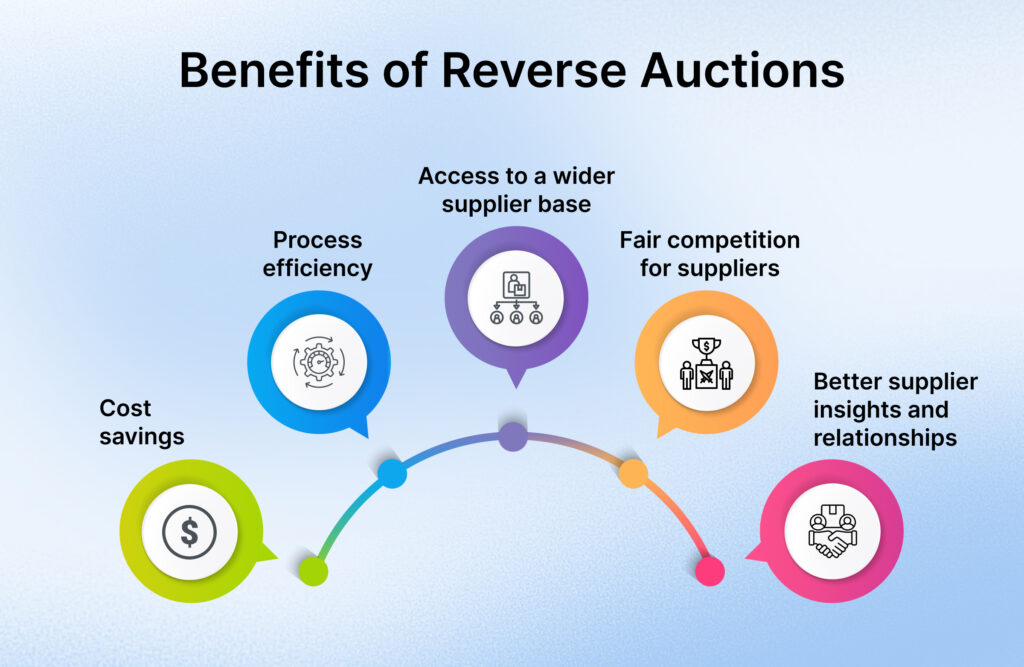
3. Access to a wider supplier base
Reverse e-auctions promote supplier diversity as the event is conducted online, so businesses can invite new suppliers from anywhere to participate. This gives a benefit to both buyers and suppliers as buyers have more bids to choose from, and all suppliers, big or small, get a chance to compete.
4. Fair competition for suppliers
An electronic reverse auction offers suppliers a platform where they can compete without any worry of being overshadowed by other competitors. All sellers have the same rules to follow, so there’s no stress of bias, either.
5. Better supplier insights and relationships
Reverse auction procurement helps buyers understand the market and the demand by gaining information on trends. Once procurement teams understand the patterns in which suppliers bid, they can source more efficiently in the future. Additionally, fair and honest auctions ensure that relationships are strong and built on trust.
How to conduct a reverse auction: step-by-step guide
According to the Center for Advanced Purchasing Studies, using reverse e-auctions leads to 50% more efficient processes, proving their usefulness. However, companies must know how to properly implement them, and that requires them to prepare well and define any specifications for goods. They also must select and pre-qualify vendors before the auction itself, because they should know if the vendors meet their standards. Then, companies can use procurement software to conduct this event. Let’s look at how this process works in complete detail.
1. Prepare for the auction and plan your objectives
This is the first step where you have to decide what you want to achieve with the auction. This is also called pre-auction planning, where you set goals like cost savings, and also where you involve your procurement stakeholders to get their approval.
2. Set auction rules and parameters
This is the stage where you decide on the auction type and how long it is going to take. You should also look at other factors, such as the starting price, if there is any, and if there are specific rules you want to set. Remember not to skip out on any details in the process, as clear rules help keep the e procurement reverse auction fair for all suppliers.
3. Identify and invite qualified suppliers
Use strategic sourcing and identify those suppliers who can actually meet your needs. And when you know who they are, you can invite them easily from the auction software. Also, definitely include all the details in the invitation, such as the date and the expectations from the supplier, so that they can come prepared.
4. Provide training
Some suppliers still may be new, and so they might need some extra training and may have some questions about the reverse auction process. Listen to what they have to say and clear all of their doubts, as this gives everyone an equal chance to participate.
5. Prepare the platform and other logistics
Select a suitable platform, preferably one with AI and automation, so you can begin the auction easily. Make sure you test it enough and answer all the questions suppliers may have about it.
⭐Fun fact: With Procol, buyers can turn an RFQ into a live eAuction in just one click, while suppliers get a fully guided and easy bidding experience!
6. Launch and monitor the auction
Start the auction at the time you’ve scheduled it for and make sure you don’t delay, as it impacts the supplier’s time and efforts as well. While it is going on, track its progress and supplier responses so that you get a clear view of all aspects.
7. Evaluate bids beyond price
When you have all of the bids from the supplier, assess them not only on price but on other more important criteria aside from price. You need to also look at other things, such as the qualifications of the supplier and delivery terms. This ensures that the final decision you make reflects the goals you had set.
8. Award the contract
When you are satisfied with the results of the auction and you end it, you must tell the supplier who won so that you can start to negotiate the terms of the contract. This way, you can make your partnership final and begin the process formally. Also, communicate with suppliers who didn’t win the auction as well, and thank them for their participation.
Best practices of reverse auctions
To ensure your reverse auction is successful, you need to plan and research well. Aside from defining goals and inviting qualified suppliers, you can also consider using AI in your e-auctions. Research from Digital Commerce 360 shows that 85% of procurement leaders have already begun using AI, and 73% have launched AI agents as well. Read on, because we cover all of the backward auction best practices in this section.
1. Clearly define requirements and specifications
Begin the process with a very clear RFP or RFQ that describes the product or the requirement in a precise and detailed manner. It should have specifications such as quantity and delivery timelines, as well as quality terms. Detailed requirements help suppliers submit accurate bids.
2. Invite the right number of qualified suppliers
Invite a small group of suppliers to your reverse bid auction. They should be checked before the invitation is sent to ensure they are qualified and have the products you need. This step helps in more competitive pricing and a better chance of your requirements being met.
3. Plan the auction structure carefully
Plan your auction with a good procurement strategy. Before you set rules, you need to know the auction will actually run. Choose the auction format and set realistic timelines, along with bid criteria. Paying attention to the small details keeps the event organized and ensures suppliers have a level playing field.
4. Communicate and engage with suppliers
Talk with your suppliers before the event and explain the goals and rules of the event. Also, encourage them to share any doubts they might have before the auction because it’s very important that they understand fully how the reverse bidding process works.
5. Use reliable technology to support your auctions
Using a trusted digital platform helps your auctions run very smoothly and makes the process a lot faster. It makes bidding easier for suppliers and helps procurement teams track progress and bids from a single space.
⭐Fun fact: Procol’s eAuction platform helps procurement teams launch and manage reverse auctions quickly. Using our platform, they have a clear and live view of bids and supplier activity from one place.
6. Use data and analytics to guide decisions
Procurement teams should use data to help make predictions and identify patterns that would otherwise be invisible. They can track supplier performance and even adjust current cost patterns based on past spending, helping them make better decisions about auctions.
How Procol’s e-auction platform improves reverse auctions
Procol’s eAuction platform helps teams run auctions in a structured and transparent way. Our platform enables one-click RFQ to auction conversion, which makes the process faster and turns bids into potential offers with just a click. We also offer multiple auction strategies so that buyers may host any type of event they’d like to achieve the best outcomes, and also to encourage healthy competition among vendors. Our auction solution is supplier-friendly, too, providing a chat feature through which suppliers can chat with buyers in real time and clarify any doubts. Procol keeps all auctions transparent and easy to manage for procurement teams.
Procol helped DEI centralize its procurement and sourcing activities on one system. After implementing our solution, the leading digital entertainment company noticed more transparent supplier competition with our live eAuctions and better visibility across all of their sourcing events. As a result, they were able to achieve an 82% increase in supplier participation and conducted 3,500+ sourcing events.

Conclusion
Are you still thinking of a reverse auction as a formality? Well, hopefully not, because by now, it should be obvious that they are a powerful tool for modern procurement teams and actually deliver positive outcomes. They make the overall bidding process better and help buyers secure better deals while also giving suppliers an equal chance to compete. So, when you understand the process of a reverse e-auction, you can plan it better and invest in the right technology to support its success and make smarter sourcing decisions.
Frequently asked questions
What is the process of a reverse auction?
A reverse auction begins with the buyer defining specifications and then inviting qualified suppliers to participate in the auction. During the auction, live bidding takes place, where all the participants submit their bids and adjust them according to the competition. Once the buyer selects the lowest bid, that supplier is awarded the contract, and the partnership begins.
What are the industries in which reverse auctions are mainly used?
Reverse auctions are mainly used in industries that need standardized goods in high volumes, so they would primarily be used by manufacturing, construction, and logistics industries, to name a few.
When should a reverse auction be held?
The best time to hold a reverse auction is when there are many suppliers offering the same goods who are available in the market. Companies can also host auction events when they have clearly identified their specific needs and have shortlisted potential suppliers. Lastly, auctions can be held when price is the main deciding factor.
What is the difference between a forward auction and a reverse auction?
There is actually a lot of difference between a forward auction and a reverse auction. In a forward auction, multiple buyers bid high prices to win an item from the seller. Reverse auctions work in the opposite way, where multiple sellers compete against each other by offering the lowest prices to buyers.
Are reverse auctions good for buyers or sellers?
Reverse auctions are mainly beneficial for buyers who are looking to secure the lowest price on goods or services. They do provide sellers benefits as well, though, such as a competitive and fair environment to showcase their products, and can even increase a supplier’s market visibility.
What are some reverse auction examples?
A reverse auction example would be bidding for government contracts. These contracts typically include specific and high-priority requirements, such as fighter jets and gas. However, reverse auctions are also used in corporate settings to purchase materials or specialized services.
What are the risks of a reverse auction?
In the process of a reverse auction, sellers compete to offer buyers the lowest price. While this is going on, there may be some problems, such as compromised quality, resulting from an emphasis on the lowest price. Additionally, the pressure to offer the lowest possible bid may put a strain on supplier relationships. There can also be hidden costs that may impact profits in the long-term.
How do you win a reverse auction?
Winning a reverse auction requires the supplier to offer the lowest possible price while not compromising on profitability. This can be done by holding back the very best offer until the last moment to avoid dropping your price too early and missing out on a better opportunity to bid. There are strategies that suppliers can use to ensure that they don’t compromise profitability but still win, such as setting a “walk away” price or analyzing their competitor’s behaviour.
What is the best reverse auction software?
Procol is the ideal e-auction platform for reverse auctions. We provide one-click auction conversions and 45+ auction strategies, along with faulty bid detection and compliance safeguards built in, which is suitable for businesses of any size and keeps all auctions fair and transparent.
Shivangi Singh is a senior content writer at Procol, specialising in B2B content strategy and procurement-focused storytelling. She covers vendor management, strategic sourcing, and supply chain topics — translating complex procurement concepts into clear, actionable insights for enterprise buyers and procurement professionals.
Schedule a Demo
We’d love to hear from you. Please give us a call on +1 315-645-2799.
Explore more from Procol
Discover expert tips, how-to guides, industry insights, and the latest procurement trends.

Vendor Management System: Everything you need to know in 2026
Know everything about the vendor management system before choosing the right...

Shivangi Singh • April 22, 2026

What is tail spend management? A complete guide for 2026
Enhance visibility, streamline processes, conduct thorough tail spend analysis, and maximize...
Shivangi Singh • April 8, 2026
Vendor Management: A simple guide for businesses of all sizes
Every business depends on outside suppliers in some way, whether it’s...
Shivangi Singh • April 8, 2026