
Rutuparna Rout • January 29, 2026
A complete guide to spend analysis in procurement: Benefits & key stages

Nyla UddinContent Writer
Last update: February 16, 2026
15 min read
In today’s business world, understanding where your money goes is as important as earning it. With AI and automation on the rise, automating spend analysis in procurement is crucial. As organizations face cost volatility, supply chain instability, and ESG compliance demands, spend analysis provides visibility into spending patterns, uncovers hidden issues, and supports smarter financial decisions. This blog explores why spend analysis matters, how it works, its benefits, and the best tool for a complete procurement view.
Key Takeaways
What is spend analysis in procurement?
Spend analysis in procurement is the process of collecting, cleaning, and analyzing purchasing data to understand where money is being spent and with which suppliers. It helps companies gain visibility into company expenditure, identify opportunities for cost savings, improve strategic sourcing efforts, enhance supplier management, and increase overall sourcing and procurement efficiency.

What is the importance of spend analysis?
Spend analysis is important for modern organizations as it helps them gain visibility into their expenditure, transforming raw data into actionable insights, enabling them to identify areas where they can save costs and control spending, and reduce waste. It also allows them to make smarter decisions about budgeting and supplier relationships. In Sievo’s article on procurement spend analysis, they mentioned that organizations using intelligent spend analytics in procurement reduce manual data workload by up to 90%, identify savings 3-5 times faster, and improve negotiation outcomes by 15-25% through real-time insights and benchmarking.
Furthermore, spend analysis helps detect inefficiencies like duplicate suppliers, poor contract terms, and uncontrolled spending that hinder performance. As AI-powered spend analysis tools gain popularity, procurement leaders worldwide are turning spreadsheet data into strategic decisions that drive organizational goals maintain competitive advantage, and help in a procurement transformation that lasts long-term.
8 core steps in the spend analysis process
Spend analysis in procurement is a structured and formal process that involves collecting, cleansing, classifying, and analyzing expenditure data to uncover cost-saving opportunities and improve efficiency. The process may be tailored to each organization depending on its unique needs and goals; however, the following steps are widely recognized as the common process of how to conduct an efficient spend analysis.
1. Identify all sources of spend data
Start by gathering data from all systems, including ERP, accounts payable, and e-procurement platforms. Capture both direct spend (e.g., materials) and indirect spend (e.g., office supplies) for a complete view of expenditures. This is a crucial step in spend analysis in procurement, as it forms the foundation for further analysis.
2. Aggregate and cleanse data
Automate data aggregation and cleansing to ensure accuracy. Spend analytics relies on removing duplicates, standardizing formats, and filling in missing data to ensure that the information is reliable and actionable.
3. Categorize spend data
Organize data into logical categories (e.g., direct vs. indirect spend). Categorizing spend data helps procurement teams uncover patterns and opportunities for cost reduction.
4. Enrich data with external information
Integrate external data like supplier profiles, ESG scores, and market trends to add context to your spend data. This spend analytics in procurement step helps organizations make more informed decisions and gain a strategic advantage.
5. Analyze and generate actionable insights
Use advanced analytics tools to identify trends, forecast spending, and detect risks, such as supplier dependencies. This step during spend analysis helps you uncover opportunities for cost savings and process improvements.
6. Recommend and implement actions
Transform insights into actionable recommendations. Whether it’s negotiating better contracts or consolidating suppliers, spend analytics in procurement enables teams to execute decisions that drive savings and operational efficiency.
7. Automate analytics and opportunity identification
AI-powered tools can automatically identify savings opportunities and risks. Automation in spend analysis enhances accuracy, reduces manual work, and speeds up the entire analysis process.
8. Empower users with self-service tools
Give procurement teams and finance leaders direct access to spend analytics in procurement data with conversational and self-service tools. These help users explore data and act on insights immediately, enabling quick, data-driven decisions without technical support.
Benefits of spend analysis in procurement
Spend analysis in procurement helps identify supplier consolidation opportunities, reduces maverick spend, mitigates risks, improves contract compliance, and strengthens supplier relationships. With clear visibility into organizational spending, various sources state that spend analysis enables 5-15% cost reductions. Furthermore, it empowers teams to make data-driven decisions and optimize sourcing and procurement performance. Here’s an elaboration of each of the benefits.
1. Cost reduction
Procurement and spend analytics reveal inefficiencies, helping reduce costs. According to Dryden Group, companies with $5 billion in revenue using spend analysis spend $8.5 million on procurement, while those without spend $19.5 million. Additionally, it identifies duplicate purchases, maverick spending, and compliance gaps to improve control.
2. Increased spend visibility
Procurement spend analytics gives you a comprehensive view of every expense across categories, suppliers, and departments. Enhanced spend visibility helps make smarter decisions, ensuring compliance and identifying new opportunities for savings.
3. Time savings and efficiency
By automating data cleansing, categorization, and reporting, procurement teams save valuable time. AI-driven tools minimize manual effort, allowing teams to focus on strategic actions that impact the bottom line.
4. Enhanced supplier management
Procurement and spend analytics help track and evaluate supplier performance. By analyzing delivery times, quality, and contract compliance, procurement teams can identify strong suppliers and proactively address issues.
5. Risk mitigation
Identify potential risks by tracking off-contract spending and supplier behavior. Additionally, AI tools continuously monitor for compliance gaps and help mitigate risks, strengthening supplier relationships and ensuring stability.
6. Improved compliance
Spend analysis improves procurement compliance and ensures adherence to company policies and negotiated contracts. It highlights areas of non-compliance, helping organizations tighten governance and minimize unauthorized purchases.
7. Strategic decision-making
With actionable insights from procurement spend analytics, procurement teams can make data-driven decisions. The ability to analyze historical data and forecast trends ensures smarter, more informed purchasing strategies.
8. Benchmarking and continuous improvement
Benchmarking performance internally and against industry standards helps drive continuous improvement. Ongoing evaluation refines procurement strategies and results in better outcomes.
Types of spend analysis in procurement
Spend analysis is an essential part of procurement as it helps organizations track, consolidate, and optimize their spending. There are numerous types of analysis conducted in the process, namely supplier spend analysis, category spend analysis, tail spend analysis, and item spend analysis. All of these categories help teams enhance operations and identify major and minor areas in which they can enhance efficiency. Here are the key types of spend analysis in procurement examples, further explained.
1. Direct spend analysis
Direct spend analysis focuses on costs tied directly to producing your final product. It includes raw materials, components, and production services. This helps optimize sourcing strategies, identify key suppliers, and negotiate better deals. A spend analysis example is analyzing steel or engines for manufacturing.
2. Indirect spend analysis
Indirect spend covers non-product expenses like office supplies, marketing, utilities, and software. Analyzing indirect spend reveals hidden costs and improves operational efficiency across departments.
3. Supplier spend analysis
Tracks how much is spent with each supplier. Helps identify key suppliers, assess dependency risks, consolidate suppliers, and strengthen supply chain stability.
4. Category spend analysis
This type of procurement spend analysis groups expenses into categories such as IT, marketing, or manufacturing. Highlights which areas that consume the most resources and opportunities for cost savings.
5. Item-level spend analysis
Focuses on individual products or SKUs. Identifies high-cost items, maverick spend, and opportunities for bulk buying or supplier consolidation.
6. Payment term spend analysis
Analyzes supplier payment terms and their impact on cash flow. Helps negotiate early payment discounts, extended terms, and reduce extra costs.
7. Contract compliance analysis
Ensures purchases follow negotiated agreements. Identifies contract leakage and enforces compliance to maximize contract value.
8. Tail spend analysis
Covers low-value, high-frequency purchases. Helps consolidate minor transactions to preferred suppliers and reduce inefficiencies.
9. Maverick spend analysis
Maverick spend, or dark spend, constitutes about 10%–20% of total indirect procurement costs, and can lead to great loss if not managed well. This analysis tracks purchases made outside approved procurement processes. Prevents policy violations and unnecessary costs.
10. ABC classification
Categorizes spend based on importance:
- A items: High value, critical
- B items: Moderate value
- C items: Low value, often tail spend
Focuses resources on strategic areas.
Common use cases of spend analysis
Spend analysis in the procurement process supports smarter decisions by turning raw spend data into actionable insights. It helps organizations uncover consolidation opportunities, control maverick spend, strengthen contract compliance, and improve budgeting accuracy across teams. Here’s where spend analysis can be used.
1. Identifying savings and risks through automated insights
Automated recommendations are a practical spend analysis in procurement example, where systems continuously scan spend data to surface savings and risk opportunities. By analyzing contracts, invoices, suppliers, and categories together, procurement teams can quickly identify supplier consolidation options, compliance gaps, maverick spend, and pricing anomalies, without manually digging through reports.
2. Using conversational analytics to access spend data faster
Conversational analytics allows teams to interact with spend data using simple, natural language queries. Instead of building dashboards, users can instantly ask questions related to budgets, suppliers, or categories and receive clear summaries or visuals. This approach makes procurement and spend analytics more accessible to non-technical stakeholders and speeds up day-to-day decision-making.
3. Gaining deeper visibility with a spend cube view
The spend cube presents procurement data across three key dimensions: category, cost center, and supplier. This multidimensional view allows teams to analyze spending from different angles, uncover hidden patterns, and identify gaps in spend visibility across business units.
4. Converting spend insights into strategic action
Together, automated insights, conversational analytics, and spend cubes help procurement teams move beyond static reporting. These use cases enable faster execution, stronger sourcing decisions, and improved control over enterprise-wide spend.
4 types of spend analysis tools
Spend analysis in procurement is conducted using various tools that streamline the process and make managing data more organized. These come in various forms, ranging from spreadsheets and business intelligence (BI) platforms to specialized spend analytics software. Each of these tools offers a different level of automation, scalability, and analytical depth based on the operational needs and size of your organization. Explained below are the main types of spend analysis tools for procurement and their pros and cons.
1. Spreadsheets (Excel-based tools)
Spreadsheets are considered the most common and accessible tools for conducting spend analysis. Consider them the “go-to” tool, especially among small to mid-sized organizations. They allow procurement teams to use formulas, pivot tables, and charts to track spend and generate basic insights.
Pros:
- Accessible and familiar: Most procurement teams already use Excel, which keeps the learning curve low.
- Flexible and customizable: Enables basic reporting through formulas and pivot tables.
- Cost-effective for small datasets and limited analysis needs.
Cons:
- Error-prone and time-consuming: Heavy reliance on manual data entry increases inaccuracies.
- Limited scalability: Struggles with large datasets and lacks automation for cleansing or classification.
- Collaboration, version control, and data security can become challenging.
2. Business intelligence (BI) tools
BI tools are software applications used for the visualization and analysis of large datasets using dashboards and reports. These tools help procurement teams visualize trends and patterns using real-time or near-real-time data.
Pros:
- Enhanced data visualization: Interactive dashboards improve visibility into spend patterns.
- Real-time analytics: Faster access to insights supports timely decision-making.
- Integrates with ERP and finance systems to centralize spend data.
Cons:
- Complex setup and high costs: Customization and ownership costs can be high.
- Limited procurement focus: Lacks built-in procurement KPIs and category taxonomies.
- Longer time to value due to configuration and data modeling.
3. ERP or procurement suite modules
Many ERP and procurement platforms offer embedded spend analysis modules that leverage transactional data already present in the system. These tools provide standard dashboards aligned with procurement workflows.
Pros:
- Direct access to transactional procurement data
- Seamless integration with sourcing and P2P processes
- Often included within existing suite licenses
Cons:
- Limited depth and flexibility compared to best-of-breed tools
- Fewer advanced analytics and AI-driven insights
4. Dedicated spend analytics software
Spend analysis in procurement can be conducted precisely with dedicated software that’s built to fit the needs and demands of an organization and its processes. These platforms deliver automated cleansing, classification, and advanced analytics through an intuitive spend analysis in procurement dashboard.
Pros:
- Procurement-specific intelligence: Pre-built KPIs, automated classification, and AI-driven insights.
- Scalable and automated: Handles large data volumes with minimal manual effort.
- Identifies savings, risks, and compliance gaps faster.
Cons:
Requires ERP and supplier system integration during onboarding.
Higher implementation costs: Greater upfront investment than spreadsheets or BI tools.
KPIs and metrics of spend analysis in procurement
Strong spend analysis in procurement uses KPIs to measure how effectively teams manage costs, suppliers, and purchasing activities. Key metrics include Spend Under Management (SUM), Cost Savings, Spend Visibility, Supplier Performance, Contract Compliance, and Procurement Cycle Time, all of which track efficiency and spending control across the organization. Here’s an explanation of each.
1. Spend under management (SUM)
The spend management KPI, called SUM, measures the percentage of total spend that is actively managed by the procurement team. A higher SUM indicates stronger governance, better visibility, and reduced maverick spending across categories and business units.
2. Cost savings
This is one of the procurement KPIs that assesses the amount of money that is saved through conducting initiatives like supplier negotiations, strategic sourcing, or spend categorization. This metric directly reflects the financial value delivered by procurement decisions and procurement spend analytics.
3. Spend visibility
Spend visibility tracks how a company manages its spend data, meaning it measures how much of your total spend data is clean, categorized, and easily accessible. High visibility enables faster analysis, better forecasting, and more confident decision-making.
4. Spend by category
This KPI breaks down spend into categories, particularly direct and indirect expenses. It helps procurement teams identify high-spend areas, prioritize sourcing strategies, and uncover category-level savings opportunities.
5. Supplier performance
This KPI tracks how reliable suppliers are and whether they are suitable for an organization. Metrics such as on-time delivery, quality, and service levels ensure suppliers meet contractual and operational expectations.
6. Contract compliance rate
Contractual compliance KPI evaluates the percentage of spend that adheres to negotiated contracts versus off-contract or maverick spending. Higher compliance reflects stronger procurement discipline and better cost control.
7. Procurement cycle time
This procurement KPI measures how long it takes to move from requisition to purchase order. Shorter cycle times indicate efficient workflows, fewer bottlenecks, and improved operational agility.
8. Payment terms compliance
Tracking adherence to agreed payment terms helps maintain supplier trust, capture early payment discounts, and improve cash flow predictability, which is an often-overlooked but valuable metric in procurement and spend analytics.
9. Supplier consolidation
This KPI measures supplier count and spend concentration. Monitoring consolidation opportunities helps reduce complexity, improve negotiation leverage, and build stronger strategic supplier relationships.
10. Operational efficiency metrics
There are several operational KPIs, such as purchase order accuracy, invoice processing time, and employee productivity. These metrics provide a holistic view of process efficiency and support continuous improvement in procurement spend analysis.
Benchmarking in procurement and spend analytics
One of the key spend analysis tools in procurement is benchmarking. It is the systematic process of comparing an organization’s costs, performance, and processes against industry standards or top-performing peers to identify gaps and improvement areas. While internal data shows how procurement is performing, it doesn’t reveal how it compares to the market, which highlights the importance of benchmarking in procurement and spend analytics.
In spend analysis, benchmarking helps turn data into actionable insights. By comparing procurement KPIs such as cost savings, payment terms, supplier performance, and compliance, teams can understand their competitive position. A common benchmarking in procurement and spend analytics example is evaluating negotiated payment terms against industry averages to assess improvement potential. Benchmarking also supports risk management, improves collaboration between procurement and finance, and strengthens negotiations.
What are the types of benchmarking?
- Internal benchmarking:
Compares KPIs across business units or time periods to track progress and set internal standards.
- Industry or third-party benchmarking:
Measures performance against industry averages or external reports to identify improvement areas.
- Peer-based community benchmarking:
Uses anonymized peer data to set realistic, market-aligned performance targets.
Key benefits of benchmarking
- Identifies inefficiencies and improvement opportunities
- Supports data-backed negotiations
- Aligns stakeholders through clear performance metrics
- Improves procurement maturity and competitiveness
When applied with the right context, benchmarking becomes more than a comparison. Instead, it provides a practical roadmap for procurement performance management.
7 key features to look for in spend analysis software
To ensure the software you choose complements your existing tools well, look for features like AI-powered data cleansing and categorization, automated data integration with ERPs and other financial systems, and real-time, customizable dashboards. Here are the must-have features of spend analysis software.
1. Comprehensive data integration
Effective spend analysis tools for procurement should seamlessly integrate with ERP, finance, and supplier systems to consolidate all spend data into a single source of truth. An integrated procurement system for spend analysis eliminates manual data preparation and ensures consistent, reliable analysis across categories and suppliers.
2. Real-time dashboards and reporting
Real-time, customizable dashboards help teams track key spend metrics and procurement workflows as they happen. Clear visual reporting improves decision-making and enables faster action on savings and compliance gaps.
3. AI-powered analytics and insights
Advanced AI transforms raw data into actionable insights, helping teams uncover savings opportunities, predict future spend patterns, and assess supplier risks. Purpose-built analytics ensure insights are tailored specifically for spend analytics in procurement, not generic reporting.
4. AI-driven data cleansing and enrichment
Automated data cleansing improves accuracy by classifying spend, normalizing supplier names, and removing duplicates. Enriched datasets, enhanced with benchmarks and market intelligence, enable more confident analysis and planning.
5. User-friendly and scalable design
An intuitive interface reduces adoption time and supports both desktop and mobile users. As procurement operations grow, scalable platforms adapt easily to new systems, regions, and sourcing requirements without heavy manual effort.
6. Security, compliance, and access control
Strong security features protect sensitive procurement data while ensuring compliance with regulatory and internal policies. Role-based access controls help maintain governance across teams and stakeholders.
7. Peer benchmarking and external insights
Built-in benchmarking allows teams to compare performance against anonymized peer data. These insights strengthen negotiations, highlight pricing trends, and help organizations understand how their spend analysis in procurement compares to the wider market.
8 best practices for procurement spend analysis
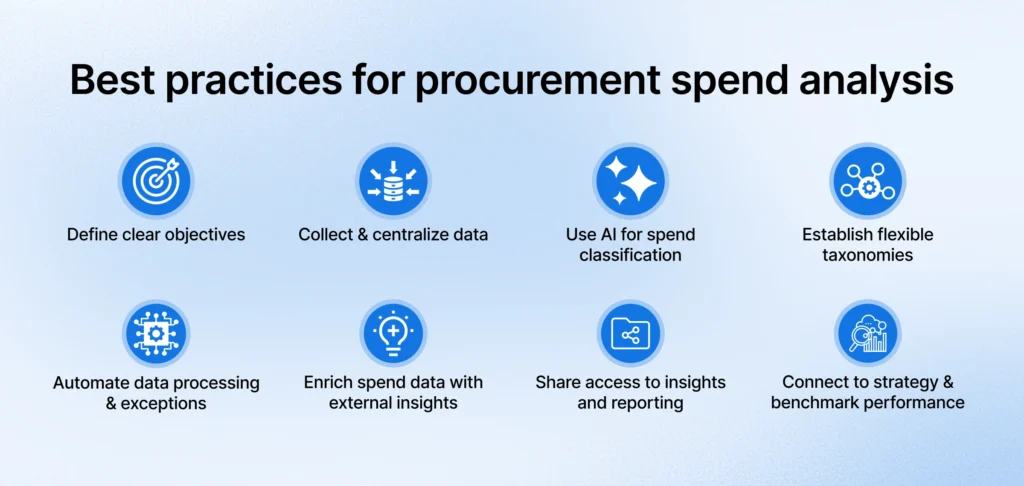
Spend analysis differs across organizations. Hence, while there’s no textbook way to administer spend analysis in procurement, there are certain proven ways you can ensure it’s more effective for your business. Start by defining clear goals and objectives, collecting and centralizing data from all sources, and ensuring data is clean, consistent, and categorized to help identify savings opportunities and manage risks. Here are the key practices companies can adhere to to generate actionable insights and ensure they make wise decisions.
1. Define clear objectives early
Before diving into spend data, set clear goals for your analysis. Whether the focus is cost reduction, supplier performance, or compliance, clear objectives for your spend analysis and e-sourcing strategy guide a structured, repeatable analysis process and ensure results align with business priorities.
2. Centralize and unify spend data
Gather data from all internal and external sources. Centralizing data from ERPs, procurement systems, and finance tools creates a single source of truth, improving accuracy and enabling consistent analysis across regions and categories.
3. Use AI for spend classification
AI in spend classification is extremely helpful, as it can gather information that you may have missed. Automation improves speed and accuracy, handles unstructured descriptions, and continuously learns to improve classification coverage at scale, which is the core of modern procurement spend analytics.
4. Build flexible, scalable taxonomies
Once your spend data is classified, develop dynamic category structures that evolve with changing suppliers and sourcing strategies. Flexible taxonomies prevent rework and ensure consistency as procurement needs change.
5. Automate data processing and exceptions
Spend analysis is truly effective when you have structured data. Automated pipelines, self-healing logic, and exception workflows help maintain data quality while routing low-confidence transactions for review.
6. Enrich data with external benchmarks
Make your data more relevant to industry standards. Combining internal spend with external benchmarks, pricing indices, and ESG metrics adds context, highlights savings opportunities, and supports risk-aware decisions.
7. Democratize access to insights
Insights should be available to everyone. Self-service dashboards, filtering by supplier or category, and natural language queries help stakeholders act faster and align decisions across teams.
8. Connect insights to action and benchmarking
Make your spending data valuable by aligning it with your goals. Linking insights to sourcing actions, performance tracking, and peer benchmarking ensures continuous improvement within procurement and spend analytics.
How Procol AI helps in procurement spend analysis
Procol delivers AI-powered procurement spend analysis that turns data chaos into actionable insights. Trusted by enterprises like Signature Global, our ERP-integrated platform offers real-time visibility into spend and performance, enabling faster collaboration, smarter decisions, and cost savings.
Our Spend Analytics AI agent centralizes procurement data, removes manual bottlenecks, and leverages dynamic workflows, automated approvals, and intelligent audit trails. Teams can identify savings opportunities, streamline processes, and make confident, data-driven decisions.
Signature Global, a leading real estate company, achieved a 40% reduction in PR-to-PO time, 14% cost savings, and successfully routed 700+ Cr+ spend through the platform. From sourcing optimization to real-time spend tracking, Procol empowers procurement and finance leaders to uncover hidden savings, strengthen supplier relationships, and drive measurable business impact. Read more about this success story in detail here.

Conclusion
Spend analysis in procurement is more than just tracking expenses; it’s about turning data into a strategic advantage. With full visibility into spending, procurement teams can optimize costs, plan budgets, and strengthen supplier relationships. This blog covers why spend analysis is essential, covers the key steps in the process, highlights important KPIs to track, and shares best practices for success. AI-powered solutions like Procol simplify the process with real-time insights and automation, helping you build a smarter, more resilient procurement organization.
Frequently asked questions
What is an example of a spend analysis?
An example of a spend analysis is when a manufacturing company discovers multiple departments purchasing the same safety equipment from different vendors. This discovery reveals many inefficiencies and consolidation opportunities to reduce costs and streamline supplier management.
How to perform a spend analysis?
To perform a spend analysis, start by defining objectives, collecting and consolidating data from all sources, then cleaning, categorizing, and analyzing it to identify savings opportunities, supplier overlaps, and areas for improved procurement efficiency.
What is the main objective of conducting a spend analysis?
The main objective of conducting a spend analysis is to enhance visibility into organizational spending. Its aim is to reduce costs, improve procurement efficiency, and ensure compliance with internal policies and supplier contracts.
What is a spend analysis tool?
A spend analysis tool is a data visualization tool, also known as a procurement spend analysis dashboard, that provides organizations with a clear and interactive view of a company’s procurement operations and expenditures.
What’s the difference between spend analysis and spend visibility?
Spend visibility is the foundational step of analyzing and tracking where an organization’s money is spent, whereas spend analysis is the process of using that data to find opportunities for cost savings.
What if spend data is fragmented or unreliable?
Fragmented or unreliable spend data leads to poor decision-making, missed savings opportunities, compliance risks, and inaccurate insights. This is why it is crucial to centralize, clean, and validate data regularly for accurate procurement analysis.
How often should a company conduct spend analysis?
A company should conduct spend analysis at least once a year. However, more frequent reviews are beneficial.
Schedule a Demo
We’d love to hear from you. Please give us a call on +1 315-645-2799.
Explore more from Procol
Discover expert tips, how-to guides, industry insights, and the latest procurement trends.

Procurement orchestration: All you need to know in 2026
Explore the value of procurement orchestration, how it works, its benefits,...
Top 22 spend management KPIs to optimize procurement in 2026
Today’s business world has moved from just ‘buying’ to ‘managing spend’...

What is supplier diversity and why is it important?
In the modern corporate competitive world, where both market resilience and...