




10 Best Procurement Software for Businesses of All Sizes

Last update: August 6, 2026
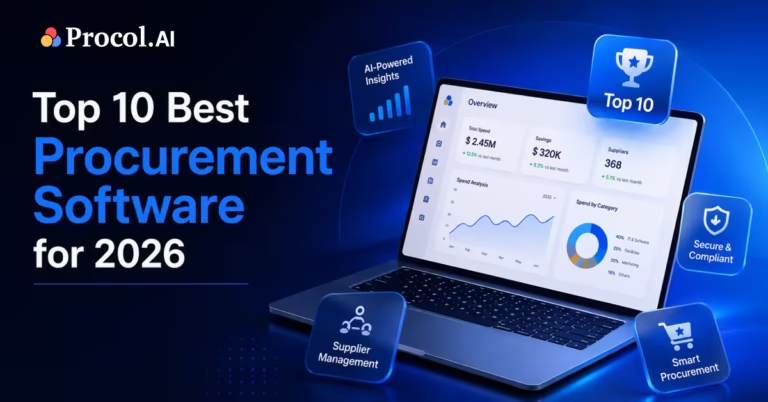
Driven by increased investment in AI, automation, and tighter spend controls, the global procurement software market is projected to reach $9.88 billion in 2026. Today, dozens of new vendors are entering the space, making it harder than ever to know which platform actually fits your business. This guide breaks down the 10 best procurement software for 2026, what each one does well, where it falls short, and who it’s built for.
Key Takeaways
What do procurement software companies do?
Procurement software companies build top procurement software that automates and manages how big enterprises buy goods, services, and software. Procurement software vendors offer a platform that centralizes and brings the entire procurement lifecycle from intake to pay together. They help finance and procurement teams control budgets, track the company’s spend and processes, and manage relationships with suppliers.

5 Different types of procurement software
There is a variety of procurement software companies in the market, each specifically geared toward optimizing a particular area of the purchasing process, like Source to Pay and Procure to Pay. Every module of the global procurement platform performs a unique role. The market is divided into categories, each built to support different stages of the procurement lifecycle.
Comprehensive suite
1) Source-to-pay: S2P software covers the entire end-to-end buying cycle, starting from supplier discovery, RFx, contracts, spend analytics, in addition to procurement transactions and payment analysis.
2) Procure-to-pay: P2P covers everything from the middle to the end processes, or the transactional processes. It involves purchasing, invoicing, goods receipt, invoice-account matching, and payment processing. A P2P platform automates a series of processes, including the management of purchase requests, purchase orders, and goods receipts in one.
Focused point solutions
3) E-procurement: E-procurement helps digitize internal approvals, basic purchase requests, ordering through the catalogs without the underlying sourcing tools and PO’s, and it usually represents the starting point for businesses going towards the direction of procurement optimization.
4) Contract life cycle management: CLM platforms are built to make managing your contracts easier by outlining a workflow for drawing up, negotiating, signing, and keeping track of your agreements with your suppliers. Auto-reminders make sure that renewals don’t get missed and that there is no lack of compliance.
5) Supplier management: Focuses on centralizing supplier onboarding, master data, compliance records, and performance tracking, enabling procurement teams to manage supplier relationships more effectively throughout the lifecycle.
10 Best procurement software in 2026
The right procurement software will be subject to the business needs of your company, such as business size, current tech stack, integration demands, level of procurement complexity, and what functionalities you want to acquire. With that said, we have taken the guesswork out of it for you by reviewing and listing the 10 best procurement software solutions available in 2026.
1. Procol
Overview: Procol is an AI-native procurement software with a multi-agent system for procurement and finance. The platform has an easy-to-use interface and is trusted by over 200 enterprises globally, managing more than $30B in spend. Procol has been named in Gartner’s Hype Cycle for procurement technology, alongside coverage from G2 and Everest Group.
Best for: Global Enterprises and Emerging Enterprises that are fed up with dealing with multiple isolated point solutions.
Pros:
- One Unified platform – strategic sourcing, e-Auctions, vendor Onboarding, P2P, AP automation on a single platform
- Deploys in 3-4 weeks with pre-built connectors for SAP, Oracle, MS Dynamics, and ERPNext
- A system of AI agents for automating all stages of the process – RFX creation, negotiation, three-way matching, and invoicing.
- Enterprise-level security and compliance (SOC 2 Type II, ISO 27001, and GDPR)
Cons:
- Newer brand presence in the US market compared to top procurement software legacy suites
- Relies on implementation teams due to lack of product documentation
Best-fit company size: Mid-market to large enterprise (typically 500+ employees, $50M+ in managed spend)
2. Coupa
Overview: Coupa is an AI-powered procurement platform that streamlines purchasing with guided buying, automated requisitions and purchase orders, and real-time spend visibility to improve compliance and reduce procurement cycle times.
Best for: Big Companies looking for consolidated spending across a single system of record to cover PO, AP & expense.
Pros:
- Deep functionality: guided buying, catalogs/punchout, contract management, and community benchmarking
- Robust C-suite spend dashboards and analytics
Cons:
- Steep learning curve and limited functionality
- Hard to navigate due to scarce documentation and workflows
Best-fit company size: Enterprise (greater than 2000 employees)
3. SAP Ariba
Overview: SAP Ariba is a cloud-based procurement platform that helps organizations streamline purchasing by connecting spend categories, automating procurement workflows, and enabling collaboration with suppliers. It supports sourcing, approvals, invoicing, and compliance, helping businesses manage procurement efficiently across global markets.
Best for: Large, SAP-centric organizations that need deep compliance, global supplier management, and AI-assisted sourcing within their existing SAP ecosystem.
Pros:
- Highly configurable with advanced features like dynamic discounting and fraud detection
- Proven at scale across Fortune 500 companies
- Tight integration with SAP ERP and the broader SAP Business Network
Cons:
- The cost compared to other top procurement platforms is high
- Navigation and troubleshooting can be challenging due to a complex interface
Best-fit company size: Large, complex, multi-entity enterprise, especially existing SAP customers
4. Zycus
Overview: It is an AI-powered procurement platform designed to take procurement from intake to measurable outcomes. Its Merlin Agentic Platform connects guided intake with autonomous execution across sourcing, supplier management, contracts, purchasing, and accounts payable.
Best for: Companies looking for an AI-centric source-to-pay solution with sophisticated sourcing & negotiation automation tools integrated with a natively built single architecture.
Pros:
- Organically built suite (not acquisition-stitched), reducing integration friction across modules
- Strong agentic capabilities in sourcing, negotiation, and supplier onboarding
Cons:
- Users can not customise as it requires a fixed kind of functionality
- Reporting can be inconsistent, and some modules need more maturity for business use
Best-fit company size: Mid-market to large enterprise, particularly manufacturing, financial services, healthcare, and energy organizations with complex sourcing needs.
5. GEP
Overview: GEP is an AI-first, end-to-end, cloud-native suite for strategic sourcing, procurement, and supply management; a modern choice that can replace legacy, siloed solutions with a unified, cutting-edge stack.
Best for: Enterprises seeking a modern, AI-forward alternative to Coupa or SAP Ariba, particularly those with complex global supply chains.
Pros:
- Unified platform architecture (rather than bolted-together modules)
- Strong AI capabilities across sourcing, category management, and supply chain risk
Cons:
- GEP Quantum Intelligence may feel expensive compared to other best procurement software solutions
- Certain user experiences have limited customization
Best-fit company size: Mid-market to large enterprise with complex, global sourcing needs
6. Ivalua
Overview: It is an AI-powered procurement platform that connects people, AI agents, workflows, and procurement data in a unified system. It helps enterprises manage spend, automate processes, and improve visibility.
Best for: Large enterprises with unique or highly regulated procurement processes that need a platform they can configure extensively rather than adapt to.
Pros:
- Deep configurability across sourcing, contracts, and supplier management
- Strong fit for regulated industries (life sciences, financial services, manufacturing)
Cons:
- A steep learning curve makes initial setup and onboarding complex and overwhelming
- Users may experience implementation challenges like complicated, unstable environments, and integration difficulties during setup
Best-fit company size: Large enterprise with dedicated procurement IT resources
7. Zip
Overview: Zip is an AI-powered intake and procurement orchestration platform that supports a business’s purchasing and vendor relationships via a single portal.
Best for: Enterprises with an existing ERP that want to fix a poor front-end request experience without ripping out back-end systems.
Pros:
- Fast time-to-adoption thanks to a consumer-grade, low-friction intake experience
- Strong native integrations with Slack, Teams, and major ERPs
- Works as an orchestration layer rather than requiring full software replacement
Cons:
- The admin functionalities may not be robust enough for advanced workflows and integrations or for module-level configurations
- May also lack flexibility in customization, which can impact the ability to integrate and utilize reporting features
Best-fit company size: Mid-market to large enterprise (100+ employees), especially those layering onto an existing P2P/ERP stack
8. Procurify
Overview: Procurify is a cloud-hosted procurement and spend management software platform that allows companies to manage, monitor, and streamline the purchasing from the initial request of items until final payments.
Best for: Growing mid-market companies that want modern approval workflows and spend control without enterprise-level complexity.
Pros:
- Strong user experience and high satisfaction ratings among finance and procurement teams
- AI-assisted spend insights and automated routine workflows
- Integrates with QuickBooks, NetSuite, and Dynamics 365
Cons:
- Steep learning curve, some users find it slow and complicated for beginners to navigate
- Some users note that multi-step approvals and difficulty finding historical requests can slow down routine procurement tasks
Best-fit company size: Mid-market (roughly 200–2,000 employees)
9. Precoro
Overview: Precoro is an AI procurement and spend platform with quick implementation that tracks, controls, and lets you save costs on purchases. It unifies procurement, supplier management, and spend management on a single data model.
Best for: Mid-sized, multi-location (including franchises) companies that want some structure in their purchasing process without the IT demands.
Pros:
- Intuitive interface and fast onboarding, per customer reviews
- Integrates with NetSuite, QuickBooks, and Xero
Cons:
- Some workflows can feel multi-step
- Navigation and search experience could be improved
Best-fit company size: Small to mid-market (multi-branch or distributed operations)
10. Jaggaer
Overview: Jaggaer is a source-to-pay (S2P) solution with industry-specific configurability and prescriptive solutions in education, health care, and manufacturing, along with its enterprise base offering.
Best for: Specialized verticals in enterprise and large institutions that require a customized approach to sourcing, supplier management, and contract workflows.
Pros:
- Strong industry-specific functionality (especially higher ed and healthcare procurement)
- Comprehensive sourcing and supplier collaboration tools
Cons:
- Configuration complexity requires meaningful onboarding investment
- UI and user experience can lag behind newer, consumer-grade global procurement platforms
Best-fit company size: Large enterprise and large institutional buyers
Quick Comparison: Best Procurement Software (2026)
| Software | Key features |
| Procol | 1) Agentic AI (Clara) automates sourcing, invoicing, and supplier operations 2) Strategic sourcing and eAuctions streamline RFQs and negotiations 3) End-to-end source-to-pay coverage from intake to payment 4) Real-time spend analytics with AI-driven savings insights 5) 3-way matching 6) Dynamic RFQ, RFx 7) No-code intake and approval workflows8) Effortless ERP integration |
| Coupa | 1) AI-driven guided intake 2) Central Contract repository 3) Real-time budget tracking against spend before approval. |
| SAP Ariba | 1) AI-assisted sourcing from request to award 2) Bid analysis and optimization 3) Mobile approvals 4) Electronic invoicing compliant with tax and legal rules |
| Zycus | 1) Merlin intake management 2) Conversation intake request 3) Real-time spend analytics 4) Prebuilt ERP integrations across major systems via APIs. |
| GEP | 1) Autonomous agents span every procurement function 2) GEP Quantum Intelligence Studio lets users build custom agents without coding 3) Connects to existing ERPs and S2P systems |
| Ivalua | 1) AI-driven intake workflow 2) Configurable intake management with role-based approval 3) Integrates with all major ERPs using open APIs and prebuilt connectors 4) No-code/low-code workflow configuration |
| Zip | 1) Automated intake-to-pay routing and approvals 2) No-code intake and approval workflows 3) Single front door for all requests 4) Centralize global vendor payouts |
| Procurify | 1) Auto-configurable routing 2) AI-powered invoice matching and accounts payable automation 3) ERP and supplier integrations 4) One-click purchase order creation |
| Precoro | 1) Three-way matching for invoice and purchase order 2) Centralized vendor, contract, and spend visibility dashboard 3) Automated purchase order and requisition workflow management 4) Real-time budget tracking with automatic overspending prevention |
| Jaggaer | 1) AI-powered sourcing 2) Guided buying 3) Contract lifecycle management with automated alerts 4) Invoicing automation with AI-powered data capture and matching |
Run procurement on autopilot with Procol
Most procurement software providers only fix one part of the process, like approvals, purchase requests, or even sourcing, and teams then have to deal with everything else in other disconnected systems.
Procol is built to fix that. It consolidates your procurement lifecycle into one connected global procurement platform with AI that supports you in managing intake, sourcing, suppliers, POs, contracts, invoicing, and spend analysis.
Why do enterprise-wide teams choose Procol as the best procurement software?
– Gain 100% spend visibility across suppliers, categories, and business units
– Up to 80% faster procurement cycle times
– Generate up to 10% cost savings
– Automate repetitive procurement tasks with a system of AI agents
– Gain complete control over procurement workflows from request to payment
– Get a fully compliant procurement process
– Easy-to-use for teams as well as for vendors

How to choose the best procurement software for Your Business
Ultimately, the best eprocurement software or procurement software is one that fits your business goals and your current infrastructure and can grow with your company’s procurement strategy, including as you look to modernize your sourcing, gain spend visibility, and implement AI-powered process automation. Take time to evaluate what you most want, what’s on offer, and what platform will give you a competitive edge going forward, and invest in smart software.
Frequently asked questions
How did we evaluate these procurement software providers?
We looked at every procurement software solution based on the most important criteria, impacting today’s procurement teams. Those are feature sets within the procurement lifecycle, like capability to integrate with present business systems, client review and sentiment (e.g., G2, Capterra), clarity in costs, the extent of its use of AI and automation, and business size.
What is procurement software used for?
Procurement software is a digital system that facilitates the automation, supervision, and control of an organization’s process of purchasing goods and services. The software can automate stages from the purchase requisition stage to the purchase order and supplier account information management, including the entire process from receipt of an invoice until recording expenditure, and help teams decrease manual effort, errors, and gain complete control of purchases.
How do I choose the right procurement software?
When choosing the right procurement software for your business, evaluate your enterprise’s unique needs. It is wise to think about which areas you’d like to automate most, determine whether software visibility into overall spend could benefit your department, and determine whether the software is easy to integrate with your existing technologies and the cost of the platform.
What is the best procurement software?
The “best” platform depends on your existing tech stack. For mid-market and enterprise teams seeking an end-to-end S2P platform with fast implementation, Procol is the best procurement software. Built as an AI-native intake-to-pay platform. Its multi-agent system autonomously executes routine procurement tasks, freeing teams to focus on strategic decision-making and strengthening supplier relationships, rather than getting caught up in manual, repetitive work across the procurement cycle.
How does procurement software reduce cost overruns?
Procurement software reduces cost overruns by automating manual workflows that are prone to error, enforcing budget controls at every approval stage, and providing real-time spend visibility across departments. This helps teams catch maverick spend early, stay within allocated budgets, and make informed purchasing decisions before costs spiral out of control.
Shivangi Singh is a senior content writer at Procol, specialising in B2B content strategy and procurement-focused storytelling. She covers vendor management, strategic sourcing, and supply chain topics — translating complex procurement concepts into clear, actionable insights for enterprise buyers and procurement professionals.
Schedule a Demo
We’d love to hear from you. Please give us a call on +91 76666 82222.
Explore more from Procol
Discover expert tips, how-to guides, industry insights, and the latest procurement trends.

Ultimate Guide to Japanese Reverse Auction in 2026
Japanese reverse auctions offer procurement teams a smarter way to drive...

Shivangi Singh • July 9, 2026

Reverse Dutch Auction: What It Is and How It Works
Procurement teams today are expected to reduce costs, shorten sourcing cycles,...
Shivangi Singh • July 9, 2026
Procol Recognized in Gartner® Hype Cycle™ 2026
Procol has been recognized in Gartner Hype Cycle 2026 for Procurement...
Shivangi Singh • June 23, 2026