When you ask a company how much they spend on raw materials and components, someone can bring you a figure in seconds. Try asking the same company how much they spend on software subscriptions, office supplies, travel, or marketing agencies, and you'll get a shrug, a guess, or three different spreadsheets that don't match up. That's the perfect example of indirect procurement. It's dirtier than most finance teams care to acknowledge, and often a whole lot bigger than they would admit.
It covers everything a business buys to keep operating, as opposed to what it buys to actually build and sell its product. It touches almost every department, involves more suppliers than any other spend category, and has historically gotten none of the strategic attention that direct spend gets. That's finally starting to shift, as procurement leaders realize just how much value has been sitting untapped in indirect purchasing all along.
In this blog, we'll discuss what indirect procurement is, how it differs from direct procurement, how it looks in practice in frequently used categories, how the management process works, how you can build an indirect procurement category strategy, what tools you need, and what the best practices are to manage it efficiently.
What is indirect procurement?
The indirect procurement meaning is straightforward enough: it’s the process of buying goods and services that a business needs to operate, including everything that never becomes part of the final product it sells. It covers what a company buys to run itself rather than what it buys to build what it sells: laptops, cloud hosting, HR software, office rent. None of that ships to a customer, but the business can't function without it.
Indirect sourcing vs direct procurement
Direct procurement is the raw materials, components, and services that are directly incorporated into the final product. For example, a manufacturer of cars who purchases steel, tires, or electrical parts for use in their cars is engaging in direct procurement.
Clearly, these two require completely different strategies. Direct procurement is typically highly centralized and forecasted, with a direct line to manufacturing, because shortage of stock can accumulate stoppage time in a manufacturing process.
Indirect sourcing is nothing like that. It's fragmented over dozens of smaller to mid-sized buys, often being executed by people who are not buyers, and virtually none of the department has visibility of what they spend. That's why this category leads to maverick spending, waste, and contract duplication that direct procurement never has to worry about.
| Direct procurement | Indirect sourcing | |
|---|---|---|
| Purpose | Goes into the finished product | Supports internal operations |
| Ownership | Usually centralized | Often decentralized across departments |
| Examples | Raw materials, components | Software, travel, facilities, marketing |
| Visibility | High, closely forecasted | Lower, harder to consolidate |
Why indirect spend needs more attention
Most organizations spend between 20% to 40% of their total procurement budget on indirect purchasing, and it can account for relationships with over 80% of their suppliers. Despite these numbers, indirect procurement is typically far less tightly managed than direct spend, largely because individual transactions don't seem to warrant the same level of scrutiny.
The trap is that a company might have a dozen departments each quietly paying for their own version of the same SaaS tool, booking travel through five different agencies, or signing separate contracts with facilities vendors that operate in the same city.
None of it looks like a problem when you're staring at one line item. But add it all up, and there's real money sitting between the lines, just waiting to be recovered. Companies that bring visibility and structure to this spend tend to be surprised by how much they find, simply because nobody had looked at the full picture before. Digitizing this side of procurement alone has been shown to unlock real savings, mostly just by surfacing purchases that were never consolidated to begin with.
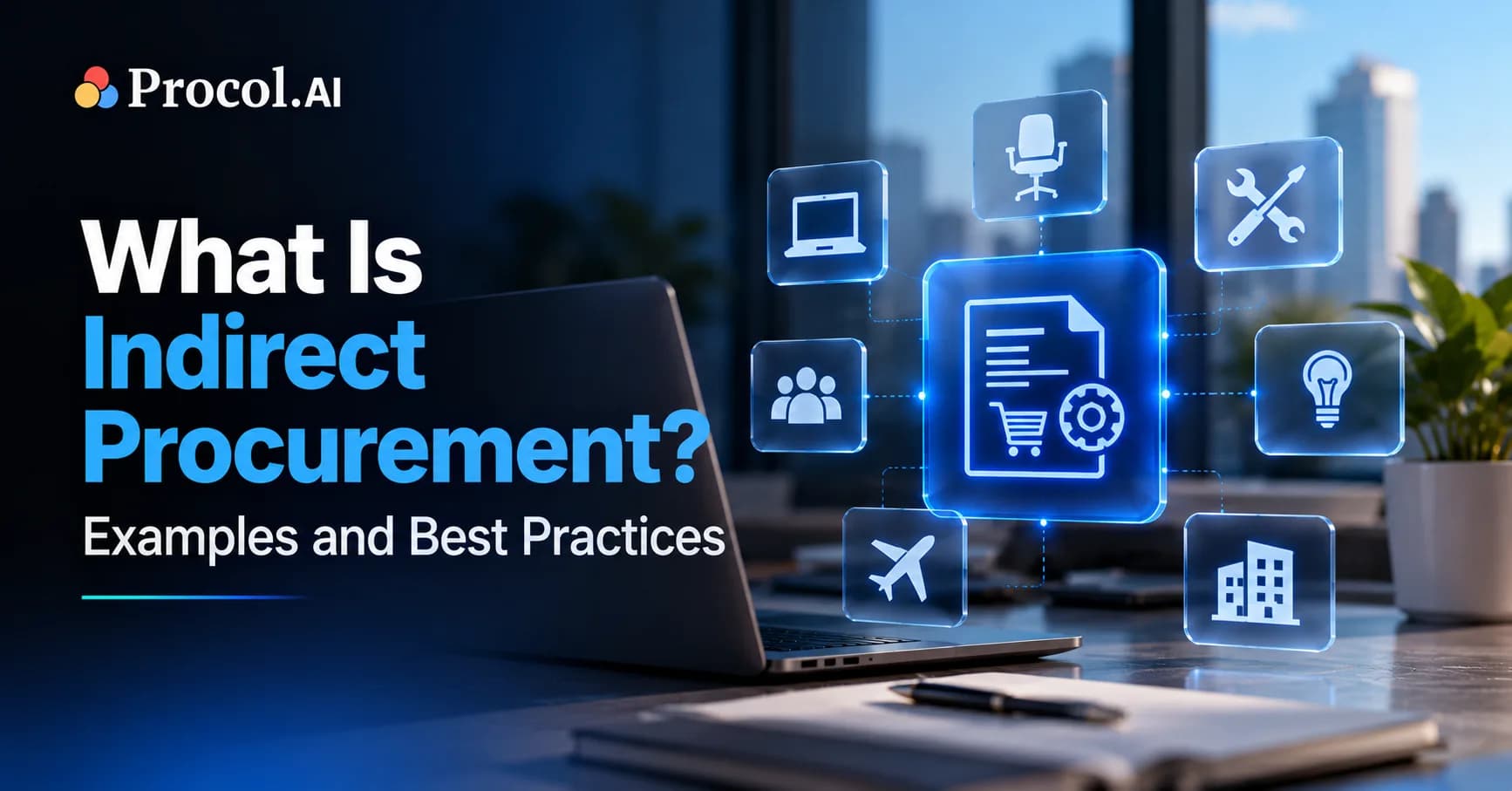
Indirect procurement examples across the business
Indirect procurement shows up basically everywhere in a company, once you start looking closely for it. Here are the categories that make up most of it:
IT and software
This is probably the fastest-growing chunk of indirect spend right now, and it's not hard to see why. Cloud subscriptions, cybersecurity tools, laptops and monitors, IT support contracts, and the dozens of SaaS tools every team seems to need — all of it falls here. That's where most of the maverick spend lives today, and it's often the space that seems to completely bypass procurement because individual purchases seem too small to bother with the whole sourcing process.
The difficult part is how easy it’s become for a team to put a card down and subscribe to something without procurement ever seeing it. Indirect purchasing in IT has effectively been decentralized by default, not by design.
One department's marketing team grabs a project management software while sales gets its own analytics dashboard, only to have nobody in finance know three months down the road what the company is paying for and that five different teams are using five different versions of the same tool.
Facilities and MRO
Janitorial, utilities, security staffing, and MRO (maintenance, repair, and operations) supplies are the "physical" side of the business and what helps offices, warehouses, and other facilities to run smoothly. This is where indirect buying gets expensive quietly. The spend recurs every month, but it’s usually owned site by site, with separate contracts nobody has renegotiated in years and no one comparing what two warehouses in the same city are paying for the same service.
Marketing and professional services
Agencies, freelance writers, ad platforms, legal counsel, consulting firms — this is all indirect buying too. What makes this category different is that so much of it comes and goes with specific projects rather than sitting there as a steady, predictable cost. A campaign wraps up, and the spend disappears. A freelancer gets hired for one thing and never shows up again after that. A lawyer gets brought in for a single deal, and that's it. It's never one of those regular recurring line items that office supplies or software subscriptions are — you can see last month, and assume this month's going to be roughly the same. That constant one-off quality is what makes it so resistant to standardization, and indeed that's why even procurement teams that have the rest of it nailed go astray here.
Travel and HR
Airfare, hotel, recruiting tools, development budgets, and benefits comprise the final chunk of spend. The difficulty is that those costs don't stay stable — they track with the number of employees and the pace of the business, so an influx of new people or a heavy conference schedule can derail plans that seemed totally realistic a month ago. It's the natural volatility that makes travel and HR spend very tricky to predict.
How does indirect procurement management work?
Indirect procurement often looks messy from the outside, but the companies that have figured it out have turned it into a real, repeatable process. Clear stages, clear owners, clear ways to tell if it's working.
Step 1: Figure out who's buying what
This is where everything has to start, and it's also the step most companies quietly skip. Somebody needs to sit down and map out who's buying what, in which department, and why. Skip this, and procurement is essentially flying blind. That's how you end up with the same software contract signed by three different teams for years, and nobody even realizes it until someone finally goes digging.
Step 2: Find and pick the right suppliers
Once you know what to purchase, your next step is to compare vendors, run RFPs, and have vendors compete. For the smaller firms that do this frequently, having a ready-to-go list of vendors who are already approved makes all of those negotiations much easier; no one has to go back to scratch each time.
Step 3: Get the contracts locked in
It's most advantageous to have pre-built, pre-negotiated contracting templates and rates. That way the next deal in the same category starts from language you’ve already cleared, instead of going back through legal from scratch. It also closes the small gaps where scope creep and surprise fees tend to live.
Step 4: Process requisitions and payments
This is the unglamorous part: requisitions, approvals, purchase orders, making sure invoices match what was ordered. Automating this piece is one of the biggest wins a company can make here, because when this part is manual, it slows down literally everything else in the chain.
Step 5: Measure and review
Final one, and the easiest to overlook. Supplier rating, auditing spend, watching those renewal dates before they pass unnoticed. Skip it and you lose the thread, usually without noticing until a renewal has already gone through.
Building an indirect procurement category strategy
An indirect procurement category strategy is basically just grouping similar spend together — IT, facilities, marketing, whatever the case — and figuring out a sourcing approach that actually makes sense for each one, rather than treating every single purchase like it's the same thing. And that matters, because a strategy built around something high-volume like office supplies is going to look nothing like one built for specialized legal work. Trying to run both through the same playbook just doesn't hold up.
Building one of these usually kicks off with someone sitting down and looking at where the money is going. The key is precise data — not assumptions, not intuition, but real figures. And once that's in place, those categories are prioritized for impact and value, then assigned to someone who understands that segment, the actual key players in that market, not just whoever has capacity this week. At that point, the strategy lays out a cadence for when to buy, who to buy from (your preferred suppliers), and what 'done' looks like, whether that's saving money, moving faster, or reducing risk.
The other thing people always forget is that this isn't a one and done. You will have to go back regularly on this, because indirect categories move faster than direct categories ever did. Supplier markets evolve, internal needs evolve, or both evolve all at the same time. A strategy that made perfect sense a couple of years ago when a company went semi-remote or when they started allocating more money to cloud tools probably doesn't anymore.
Indirect sourcing tools and technology
Procurement platforms have made this side of the job far less painful than it used to be. Purchase-to-pay software handles requisitions and approvals without someone chasing signatures. E-procurement catalogs steer employees toward suppliers that are already vetted and pre-negotiated, before anyone has the chance to go off and sign something on their own. Spend analytics flags duplicate contracts or pricing that looks off across categories, the kind of thing that used to take someone weeks to catch.
E-auction and RFP tools are where the sourcing itself happens. They allow category managers to facilitate real, large-scale competitive sourcing, even in high-turnover, low-value categories that never justified manual sourcing before. These tools don't do the complicated work of planning for you, but they sure make putting your planning into action across every department much simpler.
What to look for in indirect procurement providers
Most platforms handle the transactional side competently. The differences show up in the parts of indirect spend that are hardest to control, so these are the questions worth asking during a demo.
Catalog and guided buying. Can an employee find the approved vendor faster than they can find a corporate card? That’s the real test of whether a catalog will get used.
Spend visibility across departments. One view that doesn’t need someone to reconcile three exports first. Ask to see it built from messy data, not a demo dataset.
ERP integration. Indirect spend touches finance constantly. A platform that sits beside your ERP rather than on top of it just creates a second version of the truth.
Sourcing small categories economically. Running a competitive event on a low-value category used to cost more in effort than it returned. Ask how the platform handles repeat sourcing on the categories you’ve never bothered to tender.
Approval configurability. Thresholds that differ by category and department, without a support ticket every time something changes.
Procol handles the parts of indirect spend that usually go unmanaged. Someone raising a request gets steered toward approved vendors and pre-negotiated catalogs before they reach for a card, and approvals route by category and value without anyone chasing signatures. Spend across every department sits in a single view, with savings and budget variance tracked against it. Competitive sourcing runs on the same platform, including on the small repetitive categories most teams have never tendered, and all of it connects to the ERP you already use.
[See how Procol handles indirect spend →]
Indirect procurement best practices for 2026
These are the practices that make the good procurement teams that understand this category stand out from the average ones that just seem to try and react to whatever they are given.
See first, control second: Give departments the freedom to buy what they need, but always maintain one overhead (procurement) view of where and how much is being spent and with whom. You can't control what you don't see.
Give someone ownership of each category: Every significant category should have a dedicated individual overseeing it, someone monitoring supplier performance, and someone monitoring the change in that market, rather than it being nobody's responsibility and everyone's concern.
Consolidate suppliers when it makes sense to: Fewer suppliers usually means better leverage at the negotiating table and a lot less admin work chasing invoices and contracts from a dozen different places.
Write policies people can follow: Simple approval thresholds cut maverick spend without making every small purchase a project.
Let the data do the talking: Spend analytics reveal renewal risks and potential savings opportunities that are nearly impossible to see when looking at a transaction in isolation.
Automate the tedious ones: Catalogs and pre-approved vendor lists for low-value categories allow procurement to spend less time and money on categories that don't require an enormous amount of due diligence.
Don't blindly renew contracts: More budget is wasted than you'd think on contracts that automatically renew and nobody bothers to review.
Even picking a handful of these to actually implement tends to show real savings within a few sourcing cycles. No department overhaul required.
Conclusion
This side of procurement is probably never going to get the same attention that production spend does, and honestly, that's exactly why there's so much sitting on the table waiting to be found. The companies that actually bring some structure to it — a real category strategy, consistent habits applied over time — keep stumbling onto savings and efficiency gains that direct procurement was never going to hand them on its own. Treating this as an actual strategic function instead of something handled in the background, almost as an afterthought, is turning into less of a nice-to-have and more of a genuine edge over everyone else who's still ignoring it.
Frequently asked questions
Indirect procurement is the process of buying the goods and services a company needs to operate, rather than the inputs that go into what it sells. Software subscriptions, office supplies, facilities, travel, professional services. None of it ever reaches a customer, and none of it is optional either.
Direct procurement covers the raw materials and components that go into production. It’s usually centralized, forecasted, and watched closely, because a shortage stops the line. Indirect procurement covers everything else the business needs to function, and it’s typically spread across departments with far less oversight. The two need different sourcing strategies, which is why running them through the same process rarely works.
Indirect sourcing is the supplier-facing side of indirect procurement: running RFPs, comparing vendors, negotiating terms for categories like software, facilities and professional services. The work itself isn’t that different from direct sourcing. What’s different is the fragmentation. One category can mean forty small suppliers scattered across six departments, none of whom think of themselves as buyers.
Common indirect procurement examples include cloud software and SaaS licenses, laptops and IT support, janitorial and MRO supplies, utilities, marketing agencies and ad platforms, legal and consulting fees, business travel, and recruitment platforms. For most companies IT and professional services turn out to be the two biggest.
Indirect spend usually accounts for 20% to 40% of total procurement spend, and can involve relationships with more than 80% of a company’s suppliers. Services businesses tend to sit at the higher end, since there isn’t much direct spend to begin with. Heavy manufacturing runs lower.
Indirect spend is hard to control because it’s fragmented. The purchases are small, frequent, and made by people whose actual job is something else entirely. No one team sees all of it, which is how a company ends up paying three times for the same software and only finding out when someone finally goes looking.
Ownership tracks company size more than anything else. Smaller organizations usually fold indirect procurement into a procurement manager’s existing remit. Larger ones give the big categories their own owner: IT, facilities, marketing, travel. What you’re checking for either way is whether someone’s name is actually against each category.
An indirect procurement category strategy groups similar purchases together, works out the spend and supplier market behind each group, puts someone in charge of it, and sets a sourcing approach that fits that category’s value and risk. The point is that office supplies and specialist legal work shouldn’t run through the same playbook.
Start with one view of indirect spend across every department, because everything else depends on it. Then set approval thresholds simple enough that people will actually use them. After that it’s consolidating suppliers where the volume justifies it, catalogs for the low-value categories, and automating the requisition-to-payment grind. Most teams find something in the first sourcing cycle, usually a contract they were paying for twice.

Shivangi is a Senior Content Marketer specializing in B2B SaaS, procurement, and enterprise technology. She creates research-driven content that helps procurement leaders and business decision-makers navigate AI, digital transformation, sourcing, and spend management. Her work focuses on turning complex industry developments into clear, practical, and actionable insights.