


Reverse Auction Explained: Process, Benefits & Best Practices

Last update: September 17, 2026
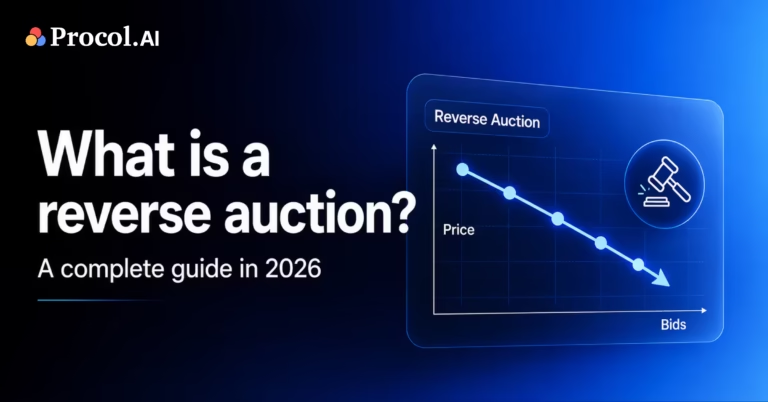
Every procurement team strives to maximize value while controlling costs. Reverse auctions make this possible by creating a competitive reverse bidding environment where suppliers compete in real time, enabling buyers to achieve better pricing, greater transparency, faster sourcing decisions, and stronger procurement outcomes.
Key Takeaways
What is a reverse auction?
A reverse auction is a part of the procurement process where the roles of buyers and sellers are flipped. In a reverse auction, the buyer sets the contract terms and specifications. Suppliers then compete against each other by offering progressively lower prices to win the business. The seller who offers the lowest bid ultimately wins and is awarded the contract.

How does a reverse auction work?
In a reverse auction, the buyer submits a request for a required good or service, and suppliers compete by lowering their prices to win the contract.
Here is a detailed view of how a reverse auction procurement works, step-by-step:
Step 1: Set up the auction
Reverse auctions take place using specialized reverse auction software or reverse auction systems designed to give buyers and suppliers a secure space for online, real-time reverse bidding.
Step 2: Define requirements
The first step is where the buyer has to detail their need, outlining what goods or services are required, along with details like the technical specifications, delivery dates, quantities, etc, including any compliance criteria and terms and conditions.
Step 3: Invite qualified suppliers
After defining the requirements, the buyer invites all of the prequalified suppliers to enter the reverse auction or backward auction. Selecting qualified and reliable suppliers is a good way to bring a fair and competitive environment so that the buyer can get a good deal.
Step 4: Register suppliers
Once invited, suppliers register on the reverse auction platform and submit the necessary details to participate. They may also issue certifications, attestations, and other evidence that indicates their compliance with your criteria for selection.
Step 5: Set auction parameters
Once the bid system is up and running and is ready to go, the buyer sets up the configuration of the auction in terms of, for example, when to end and begin the auction, what the bid increments/ bid decrement levels are, what the minimum price would be, etc.
Step 6: Run the live reverse auction
When the auction goes live, suppliers participate to place bids for the requirement on the reverse auction platform. The competition increases as the suppliers place even lower bids to try to beat their competition to win the contract.
Step 7: Monitor and adjust bids
During the auction, suppliers can watch other bids as they progress and alter prices to compete, most commonly by remaining below other submitted prices. Most platforms do not reveal suppliers’ identities, instead showing real-time information on bids and lowest prices in order to offer the highest level of impartiality and transparency throughout the auction.
Step 8: Award the contract
When the auction is closed, the final bids from qualified suppliers are analyzed against all technical, commercial, and compliance specifications, and the contract is awarded to the supplier that best delivers overall value for the purchasing organization, and usually the lowest qualified bidder, as per the agreed-upon assessment framework.

5 types of reverse auctions in procurement
The main types of reverse eauctions are ranked and open/English auctions. There are other styles as well, and they are quite interesting, such as Japanese, Dutch, and sealed-bid auctions. It is important to know each role and understand the role it plays in the procurement process. Here are the types of reverse auctions.
1. Ranked reverse auction
Ranked auctions, sometimes called British reverse auctions, score suppliers in real time based on their bids. In this type of auction, suppliers can see the ranks of others but not the exact bids, so they are essentially just trying to offer a more competitive bid. Buyers have the ability to rank sellers by price, quality, and even delivery times. This type of reverse bidding requires strategy, as only ranks and not specific bids are available.
2. Open/English reverse auction
Open (or English) reverse auctions are the most transparent format: every supplier sees the current lowest bid and must beat it to stay in the running. In a backward auction, suppliers can see the current lowest bid, and they have to submit a better price than that to stay competitive. Price is the main thing that is looked at here, but if it’s what the buyer wants, they may still weigh factors such as quality and other requirements before a final decision.
3. Japanese reverse auction
Japanese reverse auctions start with a fixed opening bid that every supplier must accept before the clock starts. The price increases at certain times, which are decided by the buyer as well, and only the price and the countdown timer are visible to suppliers. The timer will continue to count down as the event goes on, and the price keeps dropping until no supplier wants to reduce their price. This is when they must choose whether they want to stay or drop out. The last remaining supplier wins the contract.
4. Dutch reverse auction
Dutch reverse auctions look similar to Japanese auctions but work in the opposite direction: price starts low and rises over time. In this format, like a Japanese auction, suppliers can only see the price and a countdown timer. In this case, though, the price is purposely set to be very low, and it slowly increases. This is done to make suppliers decide if the pre-set price is acceptable to them. If it is, the first one who accepts the deal wins the auction.
5. Sealed-bid online reverse auction
Sealed-bid auctions ask suppliers for one best-and-final price, submitted privately with no visibility into competitors’ bids. But the catch is that they must do this privately and cannot see other suppliers’ bids. All of the bids are revealed only after the submission deadline. This is done to ensure fairness because when suppliers cannot see other bidders, they can submit genuine prices and not be swayed by others. This way, buyers can choose the most suitable bid according to their needs.
What are the challenges of reverse auction procurement?
Reverse auction in procurement give many benefits to organizations, but implementing and conducting them may have some challenges that stop companies from using them to their full potential. These reverse auction disadvantages are mainly the reduction in quality due to cost-cutting and the administrative complexity being too high.
There are other disadvantages as well, such as the auction not being suited to the product demanded.
1. Overemphasis on price and quality risks
The process of participating in reverse bidding mainly includes suppliers lowering their prices, but if they keep doing that, the quality of products and services may also be reduced. And if the buyer is not careful and focuses too much on only getting the cheapest deal, they may be harming themselves by compromising on these important factors as well.
2. Not suitable for every type of purchase
During a reverse auction, suppliers offer varieties of the same product at different prices, which gives the buyer a lot of choice. But when demand is highly specific, and only a few suppliers offer that product or service, competition and buyer choice suffer.
3. Supplier pressure and impact on relationships
During an online auction, there is a lot of pressure and competition among suppliers to offer the lowest price because their competitors are doing so. And of course, everyone wants to win, so they’d naturally lower their prices, too. But this may also create a strain on relationships if the only focus is on price.
4. Need for clear requirements from the buyer
Before the buyer starts an online reverse auction, they need to be very clear about what they want from the supplier in order for the auction to work properly. Suppose they don’t specify the exact quantity or are unclear about the delivery times; it can lead to a lot of confusion and may even impact supplier participation.
What are the advantages of reverse auctions?
Reverse auctions in procurement help buyers save costs and work more efficiently. There are multiple other benefits as well, such as faster procurement cycles and clear competition for suppliers. Let’s explore some more benefits of backward auctions.
1. Cost savings
During a reverse e-auction, suppliers compete by lowering their prices and presenting the best deal to buyers. This results in big cost savings; even enterprises that are using Procol’s auction software report 5-10% cost savings compared to traditional sourcing methods.
2. Process efficiency
The online reverse auction process is usually much faster than the traditional way of negotiating. Automating the reverse auction process can boost up to 80% faster procurement cycles. This is because multiple suppliers can submit bids at the same time, instead of long discussions, helping make faster decisions.
3. Access to a wider supplier base
Reverse auctions promote supplier diversity as the event is conducted online, so businesses can invite new suppliers from anywhere to participate. This gives a benefit to both buyers and suppliers, as buyers have more bids to choose from, and all suppliers, big or small, get a chance to compete.
4. Fair competition for suppliers
An electronic reverse auction offers suppliers a platform where they can compete without any worry of being overshadowed by other competitors. All sellers have the same rules to follow, so there’s no stress of bias, either.
5. Better supplier insights and relationships
Reverse eAuction gives buyers visibility into supplier pricing trends and market demand, informing smarter sourcing decisions over time. Once procurement teams understand the patterns in which suppliers bid, they can source more efficiently in the future. Additionally, fair and honest auctions ensure that relationships are strong and built on trust.
Top 12 reverse auction software in 2026
Deloitte’s Chief Procurement Officer Survey revealed that 78% of leaders’ main goal for the procurement process was to reduce costs, and a Scout report stated that the entire bidding process can be done in an hour with the help of auction platforms. That is just one of many benefits this software provides for procurement companies. Some of the best reverse auction companies in the industry are Procol, SAP Ariba, Coupa, and more, which are listed below, along with their key features.
1. Procol
Procol’s auction software platform is designed for buyers who want ease of use with the best AI capabilities all in one place. It is often referred to as the best reverse auction software for the global market and is built to meet the needs of modern sourcing, providing various features with AI built into each workflow.
Key features:
- One-click RFQ to auction conversion
- 45+ diverse auction strategies for every type of purchase
- Smart counter-offer abilities and automatic contract award
- Immediate faulty bid detection
- Live chat tools to facilitate supplier communication
Rating: 4.8/5
2. SAP Ariba
SAP is a diverse platform providing many capabilities, reverse auctions being one of them. Within its larger sourcing suite, SAP Ariba’s auction platform provides a secure and fast bidding process. This is best for larger companies with more complex needs.
Key features:
- Multiple smart auction formats
- Guided sourcing, which allows buyers to create and manage events
- Bidding in real time and tools for smooth supplier management
Rating: 4.1/5
3. Jaggaer
Jaggaer offers an intelligent auction platform within its source-to-pay suite, and it is designed to help buyers secure the best price for the goods and services they need. This auction tool is most used by companies that have larger procurement needs.
Key features:
- Award navigator that uses AI to guide buyers to the best bid
- Supports auctions with multiple rounds
- Chat and communication features that give feedback to suppliers in real time
Rating: 4.2/5
4. Coupa
While it’s known for its spend management platform, Coupa also has features that support reverse auctions. These can be found in the source-to-contract (S2C) software. The interface is quite user-friendly, and it also provides complete visibility into auctions.
Key features:
- Offers multiple auction types
- Uses S2C AI to analyze risks during the auction process
- Strong integrations with its procurement and finance systems
Rating: 4.4/5
5. Market Dojo
Market Dojo is an e-sourcing and reverse auction tool that can be used by both small and large companies. It operates on a “pay-per-use” model, which makes it better for companies, especially growing ones that want a budget-friendly but quite advanced option.
Key features:
- Provides a live auction manager that gives buyers full control over the process
- Bid extension abilities to prolong the bid if the result is not satisfactory
- Easy integration capabilities with tools like Excel to import data fast
Rating: 4.6/5
6. K2 Sourcing
A cloud-based platform that provides strategic sourcing solutions as well as reverse auction services. With its services, it helps companies find the best suppliers and get the most valuable relationships.
Key features:
- Completely flexible and secure auction events, which can also be viewed on mobile
- 100+ customizable auction templates
- Real-time analytics like price updates
Rating: 4.3/5
7. ProcureKey
ProcureKey is an AI-powered platform that provides reverse auction software that supports multiple auction types and formats. It aims to make supplier negotiations more effective and transparent, offering many diverse features and sourcing techniques.
Key features:
- Bid dashboards that help track the status and supplier rankings during the auction
- Automation of supplier notifications and event management capabilities
- Integrates with ERP and finance systems
Rating: 4.4/5
8. PRM360
A cloud-based procure to pay platform that also offers strong auction capabilities. In its reverse auction platform, it uses automated and interactive bidding to ensure buyers secure the best deal and suppliers get engaging competition.
Key features:
- Real-time auction management and tracking
- Multilingual support, best for companies that want to reach global suppliers
- Role-based dashboards for better auction visibility
Rating: 4.6/5
9. GEP SMART
GEP is a cloud software for procurement that also offers online reverse auction software. Inside the sourcing tool itself, teams can create auctions easily and invite multiple suppliers to place bids. GEP SMART’s goal is to help organizations gain cost savings through competitive reverse auctions.
Key features:
- Real-time bidding and tools for supplier communication within the event
- Automated RFx to auction conversion, allowing teams to create events easily
- Integration with the sourcing workflow, so moving through stages becomes easier
Rating: 4.4/5
10. EC Sourcing Group
EC Group is known for its very user-friendly auction software, which is suitable for both forward and reverse auctions. The auction platform is a part of EC’s overall sourcing suite and is praised for its fast interface and strong auction capabilities.
Key features:
- Provides real-time bidding and analytics during the auction
- Gives suppliers feedback using automated notifications and alerts
- Integrates with ERPs and is a scalable platform
Rating: 4.5/5
11. Medius
Medius’ eAuction software lets buyers run fast-forward and reverse auctions with ease. The platform is secure and flexible, designed with the user’s convenience in mind. It promotes competitive and transparent auctions.
Key features:
- Enables teams to monitor auctions in real time and track bids using charts
- Supplier performance tracking to monitor progress
- Fully automated tender management process
Rating: 4.4/5
12. Procure Suite
This provider offers a cloud-based auction software that helps reduce procurement costs significantly. This reverse auction software allows suppliers to bid in real time and also provides a comprehensive interface for buyers to manage the entire auction process with ease.
Key features:
- Easy auction creation with one click
- Helps teams track supplier bids and progress during the auction with analytics
- Automated workflows to reduce manual effort and speed up the sourcing process
Rating: 4.3/5
6 Reverse auction best practices in 2026
To ensure your reverse auction is successful, you need to plan and research well. Aside from defining goals and inviting qualified suppliers, you can also consider using AI in your e-auctions. Research from Digital Commerce 360 shows that 85% of procurement leaders have already begun using AI, and 73% have launched AI agents as well.
1. Clearly define requirements and specifications
Start the process with a very clear RFQ that describes the product or the requirement in a precise and detailed manner. It should have specifications such as quantity and delivery timelines, as well as quality terms. Detailed requirements help suppliers submit accurate bids.
2. Invite the right number of qualified suppliers
Invite a small group of suppliers to your reverse bid auction. They should be checked before the invitation is sent to ensure they are qualified and have the products you need. This step helps in more competitive pricing and a better chance of your requirements being met.
3. Plan the auction structure carefully
Plan your auction with a good procurement strategy. Before you set rules, you need to know the auction will actually run. Choose the auction format and set realistic timelines, along with bid criteria. Paying attention to the small details keeps the event organized and ensures suppliers have a level playing field.
4. Communicate and engage with suppliers through the reverse auction tool
Talk with your suppliers before the event and explain the goals and rules of the event. Also, encourage them to share any doubts they might have before the auction because it’s very important that they understand fully how the reverse bidding process works.
5. Use reliable technology to support your auctions
Using a trusted and easy-to-use agentic procurement platform helps your auctions run very smoothly and makes the process a lot faster. It makes bidding easier for suppliers and helps procurement teams track progress and bids from a single space.
6. Use data and analytics to guide decisions
Procurement teams should use data to help make predictions and identify patterns that would otherwise be invisible. They can track supplier performance and even adjust current cost patterns based on past spending, helping them make better decisions about auctions.
8 Industries that use reverse auctions in procurement
Reverse auction procurement is used across industries to increase supplier competition, reduce costs, and streamline the reverse auction process through electronic reverse auction platforms.
| Industries | How reverse auction procurement is used |
| Manufacturing | Manufacturers use reverse auctions to procure raw materials, machinery, industrial equipment, and components. With the goals of both cost savings and maintaining the integrity of their supply chain. |
| Construction | Construction companies conduct reverse bidding for building materials, subcontracting services, heavy equipment, and project contracts to secure the most competitive supplier offers. |
| Transportation and logistics | Organizations use reverse e-auctions to award freight, shipping, warehousing, and logistics contracts by encouraging carriers to submit increasingly competitive bids. |
| Information technology (IT) | IT professionals turn to reverse auctions for procurement as a means to buy hardware, software, cloud-based computing and related services, cybersecurity products, and managed IT services at the best price. |
| Healthcare | Hospitals & Medical Institutions use the reverse e-auction to procure medical equipment, medicines, laboratory goods & consumables while ensuring the quality & standards of healthcare materials and products. |
| Retail and e-commerce | Retailers use this approach to acquire merchandise, private-label products, packaging goods, and logistics services. |
| Financial services | Banks and financial institutions use reverse auctions in procurement to source technology solutions, consulting services, facility management, and security services while controlling operational costs. |
| Food and agriculture | Agribusinesses, or those in the FMCG industry, utilize this to procure food ingredients, packaging supplies, transportation, and agricultural inputs at a lower price. |
How Procol simplifies the complex reverse auction in procurement
An effective reverse eAuction goes beyond simply receiving bids. Procurement leaders require an online reverse auction system that provides the structure for suppliers to enter their offers and the visibility that enables the company to achieve their savings. Procol’s auction software is one of the best reverse auction software solutions, designed to simplify all phases of the reverse auction.
It helps customers transform an RFQ into an online reverse auction in a single click and set up several types of auction formats and live track bids from a single place. Real-time supplier communication, automated bid tracking, and complete audit trails ensure a transparent and efficient sourcing experience for both buyers and suppliers. The platform supports higher supplier engagement, facilitating an easy-to-use reverse bidding experience for procurement to facilitate confident, competitive reverse bidding events.
The impact is measurable. Procol helped DEI Global centralize its sourcing operations, resulting in an 82% increase in supplier participation and enabling the company to conduct 3,500+ sourcing events through a single procurement platform.
Conclusion
Each sourcing event brings the potential to deliver enhancements to your overall cost and procurement performance. Companies use reverse auctions to turn supplier competition into value, creating price transparency, insight-driven decision-making, and a more efficient procurement process. When coupled with a solid strategy and the proper procurement platform, a successful reverse auction can have a lasting impact well beyond a one-time purchase.
Frequently asked questions
What is the process of a reverse auction?
A reverse auction begins with the buyer defining specifications and then inviting qualified suppliers to participate in the auction. During the auction, live bidding takes place, where all the participants submit their bids and adjust them according to the competition. Once the buyer selects the lowest bid, that supplier is awarded the contract, and the partnership begins.
What are the industries in which reverse auctions are mainly used?
Reverse auctions are mainly used in industries that need standardized goods in high volumes, so they would primarily be used by manufacturing, construction, and logistics industries, to name a few.
When should a reverse auction be held?
The best time to hold a reverse auction is when there are many suppliers offering the same goods who are available in the market. Companies can also host auction events when they have clearly identified their specific needs and have shortlisted potential suppliers. Lastly, auctions can be held when price is the main deciding factor.
What is the difference between a forward auction and a reverse auction?
There is actually a lot of difference between a forward auction and a reverse auction. In a forward auction, multiple buyers bid high prices to win an item from the seller. Reverse auctions work in the opposite way, where multiple sellers compete against each other by offering the lowest prices to buyers.
Are reverse auctions good for buyers or sellers?
Reverse auctions are mainly beneficial for buyers who are looking to secure the lowest price on goods or services. They do provide sellers benefits as well, though, such as a competitive and fair environment to showcase their products, and can even increase a supplier’s market visibility.
What are some reverse auction examples?
A reverse auction example would be bidding for government contracts. These contracts typically include specific and high-priority requirements, such as fighter jets and gas. However, reverse auctions are also used in corporate settings to purchase materials or specialized services.
What are the risks of a reverse auction?
In the process of a reverse auction, sellers compete to offer buyers the lowest price. While this is going on, there may be some problems, such as compromised quality, resulting from an emphasis on the lowest price. Additionally, the pressure to offer the lowest possible bid may put a strain on supplier relationships. There can also be hidden costs that may impact profits in the long-term.
How do you win a reverse auction?
Winning a reverse auction requires the supplier to offer the lowest possible price while not compromising on profitability. This can be done by holding back the very best offer until the last moment to avoid dropping your price too early and missing out on a better opportunity to bid. There are strategies that suppliers can use to ensure that they don’t compromise profitability but still win, such as setting a “walk away” price or analyzing their competitor’s behaviour.
What is the best reverse auction software?
Procol is the ideal e-auction platform for reverse auctions. We provide one-click auction conversions and 45+ auction strategies, along with faulty bid detection and compliance safeguards built in, which is suitable for businesses of any size and keeps all auctions fair and transparent.
What is the meaning of a reverse auction?
A reverse auction (also known as a buyer-determined auction) is a digital procurement method where the traditional roles of buyer and seller are flipped. The simplified meaning of a reverse auction is an auction where the seller competes to offer the lowest possible price for goods and services to win the contract.
Younis is a Product Marketing Manager focused on technology, product strategy, and enterprise growth. He writes about procurement transformation, AI, and digital solutions that help organizations streamline sourcing and purchasing. His content translates complex procurement technology trends into practical insights for modern procurement and business leaders.
Schedule a Demo
We’d love to hear from you. Please give us a call on +1 315-645-2799.
Explore more from Procol
Discover expert tips, how-to guides, industry insights, and the latest procurement trends.
10 Best Procurement Software for Businesses of All Sizes
Looking for the best procurement software companies? Compare the top 10...

Younus Sideeq • August 10, 2026
Ultimate Guide to Japanese Reverse Auction in 2026
Japanese reverse auctions offer procurement teams a smarter way to drive...
Younus Sideeq • July 9, 2026

Reverse Dutch Auction: What It Is and How It Works
Procurement teams today are expected to reduce costs, shorten sourcing cycles,...
Younus Sideeq • July 9, 2026